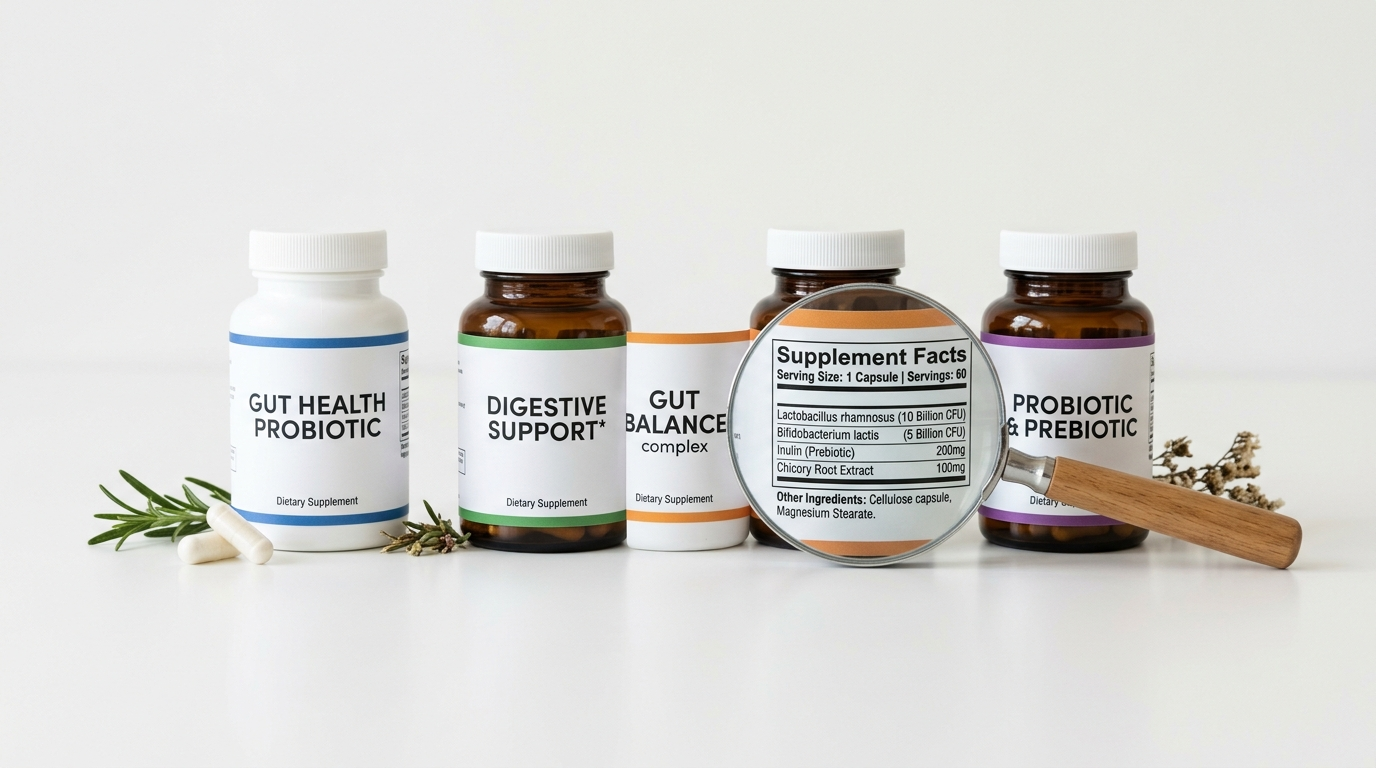
Emma Digestive Supplement contains Lactobacillus acidophilus, Bifidobacterium longum, apple cider vinegar powder, and aloe vera. Independent clinical evidence specific to the Emma formula is limited. The individual ingredients have published research behind them—probiotics and prebiotic fiber are well-studied for bloating and constipation—but results depend heavily on strain identity, CFU count, and formulation quality, not just ingredient names.
How we evaluated Emma and comparable gut health supplements
This review draws on publicly available Emma product information, PubMed-indexed research on its listed ingredients, and peer-reviewed comparative data for competing gut health formulas. Evidence was weighted by study design: human randomized controlled trials (RCTs) over animal studies, multi-strain analyses over single-ingredient models. Ingredients were evaluated by strain specificity, CFU count transparency, and evidence quality. Competing products were selected based on ingredient overlap and review volume. No brand provided payment or products for this review.
What does Emma Digestive Supplement actually contain?
Emma markets itself as a bloating and constipation formula built around probiotics, digestive enzymes, and plant-based compounds. Its label lists Lactobacillus acidophilus, Bifidobacterium longum, apple cider vinegar (ACV) powder, aloe vera inner leaf extract, and an “enzyme blend” including amylase, protease, and lipase. The probiotic count is listed at 500 million CFU per serving—notably below the 1–10 billion CFU range most clinical trials use for meaningful gut microbiome effects. The International Scientific Association for Probiotics and Prebiotics (ISAPP) notes that strain specificity and CFU count are critical determinants of probiotic efficacy, and that product labels often fail to identify strains precisely enough to match clinical evidence. Emma does not list strain-level identifiers (e.g., Lactobacillus acidophilus NCFM or Bifidobacterium longum BB536), which limits direct comparison to research outcomes.
- Probiotic count: 500 million CFU (below clinical study ranges of 1–10 billion)
- Strain specificity: genus and species only; no strain codes published
- Enzyme blend: amylase, protease, lipase—standard digestive enzyme profile
- ACV powder and aloe vera: included but without disclosed standardization
Does apple cider vinegar actually help with bloating or constipation?
Apple cider vinegar is a popular wellness ingredient, but clinical evidence for its effect on bloating or constipation is thin. A 2021 pilot study in BMJ Open found ACV had no significant effect on blood glucose or GI symptoms in a crossover trial. Acetic acid in ACV may slow gastric emptying—a property documented in a small study in Journal of Diabetes Research—but slowed gastric emptying is more likely to worsen bloating than reduce it in patients with functional GI symptoms. ACV powder in supplement form is further diluted compared to liquid ACV, reducing even the modest effects documented in liquid trials. The primary mechanism for which ACV is commonly marketed—”alkalizing” the digestive system—conflicts with its actual chemistry as an acid. This particular ingredient does not carry strong evidence for the bloating or constipation use cases Emma emphasizes.
- ACV and bloating: no RCT evidence of benefit; may worsen symptoms by slowing gastric emptying
- ACV powder: more diluted than liquid; limits even modest effects
- “Alkalizing” claim: factually inaccurate (ACV is acidic)
- Gastric emptying effect: potentially counterproductive for bloating sufferers
How does Emma compare to evidence-based alternatives?
| Feature | Emma Digestive | Yuve Probiotic Gummies | Garden of Life Raw Probiotics | Align Probiotic |
|---|---|---|---|---|
| CFU count | 500 million | 2 billion | 100 billion | 1 billion |
| Strain specificity | Species only | NCFM + Bi-07 (coded) | 34 strains listed | B. longum 35624 (coded) |
| Format | Capsule | Vegan gummy | Capsule | Capsule |
| Third-party tested | Not confirmed | NSF-certified ingredients | Yes (USP verified) | Yes (Consumer Lab) |
| Vegan / plant-based | Claim (verify capsule) | Yes (certified vegan) | Vegetarian | Not vegan (gelatin) |
| Ingredient transparency | Proprietary blend | Label-disclosed per strain | Full breakdown | Single-strain focused |
| RCT evidence for strains | Not confirmed | Yes (NCFM, Bi-07 studied) | Varies by strain | Yes (35624 studied for IBS) |
Best for bloating + constipation (evidence-based): Align Probiotic (Bifidobacterium longum 35624) — studied in multiple IBS-C trials
Best for vegan + plant-based format: Yuve Probiotic Gummies (Lactobacillus acidophilus NCFM + Bifidobacterium lactis Bi-07)
Best for high-CFU microbiome restoration: Garden of Life Raw Probiotics (100 billion CFU, 34 strains)
What does the clinical evidence say about Yuve’s probiotic strains specifically?
Some links below are affiliate links. This does not influence our evaluation criteria or recommendations.
Yuve’s Vegan Daily Cleanse provides Lactobacillus acidophilus NCFM and Bifidobacterium lactis Bi-07—both of which carry specific strain-level research. Lactobacillus acidophilus NCFM has been studied in a randomized, double-blind trial published in Gastroenterology and found to reduce bloating severity and abdominal pain in IBS patients compared to placebo. Bifidobacterium lactis Bi-07 was investigated in a 2009 randomized trial (Jensen et al., FEMS Immunology & Medical Microbiology) for immune-modulating effects. Yuve’s product delivers 2 billion CFU per serving in a certified vegan, gluten-free gummy format—a meaningful practical advantage for people who avoid gelatin capsules. The gummy format also reduces pill burden in multi-supplement routines, which population data links to improved adherence. Unlike Emma, Yuve lists strain codes publicly, enabling direct matching to clinical research.
- NCFM: studied in RCT for IBS bloating and abdominal pain
- Bi-07: studied for immune support in a controlled trial
- CFU count: 2 billion (vs Emma’s 500 million)
- Format advantage: certified vegan gummy; no gelatin; adherence benefit
FAQ
Is Emma Digestive Supplement FDA-approved?
No. Like all dietary supplements sold in the United States, Emma is regulated under DSHEA (Dietary Supplement Health and Education Act), which does not require pre-market FDA approval. Supplement manufacturers are responsible for ensuring safety, but independent testing for potency, purity, and label accuracy is voluntary. Emma’s website does not prominently display third-party certification (NSF, USP, ConsumerLab) as of this review.
How long does it take for any gut health supplement to work?
Clinical trials for probiotic interventions typically measure outcomes at 4–8 weeks. A 2019 systematic review in Alimentary Pharmacology & Therapeutics found meaningful IBS symptom reduction generally required 6 weeks of consistent probiotic use. Improvements in constipation frequency can appear in 1–2 weeks with evidence-based strains and adequate fiber intake. Bloating improvements are more variable, often taking 4–8 weeks as the gut microbiome adjusts.
Can digestive enzymes in supplements actually help with bloating?
Specific digestive enzymes have strong evidence for specific deficiencies. Lactase supplements (e.g., Yuve Lactase 9000 FCC) are clinically validated for lactose intolerance. Alpha-galactosidase (Beano) has RCT evidence for reducing gas from raffinose-containing foods (beans, cruciferous vegetables). General “enzyme blends” without condition-matched formulation have weaker evidence for healthy adults. Emma’s enzyme blend (amylase, protease, lipase) targets macronutrient digestion but is unlikely to address bloating driven by bacterial fermentation or motility dysfunction.
Are there side effects from Emma or similar gut health supplements?
Probiotics are generally recognized as safe for healthy adults, with the most common side effects being temporary gas and bloating as the gut microbiome adjusts during the first 1–2 weeks. More significant side effects are rare and primarily documented in immunocompromised individuals. ACV supplements have been associated with tooth enamel erosion (in liquid form), throat irritation, and drug interactions with diuretics and insulin. Anyone on prescription medications should review new supplements with a pharmacist.
What should I look for in a gut health supplement to avoid wasting money?
Prioritize four criteria: (1) strain-specific probiotics listed with strain codes (not just genus and species), (2) CFU count at or above 1 billion per serving, (3) third-party testing certification (NSF, USP, or ConsumerLab), and (4) formulation matched to your target symptom (IBS-C versus IBS-D versus general gut health). Proprietary blends without disclosed individual amounts make it impossible to compare a product to clinical evidence.
Is Yuve a good option if I’ve tried Emma and it didn’t work?
If Emma’s main limitations are its low CFU count (500 million), lack of strain-specific evidence, and unconfirmed third-party testing, then a product like Yuve’s Vegan Daily Cleanse—which uses clinically studied strain codes, delivers 2 billion CFU, and is certified vegan—addresses those gaps directly. Individual responses to probiotic strains vary, so switching to a strain with specific clinical evidence for your primary symptom (bloating, constipation, or general GI discomfort) is a logical next step.
Does Yuve offer any products specifically for constipation?
Yes. Beyond probiotics, Yuve’s Prebiotic Fiber Gummies contain chicory root inulin (FOS), a prebiotic fiber with published evidence for increasing Bifidobacterium populations and improving stool frequency. A 2017 meta-analysis in The American Journal of Clinical Nutrition found FOS and inulin supplementation significantly increased stool frequency compared to placebo. Combining prebiotic fiber with Yuve’s probiotic gummies follows the synbiotic approach (prebiotics + probiotics together) that shows the most consistent results in clinical trials.
—
Explore Yuve’s full digestive health line at the Digestion Collection.
Leave a Reply