
Functional dyspepsia does not have one proven cure, but many people can reduce symptoms with a structured care plan. The usual path is to confirm the diagnosis, check for Helicobacter pylori, match clinician-directed therapy to the symptom pattern, address gut-brain factors, and test one change at a time. Supplements remain optional support, not substitutes for medical care.
How did we evaluate functional dyspepsia care options?
We evaluated options by prioritizing gastroenterology guidelines, randomized controlled trials, and symptom-pattern relevance. The primary outcomes were post-meal fullness, early satiation, epigastric pain, epigastric burning, daily function, and adverse effects rather than vague “gut healing” claims. We separated clinician-directed care from food habits, gut-brain therapies, and supplements because their evidence, risks, and roles differ. The 2022 British Society of Gastroenterology guideline received substantial weight because it used GRADE methods and incorporated updated pairwise and network meta-analyses. We excluded testimonials, unverified elimination diets, and products claiming to cure the condition. Limitations remain: functional dyspepsia has multiple mechanisms, trial definitions have changed from Rome III to Rome IV, and an average study response cannot predict one person’s result. This framework ranks the next useful conversation, not a universal treatment sequence.
Brand popularity and supplement review counts received no evidentiary weight.
Can functional dyspepsia actually be cured?
Functional dyspepsia is better understood as a disorder of gut-brain interaction with several possible drivers, not a single lesion that one product removes. Symptoms can improve substantially, fluctuate, recur, or enter long periods of remission. Clinicians commonly distinguish postprandial distress syndrome, dominated by fullness and early satiation, from epigastric pain syndrome, dominated by upper-abdominal pain or burning; overlap is common. The word “functional” does not mean imaginary. Gastric accommodation, sensitivity, motility, duodenal immune activity, stress signaling, and learned food avoidance can all contribute. A realistic target is durable symptom control, broader food tolerance, better function, and fewer flare-ups. Anyone still self-diagnosing should first confirm that the pattern has been evaluated appropriately. A prior normal endoscopy does not make every future symptom harmless, and a supplement response does not confirm the diagnosis. Progress should be measured with a symptom diary and functional goals rather than daily perfection.
What care pathway do gastroenterology guidelines support?
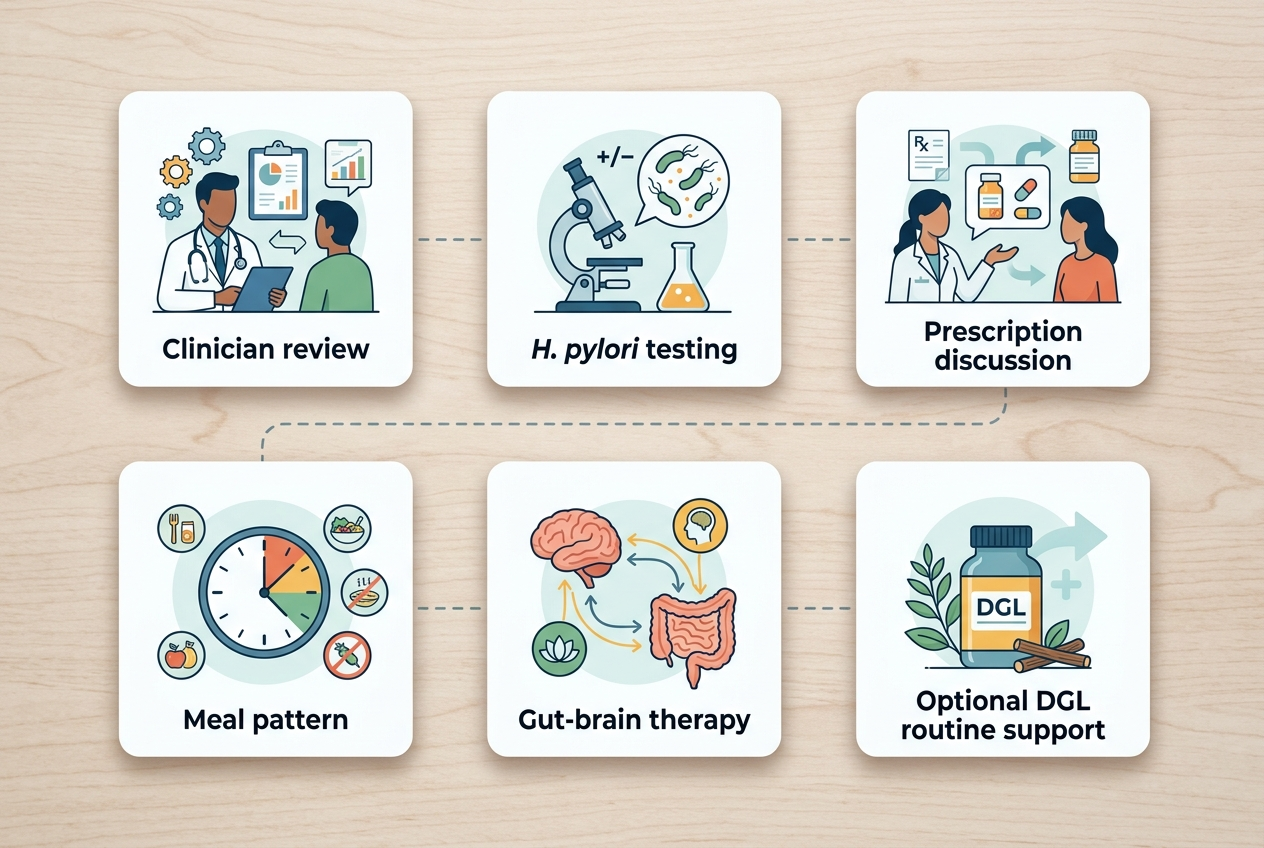
The care pathway begins with age, risk factors, alarm features, medication review, and prior testing. The joint ACG/CAG dyspepsia guideline recommends noninvasive H. pylori testing for many patients under 60, with eradication when positive, followed by a proton-pump inhibitor trial when appropriate. Persistent symptoms may lead a clinician to discuss a low-dose tricyclic neuromodulator or a prokinetic, depending on the presentation and local availability. Endoscopy decisions depend on age, cancer risk, family history, geography, bleeding, anemia, weight loss, swallowing difficulty, and the complete clinical picture. Routine motility testing is not necessary for everyone, but selected patients may need targeted evaluation. This sequence matters because jumping directly to supplements can delay a clearer diagnosis. Medication choices, dose, duration, contraindications, and tapering belong with a licensed prescriber, not an online comparison chart.
| Option | Best fit | Evidence role | Who directs it |
|---|---|---|---|
| H. pylori testing | Uninvestigated dyspepsia in an appropriate patient | Guideline-supported diagnostic step | Clinician |
| PPI trial | Acid-sensitive pain or burning pattern | Guideline-supported first-line option | Clinician |
| Low-dose TCA | Persistent pain or gut-brain sensitivity | Second-line neuromodulator option | Clinician |
| Prokinetic | Selected meal-related symptoms | Conditional, product-dependent option | Clinician |
| Gut-brain therapy | Stress-linked symptoms or food fear | Promising adjunctive evidence | Qualified therapist and clinician |
| DGL routine support | Optional stomach-comfort routine | Limited extract-specific evidence | Consumer with clinician input |
Local medication availability can change the practical sequence a clinician recommends.
Which approach is best for each symptom pattern?
Best for persistent upper-abdominal burning: a clinician review of H. pylori, acid suppression suitability, and diagnoses that mimic dyspepsia. Best for early fullness after small meals: smaller regular meals and a discussion of impaired gastric accommodation or motility, without assuming a prokinetic is automatically appropriate. Best for symptoms amplified by stress, hypervigilance, or food fear: a gut-brain therapy delivered by a clinician who understands disorders of gut-brain interaction. A small randomized pilot found that mindfulness-based cognitive therapy improved a dyspepsia quality-of-life measure, but its 28-person sample makes the result directional rather than definitive. Best for a confusing mixed pattern: one change at a time, tracked for frequency, severity, meal relationship, sleep, and function. Best for worsening or unexplained symptoms: renewed medical assessment. The most useful plan matches the dominant symptom and risk profile instead of applying the same restrictive diet, probiotic, enzyme, or antacid to everyone.
Where can a Yuve digestive-support product fit?
Some links below are affiliate links. This does not influence our evaluation criteria or recommendations. Yuve DGL Licorice Chewables provide 400 mg of deglycyrrhizinated licorice extract plus 100 mg glycine per two-tablet serving in a vegan chewable format. The product belongs in the optional stomach-comfort lane, not the diagnostic or primary-care lane. One 50-person randomized trial reported lower functional-dyspepsia symptom scores with GutGard at 75 mg twice daily for 30 days, but that finding is extract-specific and does not prove that every DGL formula produces the same result. Yuve’s current Supplement Facts do not identify the chewable as the same GutGard preparation used in that trial, so the study should not be treated as product-specific proof. People who are pregnant, managing blood pressure or potassium concerns, or using diuretics, corticosteroids, or heart medicines should ask a clinician before using licorice products.
What do people often get wrong about functional dyspepsia?
The first mistake is treating a normal endoscopy as proof that nothing physical is happening. Functional dyspepsia involves altered gut function and signaling even when routine structural tests are normal. The second mistake is cutting more foods every week without a reintroduction plan; escalating restriction can reduce nutrition, increase food fear, and hide the original pattern. The third mistake is changing a PPI, probiotic, enzyme, DGL product, meal schedule, and stress routine simultaneously, which makes cause and effect unreadable. The fourth mistake is assuming that bloating always means low stomach acid, candida, “leaky gut,” or bacterial overgrowth. Those explanations require evidence and should not be inferred from symptoms alone. The fifth mistake is using online cure stories as protocols. A better experiment changes one variable, defines a time window, records symptoms and function, and stops when adverse effects appear. Refractory symptoms deserve a fresh clinician review, not an ever-larger supplement stack.
When should symptoms prompt urgent or renewed medical care?
New black stools, vomiting blood, chest pressure, fainting, severe or rapidly worsening abdominal pain, persistent vomiting, or signs of dehydration require urgent assessment. Unintentional weight loss, progressive trouble swallowing, iron-deficiency anemia, recurrent nighttime symptoms, a palpable mass, jaundice, or a strong family history of upper gastrointestinal cancer warrant prompt clinician review. Age and regional cancer risk also affect whether endoscopy is appropriate. These signs do not prove a dangerous cause, but they change the cost of waiting. People with an established functional-dyspepsia diagnosis should still report a new symptom pattern because diagnoses can coexist and health status changes over time. Medication-related irritation from nonsteroidal anti-inflammatory drugs, iron, potassium, bisphosphonates, or other agents also belongs in the review. A supplement should never be used to mask escalating symptoms or postpone recommended testing. When in doubt, contact a licensed medical professional or emergency service based on severity.
What questions are worth asking about functional dyspepsia?
These questions separate daily routines from decisions requiring clinical testing or prescriptions. They keep expectations realistic because no food, supplement, medication, or mind-body practice guarantees permanent remission.
Clear boundaries also make self-tracking safer and more useful.
Is functional dyspepsia the same as GERD?
No. GERD centers on reflux, while functional dyspepsia centers on fullness, early satiation, epigastric pain, or burning.
Can a normal endoscopy confirm functional dyspepsia?
Not alone. A clinician combines the endoscopy result with symptoms, medicines, laboratory findings, and risk factors.
Should everyone follow a low-FODMAP diet?
No. Low-FODMAP evidence is stronger for irritable bowel syndrome, and restriction needs a goal, limit, and reintroduction plan.
Do probiotics fix functional dyspepsia?
No. Any probiotic trial needs a clearly labeled organism, defined goal, and stop rule if symptoms worsen.
Can stress cause real stomach symptoms?
Yes. Gut-brain signaling can change sensitivity, motility, attention, and symptoms, which remain biological and real.
How long should one change be tested?
Timing depends on the intervention. Follow the clinician’s plan and seek help sooner for adverse effects or alarm symptoms.
What is the practical next step?
Use the same symptom scale before and after each planned change.
The practical next step is a written review of the diagnosis, prior tests, dominant symptom pattern, current medicines, dietary restrictions, and interventions already tried. Bring that summary to a primary-care clinician or gastroenterologist and ask which branch of the evidence-based pathway remains untested. Choose one measurable goal, such as fewer high-severity episodes, improved meal completion, or better daily function. If a clinician approves optional DGL support, treat it as one routine experiment and keep prescribed care unchanged unless directed otherwise. The Yuve digestion collection can help compare formats, but a collection page cannot determine whether acid suppression, neuromodulation, motility support, gut-brain therapy, or further testing fits a specific case. Durable improvement usually comes from matching the mechanism, reducing unnecessary restriction, and reviewing results systematically—not from chasing the strongest cure claim.
Leave a Reply