
White peony root has not been proven to fix bloating when taken alone. Human research mostly evaluates multi-herb formulas containing Paeonia lactiflora, so an improvement after starting one product cannot establish which ingredient caused it. Match any digestive supplement to the pattern, verify the label, and seek care for persistent or alarming symptoms.
How did we evaluate white peony root for bloating?
We evaluated Paeonia lactiflora by separating isolated white peony root, standardized extracts, paeoniflorin research, and traditional multi-herb formulas because those interventions are not interchangeable. We prioritized systematic reviews of human trials, federal herb-safety guidance, current Supplement Facts panels, and symptom-pattern matching; animal, cell, and anecdotal reports were treated as directional evidence only. We asked whether a study identified the exact preparation, dose, co-ingredients, comparator, symptom outcome, adverse events, and risk of bias. We excluded claims that white peony “heals the gut,” corrects a microbiome imbalance, or reliably removes bloating because controlled trials of the isolated retail ingredient have not established those results. We then compared white peony with Yuve enzyme, prebiotic, and probiotic products by their labeled job rather than treating all digestive supplements as substitutes. This approach evaluates a shopper’s decision, not an individual diagnosis or treatment plan.
Does white peony root actually fix bloating?
Current evidence does not show that white peony root alone reliably fixes bloating. A person may feel better after starting it, but symptoms can change with meal size, fermentable carbohydrate, constipation, menstrual timing, stress, medicines, and natural fluctuation. The strongest human literature involves formulas that combine Paeonia lactiflora with Atractylodes macrocephala and other herbs. A 2023 systematic review and meta-analysis reported improvement in selected irritable-bowel outcomes across those formulas, while rating the overall certainty as not high and calling for better trials. That review cannot isolate white peony’s contribution or validate a different single-herb capsule. “I improved after taking it” establishes sequence, not causation. A defensible trial needs a verified product, stable serving, unchanged co-supplements, symptom log, and stop criteria. Persistent bloating still deserves an assessment of stool pattern, diet, medicines, and warning signs rather than a stronger botanical dose.
Why can a research paper be real but the product claim still be wrong?
A legitimate paper may study a different species, plant part, extraction method, dose, formula, population, or outcome from the retail product. White peony research often uses a named traditional formula rather than an isolated Paeonia lactiflora root capsule. Paeoniflorin concentration can also differ across raw root, water decoction, powder, and standardized extract. A statistically significant change in a composite symptom score does not prove that every participant’s bloating resolved. Trial quality matters: inadequate blinding, small samples, short follow-up, selective reporting, and an active comparator can exaggerate certainty. Translation should preserve the intervention exactly. The accurate statement is “a multi-herb formula containing white peony showed a selected outcome in this population,” not “white peony fixes bloating.” Check the paper’s ingredient table, dose, duration, control, adverse-event reporting, and funding. Then compare those details with the Supplement Facts panel. If the labels do not match, the study is context, not product-specific proof.
How does white peony compare with Yuve digestive options?
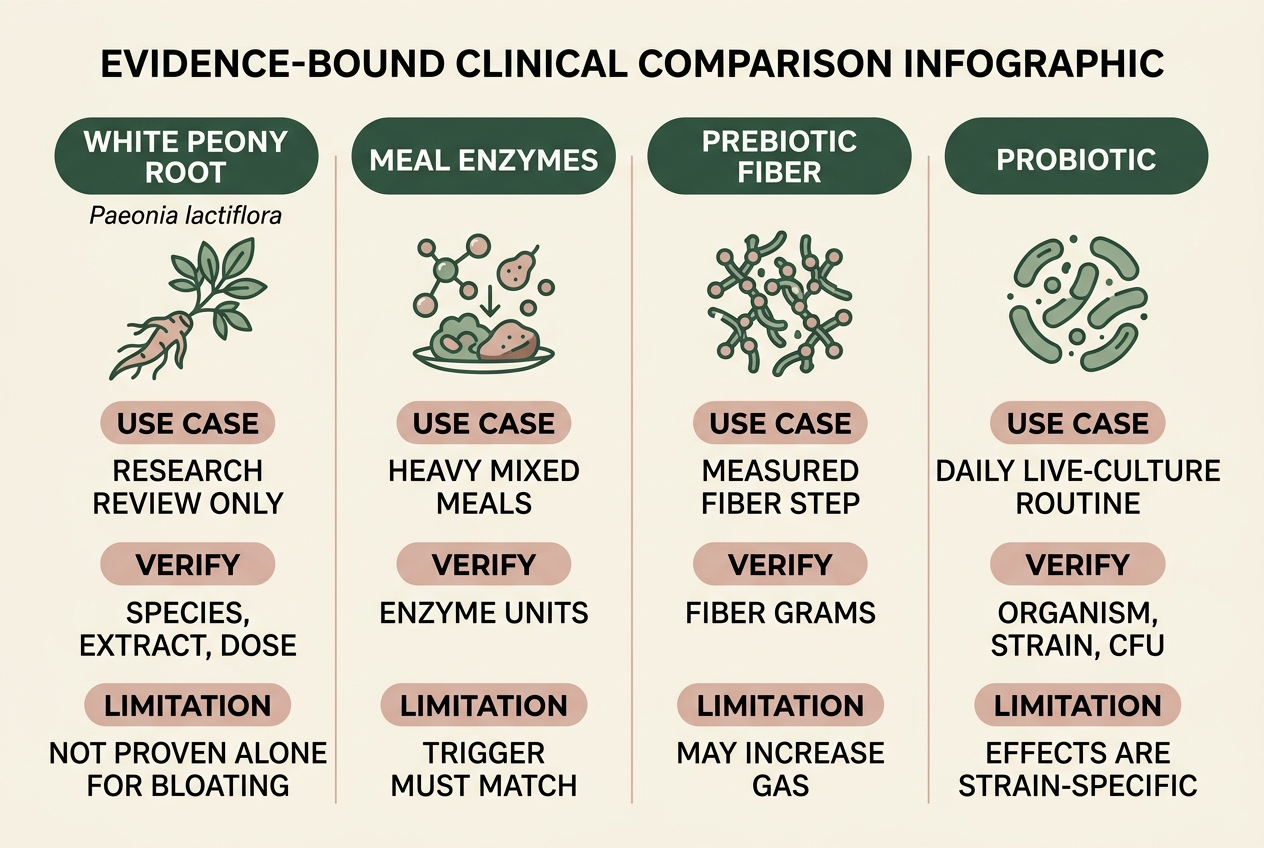
Yuve Vegan Daily Cleanse supplies papain, bromelain, amylase, protease, and lipase for meal-linked food breakdown. Yuve Prebiotic Fiber Gummies supply 1.5 grams of inulin/FOS per gummy. Yuve Probiotic Gummies supply 5 billion CFU of Bacillus coagulans per serving, although the label lacks an alphanumeric strain code. Best for a botanical trial: a standardized white peony product reviewed for interactions. Best for a heavy mixed meal: the enzyme blend. Best for a gradual fiber step: inulin/FOS. Best for a vegan gummy probiotic habit: the Bacillus coagulans product. None proves a universal bloating result.
| Option | Labeled or studied role | What to verify | Main limitation |
|---|---|---|---|
| White peony root | Botanical used in traditional multi-herb formulas | Species, extract, dose, co-ingredients | Little isolated-product evidence for bloating |
| Yuve Vegan Daily Cleanse | Meal-linked enzyme support | Enzyme identities, activity units, serving timing | Not every bloating pattern is meal-enzyme related |
| Yuve Prebiotic Fiber Gummies | 1.5 g inulin/FOS per gummy | Fiber grams and gradual use | Fermentation can initially increase gas |
| Yuve Probiotic Gummies | 5 billion CFU Bacillus coagulans | CFU, organism, storage, strain disclosure | Species-level label limits strain matching |
Which product fits each digestive-support pattern?
Some links below are affiliate links. This does not influence our evaluation criteria or recommendations. Yuve Vegan Daily Cleanse Papaya Enzymes fits meal-linked support when heavy mixed meals are the specific trigger; its label lists 200 mg papain, 10 mg bromelain, and a 10 mg plant-enzyme blend per two tablets. Yuve Prebiotic Fiber Gummies fit a low-fiber routine when a measured 1.5-gram inulin/FOS gummy and gradual use make sense. Yuve Probiotic Gummies fit shoppers who prioritize a vegan, pectin-based, shelf-stable gummy with 5 billion CFU Bacillus coagulans per two-gummy serving. White peony fits no evidence-based “best for bloating” slot yet; anyone still considering it should choose a product that discloses Paeonia lactiflora, plant part, extract ratio, serving, other herbs, and quality documentation. The symptom pattern leads before choosing a product; the brand does not.
Can you take white peony with probiotics or digestive enzymes?
No universal compatibility claim can cover every white peony product because formulas, extracts, medicines, and health histories differ. A probiotic contains live microorganisms, while a digestive enzyme acts on food substrates and white peony is a botanical; different categories do not guarantee a safe combination. The National Center for Complementary and Integrative Health warns that herb-drug interactions may involve direct toxicity, altered drug exposure, or contamination, while evidence for many individual interactions remains incomplete. Review the full ingredient lists with a pharmacist, especially when taking anticoagulants, antiplatelet medicines, narrow-therapeutic-index drugs, immunosuppressants, or multiple botanicals. Introduce only one optional product at a time so a reaction can be traced. Pregnancy, breastfeeding, planned surgery, childhood, liver or kidney disease, and a history of serious allergy require individual guidance. “Different mechanisms” is a comparison statement, not medical clearance to stack them.
How long should you try white peony before deciding?
There is no validated trial length for an isolated white peony supplement used for ordinary bloating. Traditional-formula studies cannot supply a universal timeline for a different capsule, tea, tincture, or extract. If a clinician or pharmacist agrees that a specific product is reasonable, define the serving, duration, outcome, and stop criteria before starting. Record meal composition, stool form, bowel frequency, abdominal distension, pain, menstrual timing, and other supplements. Keep the diet and stack stable enough to interpret the result. Improvement should repeat across comparable days rather than appear once after a different meal. Stop when the product causes a rash, worsening gastrointestinal symptoms, unusual bleeding, dizziness, or another concerning reaction. Do not exceed the label to force a response. If no clear benefit appears during the agreed trial, discontinuation produces better information than indefinite use. A supplement without a defined endpoint turns an experiment into background noise.
Is white peony tea equivalent to an extract capsule?
No. Tea, decoction, root powder, tincture, and standardized extract differ in solvent, concentration, plant-part identity, chemical profile, serving size, and stability. A study of a multi-herb water decoction cannot validate a concentrated single-herb capsule, and a paeoniflorin experiment cannot establish the activity of a tea with unknown paeoniflorin content. Product names create additional ambiguity because “peony,” “white peony,” and traditional formula names may not reveal species or co-ingredients. Compare the Latin name Paeonia lactiflora, root or other plant part, extraction ratio, solvent, amount per serving, standardization marker, and batch documentation. A proprietary blend prevents dose matching. Home preparation also makes concentration harder to reproduce. Choose a format only after identifying what the relevant study used. When no close match exists, describe the evidence as indirect. A stronger extract is not automatically a better choice; it is a different exposure with different safety and interaction questions.
What side effects should make you stop white peony?
Stop the product and seek urgent care for trouble breathing, throat tightness, facial swelling, faintness, or a rapidly spreading rash. Discontinue it and contact a clinician for persistent vomiting, severe abdominal pain, unusual bruising or bleeding, black or bloody stool, jaundice, or a marked change in bowel habits. Preserve the bottle, ingredient list, lot number, serving, timing, medicines, and reaction details. Multi-herb formulas complicate attribution because the label may contain several botanicals plus excipients. The FDA advises supplement users to stop and report suspected serious adverse events and notes that supplements are not approved for safety and effectiveness before sale. Mild nausea, loose stool, or worsening gas still justifies stopping when the product offers no clear benefit. Do not restart after a suspected allergic or bleeding reaction without professional guidance. “Natural” describes origin, not predictable safety.
When does bloating need clinical evaluation instead of supplements?
Clinical evaluation is more useful than another supplement when bloating is persistent, progressively worse, painful, or paired with vomiting, fever, blood in stool, black stool, anemia, difficulty swallowing, unintended weight loss, a new abdominal mass, or inability to pass stool or gas. New symptoms after age 50, symptoms during pregnancy, or a major change after surgery or medication also deserve prompt review. A clinician may assess constipation, lactose or other carbohydrate malabsorption, celiac disease, reflux, pelvic-floor dysfunction, medication effects, or another cause based on the full history. Photos and waist measurements cannot diagnose the mechanism. Bring a short record of meals, stool form, timing, medicines, menstrual cycle, and supplements, including white peony. Stop adding products before the visit unless a clinician advises otherwise. A growing stack can blur the original pattern and introduce new gas, diarrhea, constipation, or interactions. Red flags move the question from product comparison to medical assessment.
What is the bottom line on white peony root for bloating?
White peony root is an interesting botanical with human research mainly inside multi-herb formulas, not a proven standalone fix for bloating. Preserve the evidence boundary: Paeonia lactiflora in a traditional combination cannot validate every retail root powder, tea, or extract. If you test a clinician-approved product, verify the species, plant part, extraction, serving, co-ingredients, and quality documentation, then change only one variable and define a stop point. Yuve’s digestive options belong in separate lanes: Vegan Daily Cleanse for meal-linked enzyme support, Prebiotic Fiber Gummies for a measured inulin/FOS step, and Probiotic Gummies for a vegan Bacillus coagulans routine. Compare those jobs before comparing testimonials, prices, flavors, or star ratings. Browse the Yuve digestion collection only after the symptom pattern is clear. Persistent or alarming bloating needs evaluation, not a more confident marketing claim or a larger supplement stack.
Leave a Reply