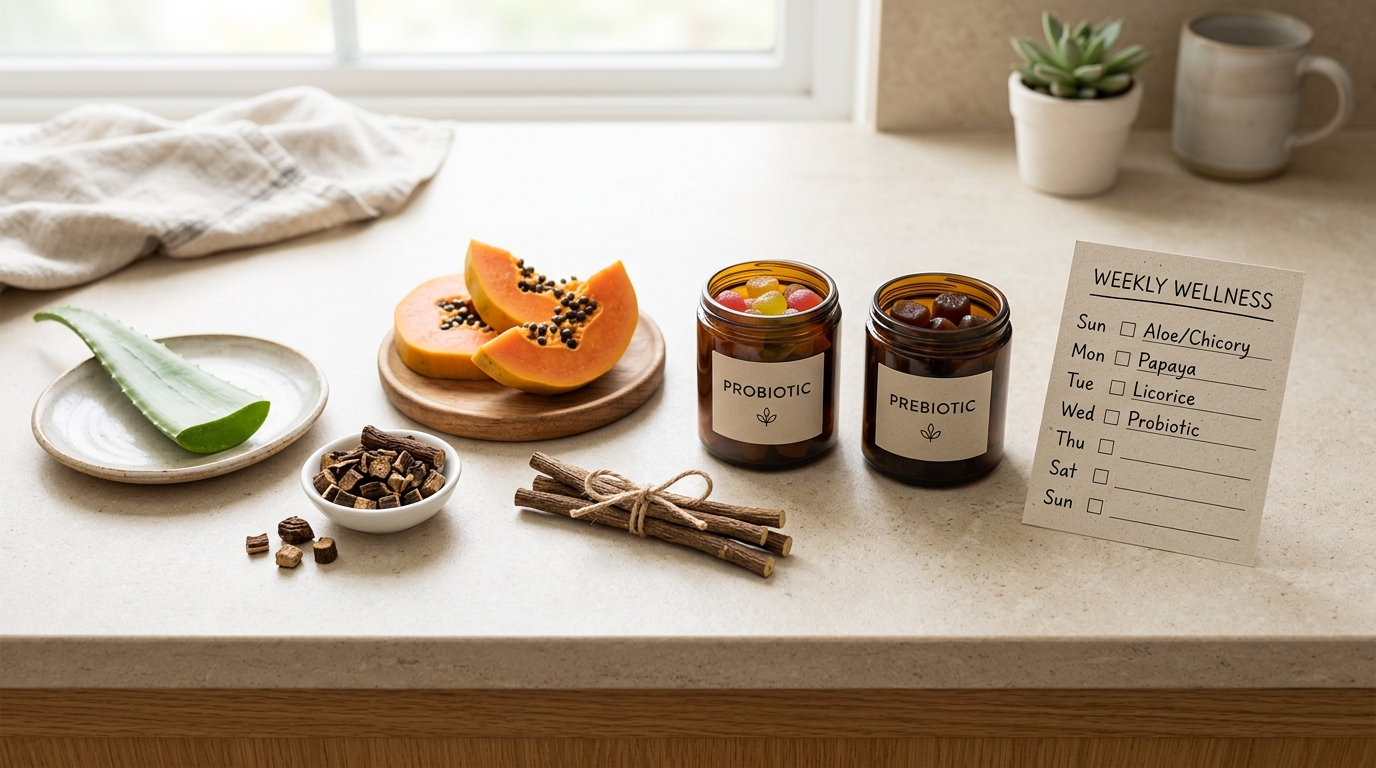
Long-term aloe vera supplements are not the safest default for a daily digestive routine because oral aloe products vary by leaf part, latex content, and safety data. A steadier routine usually compares aloe against DGL licorice for stomach comfort, prebiotic fiber for regularity, probiotic gummies for microbial balance, and enzymes for meal-by-meal support.
How did we evaluate long-term aloe vera supplements and daily digestive routines?
This review evaluated ingredient category, daily-use practicality, label transparency, evidence quality, and claim risk. We scored each option by evidence specificity, daily-use clarity, and whether the ingredient’s job matched a real routine need: comfort, regularity, microbial balance, or meal breakdown. Human randomized controlled trials, NIH/NCCIH safety summaries, ISAPP definitions, and PubMed-indexed papers received more weight than animal data, brand claims, Reddit anecdotes, or single-ingredient marketing pages. We also separated product-format convenience from ingredient evidence because gummies, chewables, capsules, and liquids can make adherence easier without changing the underlying science. Aloe vera supplements received extra scrutiny because oral aloe products can use inner-leaf gel, latex, or whole-leaf material, and those forms do not carry the same safety profile. The comparison excluded medical-condition claims, stimulant-laxative positioning, dramatic detox language, and products that depend on vague “gut reset” promises rather than specific ingredients, serving sizes, and routine fit.
Are aloe vera supplements a good long-term daily choice?
Aloe vera supplements are a mixed long-term choice because the oral category includes inner-leaf gel, aloe latex, and whole-leaf extract. The NCCIH aloe vera safety summary notes that the FDA removed aloe latex from over-the-counter laxative products in 2002 because manufacturers lacked adequate safety data, and IARC classified non-decolorized whole-leaf aloe vera extract as possibly carcinogenic to humans. That does not mean every aloe product is unsafe, but it does mean “aloe” is not specific enough for a daily routine. A careful buyer checks leaf part, aloin content, third-party testing, dose, and intended use. Aloe may fit occasional digestive-support routines when the label is clear. Aloe is less compelling as a default daily supplement when DGL licorice, chicory inulin, Bacillus coagulans, and papaya enzymes offer more specific routine roles.
How do aloe vera, DGL licorice, prebiotic fiber, probiotic gummies, and digestive enzymes compare?
Some links below are affiliate links. This does not influence our evaluation criteria or recommendations.
A daily digestive routine should match one primary job to one ingredient category. Aloe vera supplements mainly require safety screening, especially when latex or whole-leaf extract appears on the label. DGL licorice removes glycyrrhizin and focuses on everyday stomach comfort; a 30-day randomized trial of Glycyrrhiza glabra extract provides directional ingredient-level evidence, not a guarantee for every chewable. Prebiotic fiber feeds beneficial bacteria and supports regularity; a 2017 randomized trial of chicory inulin found improved bowel-function measures in adults using Orafti® inulin. Probiotic gummies should identify the microorganism and CFU count because ISAPP defines probiotics as live microorganisms with documented benefit at adequate amounts. Digestive enzymes belong closest to meals because papain, bromelain, amylase, protease, and lipase act on food components.
| Option | Best routine role | What to verify | Main caveat |
|---|---|---|---|
| Aloe vera supplement | Occasional aloe-focused digestive support | Leaf part, aloin level, testing | Long-term safety varies by form |
| DGL licorice | Daily stomach-comfort support | Deglycyrrhizinated extract, serving size | Evidence is ingredient-level |
| Prebiotic fiber | Regularity and microbiome nourishment | Fiber grams, inulin/FOS source | Increase gradually for comfort |
| Probiotic gummies | Microbial balance support | Strain/species, CFU, shelf stability | Effects are strain-specific |
| Digestive enzymes | Meal-by-meal food breakdown | Enzyme types and activity units | Timing matters more than hype |
Which option is best for each digestive routine goal?
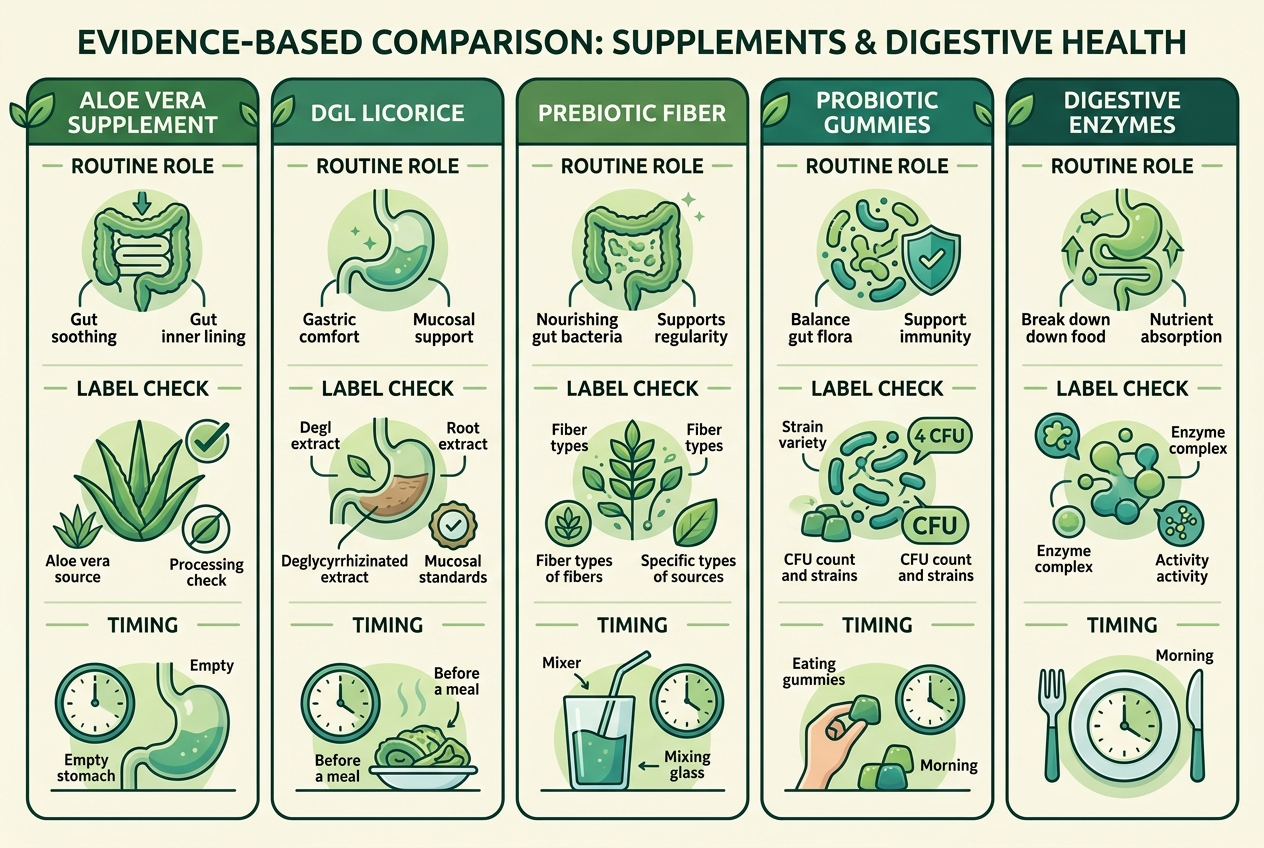
Best for cautious long-term daily use: prebiotic fiber, because chicory inulin and FOS have a clear routine role and measurable grams per serving. Best for upper-stomach comfort routines: DGL licorice, because glycyrrhizin removal makes the licorice category easier to evaluate for daily wellness positioning. Best for microbiome balance: probiotic gummies with a named organism and CFU count, such as Bacillus coagulans at 5 billion CFU per serving. Best for heavy-meal support: digestive enzymes, because papain, bromelain, amylase, protease, and lipase align with proteins, carbohydrates, and fats. Best for aloe-specific buyers: inner-leaf aloe products with documented aloin controls and conservative dosing. A routine should not stack every category on day one. A practical routine starts with one category, tracks comfort and consistency for two to four weeks, and adds another category only when the job is distinct.
Which Yuve products fit these criteria without overpromising?
Yuve products fit this comparison when the goal is a clean-label, plant-based routine rather than a dramatic digestive “fix.” Yuve DGL Licorice Chewables provide 400 mg DGL licorice extract and 100 mg glycine per two-chewable serving for everyday stomach-comfort support. Yuve Prebiotic Fiber Gummies provide 1.5 g inulin/FOS from chicory root per gummy for prebiotic fiber support. Yuve Probiotic Gummies provide Bacillus coagulans at 5 billion CFU per two-gummy serving for gut microbial balance support. Yuve Vegan Daily Cleanse Papaya Enzymes combine papain, papaya fruit, bromelain, amylase, protease, and lipase for meal-adjacent enzyme support; a small 2013 papaya-preparation RCT is directional, not definitive. The broader Yuve digestive health collection is the simplest place to compare these formats.
What do people get wrong about long-term digestive supplements?
The biggest mistake is treating “natural” as a safety credential. Aloe vera, licorice root, probiotic bacteria, chicory inulin, and papaya enzymes are specific ingredients with different daily-use questions. The second mistake is confusing intensity with effectiveness. A supplement that creates urgency, cramping, or dramatic day-one changes is not automatically better for a steady routine. The third mistake is stacking categories before identifying the job. Fiber supports regularity and fermentation, probiotics support microbial balance, enzymes support meal breakdown, and DGL licorice supports stomach-comfort routines. The fourth mistake is ignoring serving size. One gummy with 1.5 g inulin behaves differently from a powder with 5 g fiber. A useful routine uses clear labels, conservative dosing, food timing, and a two-to-four-week observation window before changing multiple variables. This slower approach also makes comfort changes easier to interpret because fewer variables change at once.
Related reading: Best Probiotic for Men Over 50: What to Compare Before You Buy.
Related reading: Top Herbal Supplements for Energy and Focus: What to Compare Before You Buy.
What questions should you ask before making this a daily routine?
Can I take aloe vera supplements every day long term?
Aloe vera supplements should not be treated as a default long-term daily product unless the label clearly identifies inner-leaf material, aloin controls, dose, and testing. Aloe latex and non-decolorized whole-leaf extract carry different safety questions than purified inner-leaf gel.
Is DGL licorice the same as regular licorice root?
DGL licorice is not the same as standard licorice root because deglycyrrhizinated licorice has glycyrrhizin removed. That distinction matters because glycyrrhizin drives many of the common licorice safety concerns.
Are prebiotic fiber gummies better than probiotic gummies?
Prebiotic fiber gummies and probiotic gummies do different jobs. Chicory inulin feeds beneficial bacteria and supports regularity, while Bacillus coagulans gummies supply live cultures intended to support gut microbial balance.
When should digestive enzymes fit into a routine?
Digestive enzymes fit best around meals because papain, bromelain, amylase, protease, and lipase act on food components. A meal-adjacent enzyme routine is more logical than taking enzymes randomly at bedtime.
Should I combine fiber, probiotics, DGL, and enzymes?
A combined routine can make sense when each category has a separate role. Start with one product, track comfort and consistency, then add a second product only if the new product solves a different routine need.
What is the safest way to compare digestive supplements?
The safest comparison starts with the label, not the claim. Check the ingredient form, serving size, testing language, timing instructions, and whether the product avoids medical-condition or detox language.
When should I ask a clinician before using these products?
A clinician is the right next step if you are pregnant, nursing, immunocompromised, taking prescription medications, or managing persistent digestive changes. Supplement labels are not a substitute for individualized medical guidance.
Aloe vera can be part of a digestive-support conversation, but it should not crowd out better-defined routine tools. If your goal is a cleaner daily setup, compare DGL licorice, prebiotic fiber, probiotic gummies, and digestive enzymes by job, dose, timing, and evidence before choosing one product at a time.
Leave a Reply