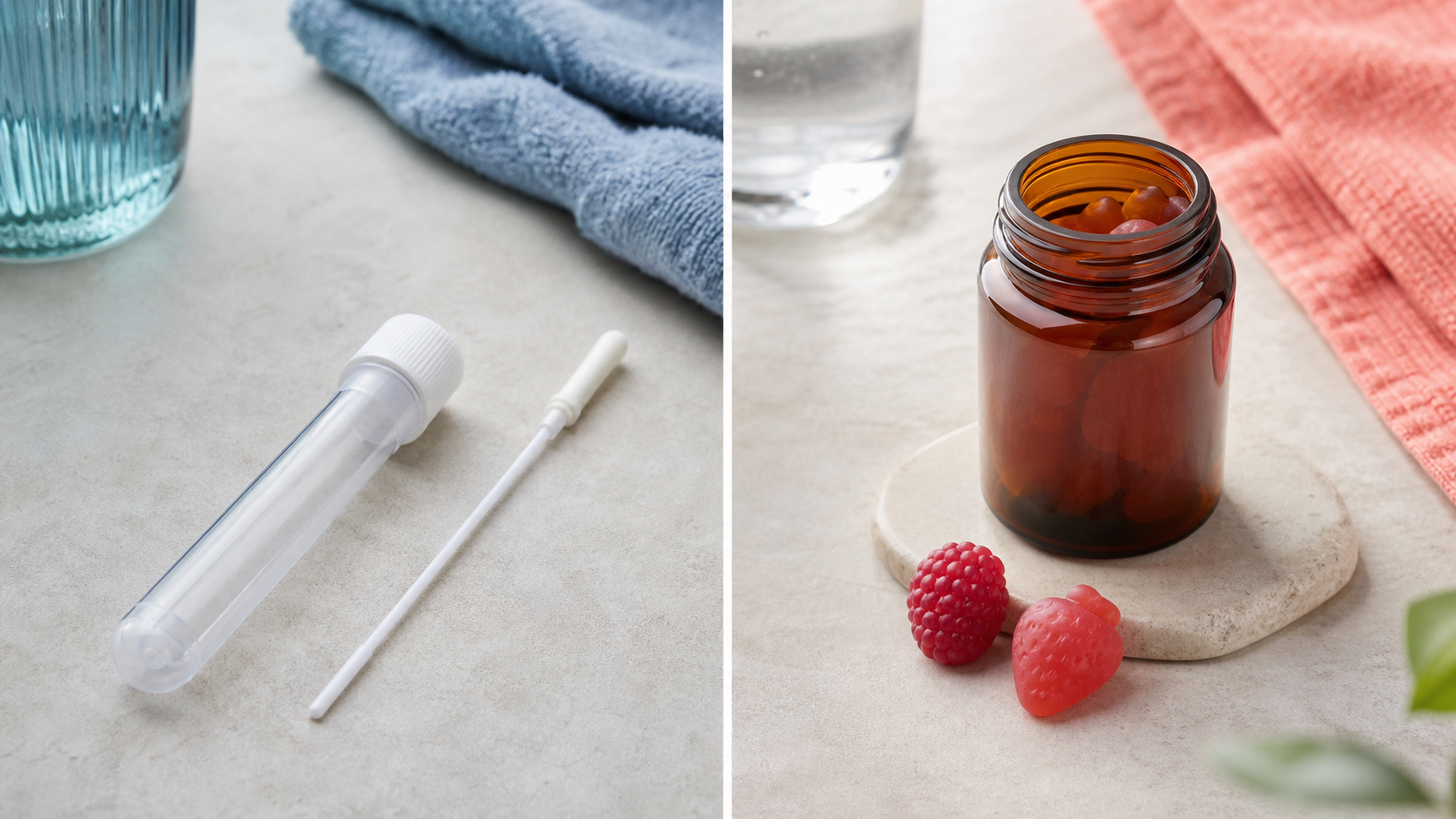
A $40 Tiny Health discount lowers the price, but it does not make the microbiome result clinically diagnostic or necessary before choosing a probiotic. Buy the test only if you value an educational snapshot and structured tracking. Yuve Probiotic Gummies should be evaluated by their organism, dose, label limits, ingredients, and routine fit—not by a consumer microbiome score.
How did we evaluate Tiny Health and Yuve?
We evaluated the current Tiny Health Adult Gut Health Test, Tiny+ Adult Membership, Yuve Probiotic Gummies, and the option of not buying either product. We prioritized current official product pages for price, contents, sample instructions, organism, dose, and disclaimers; FDA guidance and an international expert consensus controlled claims about direct-to-consumer microbiome testing. We excluded Reddit coupon codes, affiliate posts, testimonials, “root cause” language, and disease-association marketing from the evidence assessment. We compared each option by purpose, output, repeatability, clinical validity, privacy considerations, cost structure, and main limitation. Important constraints remain: promotions can expire without notice, microbiome methods and reference databases evolve, one stool sample captures a changing ecosystem, and supplement formulas can change. Tiny Health and Yuve are not substitutes because one sells information while the other sells a daily probiotic format. This analysis does not interpret a test result, select a treatment, or replace evaluation of persistent symptoms by a licensed clinician.
What does the Tiny Health Adult Gut Health Test include?
Tiny Health currently lists a one-time Adult Gut Health Test at $249. The company says the kit includes one at-home stool-swab test, a microbiome report with condition associations, a personalized action plan, and a group results-review session. Its annual Tiny+ Adult Membership is listed at $399 before temporary discounts and includes two gut tests, two reports, and one individual coaching session. Tiny Health states that samples are processed through a CLIA-certified and CAP-accredited laboratory partner and that its tests are for wellness education rather than diagnosis or treatment. Current sampling instructions advise waiting four to six weeks after antibiotics and describe a brief probiotic pause for some users, illustrating how recent exposures affect the snapshot. Those details establish what the service provides; they do not establish that a report will identify the cause of symptoms, predict a response to a supplement, or improve an individual outcome.
What can a consumer microbiome test show?
A stool microbiome test can identify microbial DNA in the submitted sample, estimate relative abundance, calculate diversity metrics, and compare features with a reference database. It can create a repeatable personal record when the same method, collection procedure, and timing are used. It cannot capture every organism attached to the intestinal lining, establish permanent colonization, or prove that one relative-abundance result caused a symptom. The ecosystem also changes with diet, travel, illness, medication, bowel transit, and sampling technique. A 2025 international consensus statement concluded that evidence supporting routine clinical usefulness remains scarce and warned that direct-to-consumer microbiome testing can waste resources or complicate management when interpreted beyond validated uses. Analytical validity, clinical validity, and clinical utility are different standards. A laboratory may accurately measure DNA while the report’s wellness category lacks an accepted diagnostic threshold or an intervention proven to improve outcomes. Treat the report as descriptive information, not a verdict.
Should a $40 discount determine whether the test is worth it?
No. If the $249 one-time price and a valid $40 promotion apply at checkout, the arithmetic becomes $209 before taxes, shipping, subscriptions, or add-ons. That savings matters only after the service fits the buyer’s goal. A person seeking an educational baseline, willing to preserve raw reports, and comfortable discussing uncertain findings may value the test. A person seeking a diagnosis, a guaranteed food list, or the exact probiotic strain to buy is asking the service to answer questions that current evidence cannot reliably settle. Coupon availability, expiration, eligibility, and stacking rules can change, so the checkout page—not a Reddit comment—controls the final price. Compare the net cost with alternatives: a symptom and food log costs little; a registered-dietitian consultation provides individualized context; clinician-selected laboratory tests may answer a narrower medical question. A discount reduces financial cost, not uncertainty, privacy exposure, or risk of overinterpreting a colorful report.
How do the main options compare?
Tiny Health’s one-time test offers a consumer microbiome snapshot and group review. Tiny+ adds a second test and individual coaching. Clinician-directed evaluation uses history, examination, and targeted testing for the presentation. Yuve Probiotic Gummies provide a repeatable Bacillus coagulans gummy, not diagnostic information. Disclosure: links below may be commercial Yuve links; this does not alter the criteria or the stated missing-strain-code limitation.
| Option | Primary output | Current cost structure | Main limitation |
|---|---|---|---|
| Tiny Health one-time test | One stool microbiome report plus group review | $249 before promotions | Snapshot does not establish a diagnosis or probiotic response |
| Tiny+ Adult Membership | Two tests, reports, and individual coaching | $399 per year before promotions | Higher recurring cost; clinical utility remains limited |
| Clinician-directed evaluation | History, examination, and targeted tests | Varies by care and coverage | Access, cost, and test selection vary |
| Yuve Probiotic Gummies | Daily B. coagulans gummy routine | Product purchase | Not a test; species listed without public strain code |
Can Tiny Health results tell you which probiotic to buy?
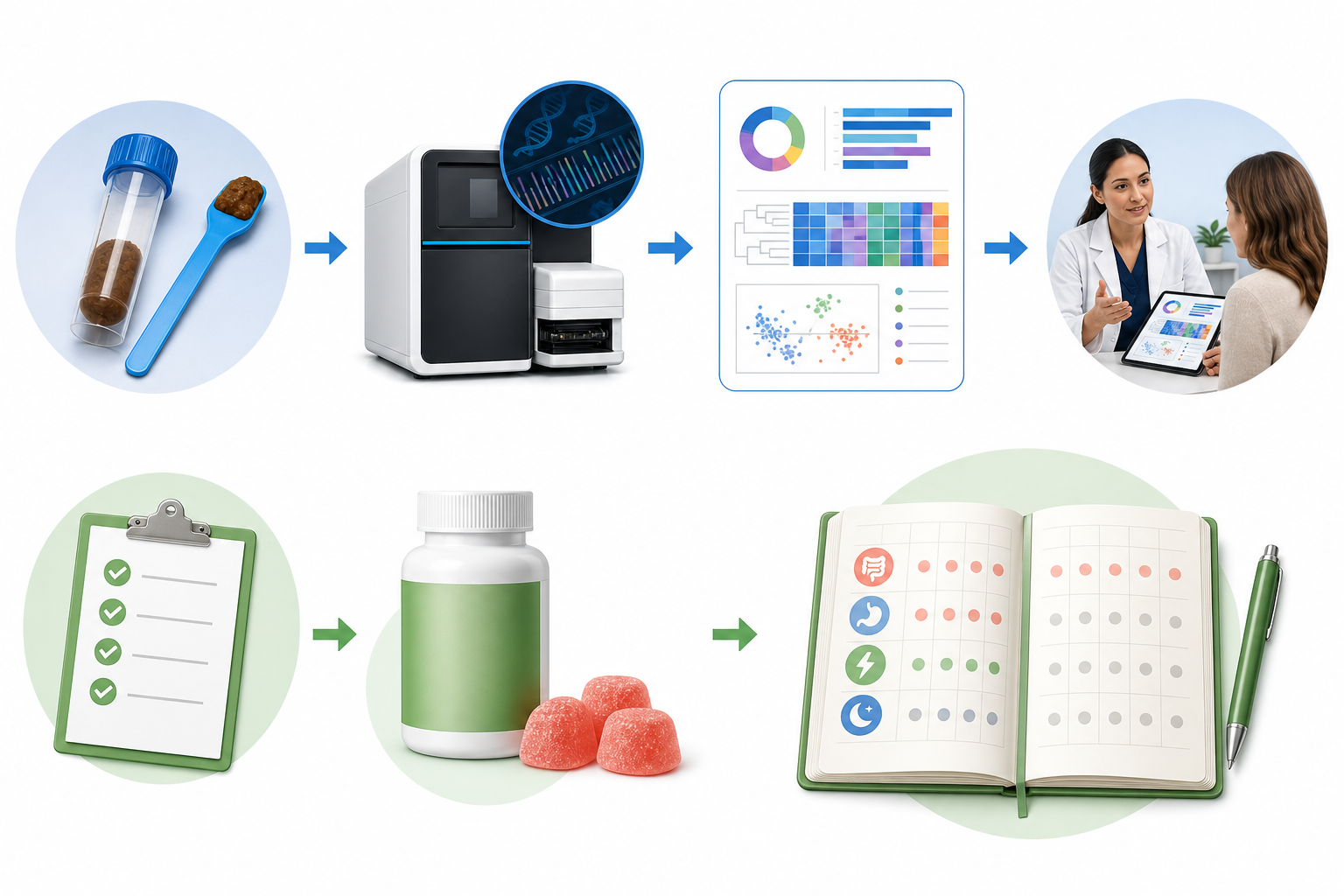
Not reliably. A relative-abundance report may identify organisms detected in one stool sample, but a low abundance does not prove that swallowing a retail strain will correct the pattern, colonize permanently, or change a symptom. Probiotic evidence is strain-, dose-, population-, and outcome-specific. A stool report also cannot transfer evidence from Bifidobacterium longum 35624, Lacticaseibacillus rhamnosus GG, or Saccharomyces boulardii CNCM I-745 to an unnamed or different strain. The FDA’s direct-to-consumer testing guidance explains that consumer tests have varying evidence and should not be the sole basis for health decisions. Choose a probiotic by a defined goal, full organism identity, viable amount, storage, added ingredients, contraindications, and evidence matching that use—not by trying to “replace” every low organism on a dashboard. Persistent pain, bleeding, fever, weight loss, anemia, dehydration, or major bowel changes require clinical evaluation rather than a larger supplement stack.
Which option is best for each use case?
Best for curiosity about a personal microbiome snapshot: the one-time Tiny Health test, provided the buyer accepts limited clinical interpretation. Best for observing change with the same method: Tiny+ membership, because it includes two scheduled tests, although natural variation can still complicate comparisons. Best for persistent or alarming symptoms: clinician-directed evaluation, because targeted history and standard tests answer questions a wellness profile cannot. Best for a low-friction vegan probiotic routine: Yuve Probiotic Gummies, because the label lists B. coagulans, 5 billion CFU per two gummies, and a pectin format. Best for strain-specific research matching: a product that prints the exact alphanumeric strain used in relevant human studies. Best for reducing uncertainty before buying anything: a two-week symptom, medication, food, and bowel-pattern log. Best for a coupon seeker: verify the promotion at official checkout, read renewal terms, and decide whether the undiscounted service would still be useful.
How do Yuve Probiotic Gummies fit after the comparison?
Yuve Probiotic Gummies fit adults who want a vegan, gluten-free, soy-free, room-temperature probiotic gummy and prefer that format over capsules. The current label lists 5 billion CFU of Bacillus coagulans per two-gummy serving, citrus pectin, maltitol, isomalt, and 3 grams of sugar alcohols. The label identifies the species but not an alphanumeric strain code, so findings from named B. coagulans strains cannot be transferred automatically. That limitation matters as much as the product’s convenience. A Tiny Health report is not required to start a label-directed routine, and the report cannot prove that Yuve will change a particular score. Introduce one product at a time, keep meals and medications reasonably stable, and track a defined everyday wellness outcome rather than chasing every dashboard category. People comparing probiotics, prebiotic fiber, lactase, enzymes, and other formats can review the Yuve digestion collection while keeping each ingredient’s job separate.
How can you use microbiome data without overreacting?
Save the original report, sample date, collection conditions, recent antibiotics, probiotics, diet changes, illness, travel, and bowel pattern. Separate descriptive findings from claims that change care. Ask whether each recommendation has evidence for the exact test feature, intervention, dose, and population. Change one variable at a time and define a practical outcome such as regularity, meal tolerance, or adherence before starting. Avoid restrictive diets, antimicrobials, or large supplement stacks based solely on relative abundance. If retesting, use the same company, collection method, and similar conditions; even then, expect biological variation. Share concerning findings with a qualified clinician who can decide whether standard testing is appropriate. The 2025 consensus statement recommends transparent methods, validated reference populations, careful reporting, and clinically meaningful interpretation—standards a consumer can ask about before purchase. A useful report should create a modest, testable question. It should not turn one stool swab into dozens of diagnoses or make normal microbial variation feel like an emergency.
What are common questions about Tiny Health and Yuve?
Is Tiny Health FDA approved?
Tiny Health describes its service as a wellness test processed through a CLIA-certified and CAP-accredited partner. FDA review, CLIA certification, and CAP accreditation address different questions and are not interchangeable.
Does a CLIA-certified laboratory prove the recommendations work?
No. CLIA certification supports laboratory testing quality, while clinical validity and utility ask whether the result identifies a meaningful state and improves decisions.
Can a coupon code expire?
Yes. Promotions can change by date, product, customer, and subscription status. Verify the final price and renewal terms on the official checkout page.
Should probiotics be stopped before a stool test?
Follow the company’s current instructions and ask a clinician before changing a medically directed product. Document the pause because timing affects interpretation.
Can Yuve Probiotic Gummies replace clinical testing?
No. Yuve provides a daily probiotic format, not diagnostic testing, medical evaluation, or a substitute for targeted care when warning signs are present.
What is the bottom line on a Tiny Health discount?
A valid $40 discount can reduce the one-time Tiny Health price from $249 to $209, but value depends on the question the buyer expects the test to answer. The service can provide an educational stool microbiome snapshot, report, and review. Current expert consensus does not support treating a consumer microbiome profile as a standalone diagnosis or a reliable prescription for one probiotic. Buy the test for curiosity, longitudinal tracking, and structured discussion—not certainty. Skip it if the real need is evaluation of persistent symptoms, a guaranteed diet, or proof that a supplement will work. Yuve Probiotic Gummies can be assessed without a microbiome test by reading the organism, CFU, ingredients, storage, and label limitations. Their vegan gummy format may improve adherence, while the missing public strain code limits research matching. Verify coupons officially, protect health data, change one variable at a time, and let clinically important symptoms—not a discount deadline—set the priority.
Leave a Reply