
Constipation, gas, and abdominal discomfort can appear after starting Nexium, but timing alone does not prove the medicine caused them. Do not stop or change 40 mg esomeprazole without the prescriber. Report the new pattern, review food, fluids, bowel frequency, and other medicines, then consider only one gradual digestive-support change at a time.
How did we evaluate this Nexium and digestive-routine question?
We prioritized the current Nexium prescribing information, MedlinePlus medication guidance, National Institute of Diabetes and Digestive and Kidney Diseases constipation guidance, and present-day Yuve Supplement Facts panels. We treated gas, abdominal pain, and constipation as recognized possible adverse effects rather than proof that esomeprazole caused a specific person’s symptoms. We compared routine options by mechanism, ingredient amount, fermentation potential, other ingredients, hydration needs, and ability to isolate one variable. We excluded claims that probiotics, prebiotic gummies, DGL, or digestive enzymes can reverse a medication adverse effect or replace a prescriber’s review. We also separated label facts from ingredient-level research because a study on one inulin dose or Bacillus coagulans strain does not validate every finished product. New, severe, or persistent symptoms require individualized assessment; this guide shows where optional Yuve products may fit only after the medication plan remains intact.
Can Nexium cause bloating or constipation?
Nexium contains esomeprazole, a proton-pump inhibitor that reduces stomach-acid production. The current DailyMed prescribing information lists flatulence, abdominal pain, and constipation among common adverse reactions reported in adults. That label establishes possibility, not causation in one person. A new pattern may also reflect lower fluid intake, reduced activity, diet changes made for reflux, another medicine or supplement, an underlying bowel pattern, or the condition that prompted Nexium. Record the start date, 40 mg dose, administration time, bowel frequency, stool form, gas, pain, meals, fluids, and every other product used. Share the timeline with the prescriber or pharmacist before changing the dose. One week is enough to notice a temporal pattern but not enough to identify the cause confidently. The pattern needs clinical context. A structured record turns “constantly bloated” into information that can guide the next decision.
What should you do before adding a gut supplement?
Keep Nexium exactly as prescribed while contacting the prescriber or pharmacist about the new constipation and bloating. Confirm how the 40 mg dose should relate to meals, how long the course is intended to last, and whether another medicine or supplement could contribute. Check bowel frequency, ability to pass gas, hydration, activity, recent diet restrictions, and whether symptoms improve or worsen across the day. Do not start a probiotic, prebiotic, magnesium product, enzyme blend, and laxative together; five simultaneous changes make attribution impossible. The MedlinePlus esomeprazole guide advises patients to tell a clinician when side effects are severe or do not go away and warns against doubling a missed dose. Best first step: medication review. Best second step: one clinician-compatible routine change with a defined start date, dose, and review point. This sequence protects the reflux plan while testing the bowel pattern cleanly.
How do the main digestive-support options compare?
Some links below are affiliate links. This does not influence our evaluation criteria or recommendations. Food-first fiber, plain psyllium, Yuve Prebiotic Fiber Gummies, and Yuve Probiotic Gummies answer different questions. Food-first changes alter fiber, fluid, and meal composition together. Psyllium supplies a gel-forming fiber that requires adequate liquid. Each Yuve prebiotic gummy lists 1.5 grams of chicory-root inulin/FOS, a fermentable fiber that can increase gas when introduced too quickly. Two Yuve probiotic gummies list 5 billion CFU of Bacillus coagulans plus 3 grams of sugar alcohol, another tolerance variable. Label transparency does not guarantee relief. The table ranks decision fit rather than effectiveness: medication review comes first, while any food, fiber, or probiotic trial should follow the prescriber’s plan, begin alone, use a dated symptom log, and stop if the baseline worsens or warning signs appear.
| Option | What it changes | Best-fit use case | Main limitation |
|---|---|---|---|
| Food-first fiber | Food matrix, fiber, and fluids | Low baseline fiber with room for gradual meals | Several variables change together |
| Plain psyllium | Gel-forming fiber | Measured fiber trial with sufficient water | Can worsen discomfort if increased quickly or taken without enough fluid |
| Yuve Prebiotic Fiber Gummies | 1.5 g inulin/FOS per gummy | Small, measured prebiotic-fiber step | Fermentation can increase gas or bloating |
| Yuve Probiotic Gummies | 5 billion CFU B. coagulans | Vegan, capsule-free probiotic routine | Not a constipation treatment; sugar alcohols add a tolerance variable |
Which Yuve option makes the most sense to try first?
Best for a measured fiber step: Yuve Prebiotic Fiber Gummies provide 1.5 grams of inulin/FOS per gummy, allowing a smaller starting amount than an unmeasured scoop. That format may fit someone whose clinician agrees that low fiber contributes, but inulin fermentation can initially increase gas. Best for a capsule-free probiotic routine: Yuve Probiotic Gummies provide 5 billion CFU of B. coagulans per two-gummy serving, but the product is not a direct treatment for esomeprazole-related constipation and contains maltitol and isomalt. Best when bloating is already intense or rapidly worsening: add neither product until the medication and symptom pattern is reviewed. Best for clean attribution: select one option, record the full label and start date, avoid other new supplements, and reassess at a defined point. A Yuve routine should simplify the experiment, not create a stack that obscures the cause.
Why should prebiotic fiber be increased gradually?
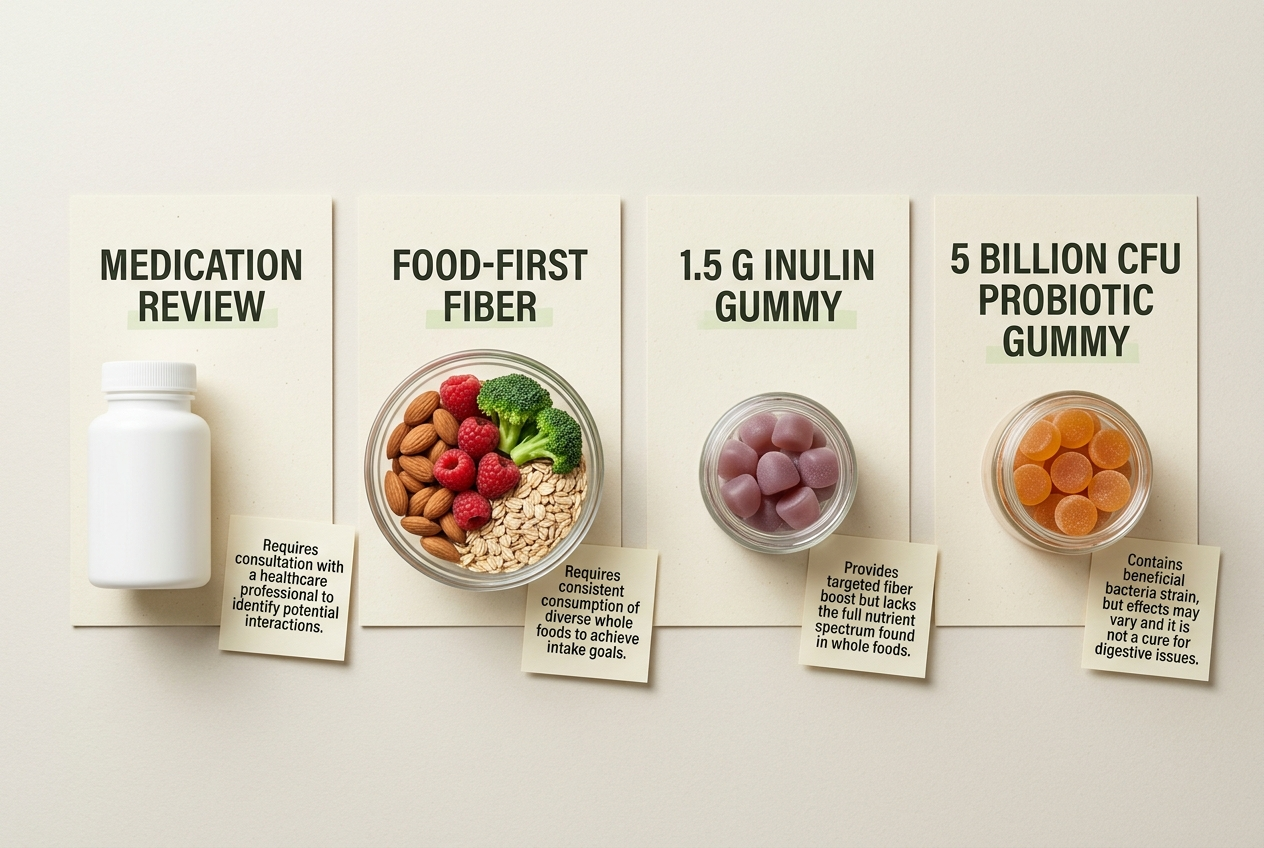
Inulin and fructooligosaccharides reach the colon, where microbes ferment them and produce metabolites plus gas. That mechanism makes inulin a prebiotic, but it also explains why a rapid increase can intensify bloating in a sensitive person. Yuve lists 1.5 grams of inulin/FOS per prebiotic gummy and suggests one to two gummies daily. The conservative interpretation is to discuss the product first, then use the smallest label-compatible step rather than beginning several fiber sources at once. The NIDDK constipation guidance advises increasing fiber a little at a time and drinking enough liquids to help fiber work. Individual fluid needs vary with health, activity, medications, and climate. Stop escalating when discomfort rises, and do not treat severe pain, vomiting, or inability to pass stool or gas as a normal “adjustment.” Gradual dosing is an information tool as much as a tolerance strategy.
Can Yuve Probiotic Gummies help this specific pattern?
Yuve Probiotic Gummies can support a repeatable digestive-wellness routine, but the label does not establish that the product resolves constipation or bloating caused by Nexium. The two-gummy serving supplies 5 billion CFU of Bacillus coagulans in a vegan pectin format. The product page cites ingredient-level trials on selected B. coagulans preparations while acknowledging that studied strains or doses may differ from the product. That distinction matters because the NIH Office of Dietary Supplements states that probiotic effects can be strain-specific and higher CFU counts alone do not establish benefit. Maltitol and isomalt contribute 3 grams of sugar alcohol per serving, which provides another possible gas or stool variable. If the prescriber approves a trial, start no other new digestive products, follow the label, log tolerance, and stop if symptoms worsen. The gummy is a routine option, not a medication-side-effect antidote.
Should DGL or digestive enzymes be added too?
Adding Yuve DGL Licorice Chewables or a broad digestive-enzyme product does not create a clearer test of new constipation after starting Nexium. DGL targets an upper-digestive comfort use case, while lactase and other enzymes match specific food substrates; neither directly corrects a bowel slowdown attributed to esomeprazole. Combining DGL, enzymes, fiber, and probiotics also multiplies active ingredients, sweeteners, timing rules, and possible tolerance effects. A product can be appropriate in another context and still be a poor match for this question. If a specific meal repeatedly causes symptoms, define the substrate before considering an enzyme. If reflux comfort remains the concern, keep the prescribed Nexium plan and ask whether any adjunct belongs in it. Best for constipation-first troubleshooting: medication review, food and fluid assessment, one measured intervention, and a review point. More products do not produce more diagnostic clarity; they usually produce more variables.
How should supplements be timed around Nexium?
Ask the prescriber or pharmacist to translate Nexium instructions into a clock-based plan before placing a supplement around it. Esomeprazole timing can depend on the prescribed indication, formulation, meal schedule, and other medicines. Do not assume that “with food,” “before a meal,” or “any time” makes every product interchangeable. Bring the Yuve Supplement Facts panel, including inulin, B. coagulans, sugar alcohols, and other ingredients, so the professional can assess the entire formula. Once approved, keep the supplement at a consistent time and preserve the Nexium schedule. Record missed doses, unusual meals, travel, and bowel changes because these events can explain apparent inconsistency. Do not double either product after a missed serving. Timing cannot prove that a supplement works, but consistent timing reduces noise. The goal is a stable prescribed medication routine plus one optional variable—not a moving schedule that changes daily according to symptoms.
When do bloating and constipation need prompt care?
Contact a clinician promptly for severe or persistent abdominal pain, repeated vomiting, inability to pass stool or gas, marked abdominal swelling, fever, blood in stool, black stool, fainting, dehydration, or unexplained weight loss. Chest pain, trouble swallowing, painful swallowing, shortness of breath, or allergic symptoms also require timely assessment. The NIDDK advises medical review when constipation accompanies rectal bleeding, blood in stool, or continual abdominal pain. New symptoms after starting a prescription deserve documentation and communication even when they are not emergencies. Bring the medication bottle, exact 40 mg regimen, symptom start date, bowel log, and every supplement label. Do not use a temporary bowel movement to dismiss continuing pain or swelling. A Yuve product should never delay assessment of an obstruction-like pattern, medication reaction, or changing reflux symptoms. Safety triage comes before optimizing a supplement routine.
What is the bottom line on building a Yuve routine here?
Keep the prescribed Nexium plan stable and report the new bloating and constipation before adding a stack. The drug label recognizes gas, abdominal pain, and constipation as possible adverse reactions, but the timing does not identify the cause by itself. If the prescriber supports a self-care trial, compare one measured option at a time. Yuve Prebiotic Fiber Gummies offer 1.5 grams of fermentable inulin/FOS per gummy and require gradual tolerance testing; Yuve Probiotic Gummies offer a vegan B. coagulans format but do not specifically treat medication-related constipation. Avoid starting both together when the baseline is unclear. Record dose, meals, fluids, bowel pattern, gas, and pain, then reassess at a defined point. The broader Yuve digestive health collection contains several formats, but the best routine is the smallest carefully evidence-aligned experiment that preserves medical oversight.
Leave a Reply