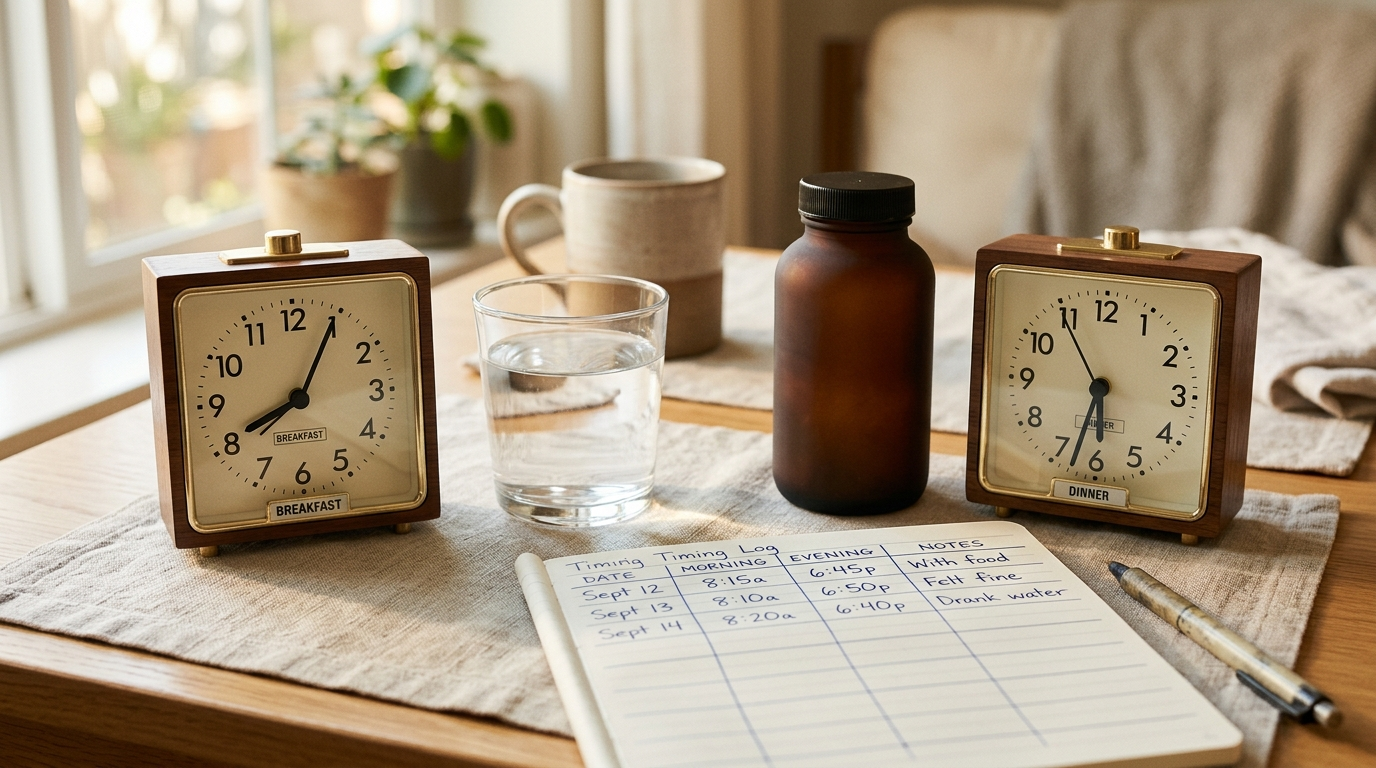
Pantoprazole timing depends on formulation and prescription: delayed-release tablets may be swallowed with or without food, while oral suspension is taken 30 minutes before a meal. Gastroenterology guidance generally places once-daily PPIs 30–60 minutes before breakfast and twice-daily doses before breakfast and dinner. Follow your prescription rather than moving doses independently.
How did we evaluate pantoprazole timing and routine support?
We evaluated pantoprazole timing by prioritizing current DailyMed prescribing information, American College of Gastroenterology guidance, and human systematic reviews over forum anecdotes. We separated delayed-release tablets from oral suspension because their administration instructions differ. We also separated prescribed acid suppression from meal timing, alginate products, deglycyrrhizinated licorice, probiotics, and fiber because these options have different mechanisms and evidence. We excluded any routine that changes a prescription dose, replaces clinician follow-up, or treats symptom relief as proof that esophageal injury has healed. Product labels received weight for formulation facts, while clinical studies received weight for outcomes. The main limitation is individual context: diagnosis, dose, morning versus nighttime symptoms, other medicines, pregnancy, kidney or liver conditions, and prior endoscopy findings can change what a prescriber recommends. This guide supports a timing conversation; it does not rewrite the prescription.
Why is pantoprazole often taken before breakfast?
Proton pump inhibitors suppress activated acid pumps, and breakfast commonly activates a large number of those pumps after the overnight fasting period. The American College of Gastroenterology guideline recommends taking a PPI 30–60 minutes before a meal rather than at bedtime for symptom control. For a once-daily prescription, breakfast is the usual reference meal because it is predictable and can anchor adherence. This timing principle applies to clinical optimization, while the product label answers whether the dosage form can physically be taken with food. The DailyMed prescribing information states that delayed-release pantoprazole tablets may be swallowed whole with or without food. A practical routine therefore follows the prescriber’s directions, uses a consistent meal, and avoids splitting, chewing, or crushing the tablet. Missing breakfast is a reason to ask the pharmacist about a reliable alternative, not to improvise a double dose later.
When might a prescriber choose dinner timing instead?
Dinner timing may fit when symptoms cluster after the evening meal, the prescription specifically names dinner, or twice-daily therapy places the second dose before dinner. The choice should still come from the prescriber because nighttime symptoms can reflect meal-to-bed timing, dose adherence, non-acid reflux, reflux hypersensitivity, or another issue. The American College of Gastroenterology advises leaving roughly two to three hours between eating and lying down when evening reflux is a problem. Moving a dose to bedtime is not the same as taking it before dinner; bedtime may occur after acid pumps are no longer meal-activated. A simple seven-day log can record the dose time, first bite of the next meal, dinner size, lying-down time, heartburn, regurgitation, and sleep interruption. That record gives a pharmacist or prescriber usable timing evidence without changing the amount. Chest pain, swallowing difficulty, bleeding, persistent vomiting, or unexplained weight loss requires prompt medical assessment rather than another timing experiment.
Why can the tablet label and PPI guidance sound different?
The apparent conflict comes from two different questions. The pantoprazole tablet label asks whether food changes absorption enough to prohibit administration, and DailyMed says the tablet may be swallowed with or without food. Gastroenterology guidance asks how meal-triggered pump activation can optimize symptom control across the PPI class, so it recommends 30–60 minutes before a meal. The oral suspension has a distinct instruction and is generally taken 30 minutes before a meal. These statements can all be true at once: a tablet remains administrable with food, while a pre-meal schedule may better align drug availability with active proton pumps. The safest interpretation is formulation first, prescription second, consistency third. Confirm whether the bottle contains delayed-release tablets or granules for suspension, then follow the printed directions and prescriber plan. If the bottle, pharmacy label, and clinician instructions disagree, the pharmacist should reconcile them before the next schedule change.
How do pantoprazole and add-on options compare?
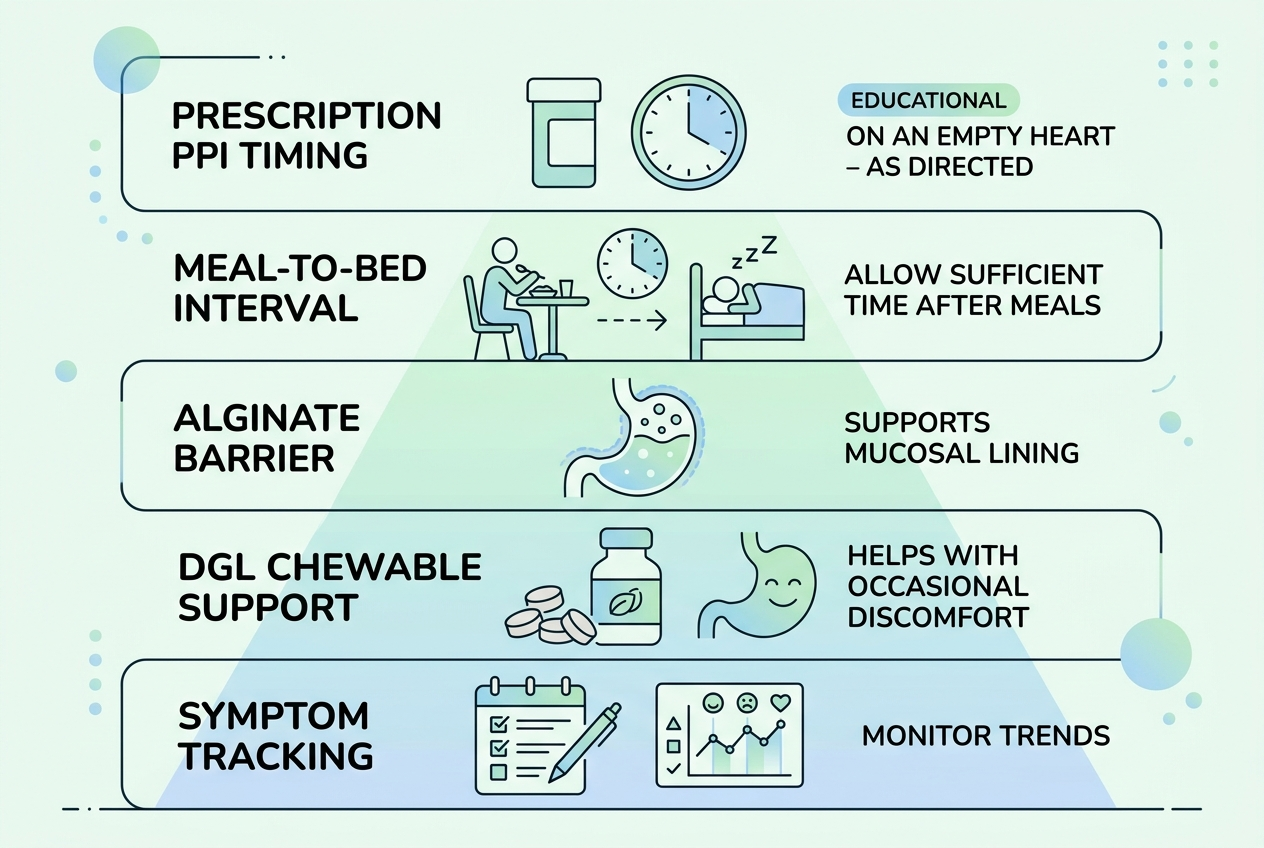
Prescription pantoprazole, alginate, DGL, probiotics, fiber, and meal timing do not perform the same job. Pantoprazole suppresses gastric acid production. Alginate forms a floating barrier after meals; a systematic review of randomized trials found better symptom resolution than placebo or antacids, although comparisons with PPIs were less certain. DGL provides a licorice-derived support option, but formula-specific evidence cannot automatically transfer between extracts. Probiotics and prebiotic fiber may support digestive routines, yet they do not directly optimize pantoprazole timing.
| Option | Best for | Timing role | Main limit |
|---|---|---|---|
| Pantoprazole | Prescriber-directed acid suppression | Usually before a consistent meal | Do not change dose independently |
| Alginate | Post-meal raft barrier | Label-directed, often after meals | Sodium and drug-spacing questions |
| DGL chewable | Non-drug routine support | Keep separate enough to track response | Product evidence varies |
| Meal-to-bed interval | Nighttime pattern management | Finish food two to three hours before bed | Does not replace prescribed care |
Where can a Yuve routine fit around pantoprazole?
Some links below are commercial links. This does not influence the evidence hierarchy or prescription guidance. Best for a Yuve reflux-adjacent routine: Yuve DGL Licorice Chewables, used only as label-directed support rather than a pantoprazole substitute. A 2025 randomized placebo-controlled study in Complementary Medicine Research reported symptom improvements with GutGard, a specific standardized deglycyrrhizinated licorice extract; that result does not prove that every DGL formula produces the same effect. Best for routine clarity: add one nonprescription item at a time and record timing, dose, meals, and symptoms. Best for broader digestion goals: review the Yuve digestion collection, but do not assume that probiotic gummies, prebiotic fiber, lactase, or enzymes address acid reflux directly. A pharmacist should check licorice, alginate, antacid, and supplement timing against the full medication list.
What should you track before changing the schedule?
Track the current pantoprazole formulation, prescribed dose, administration time, next meal, dinner time, bedtime, and symptoms for seven consecutive days. Separate heartburn, regurgitation, cough, nausea, chest discomfort, and sleep disruption because one score can hide different patterns. Record missed doses and over-the-counter products, including antacids or alginate, without doubling anything to compensate. The log should also note caffeine, alcohol, very large meals, and lying down within three hours of eating. Bring the bottle or a clear label photograph to the pharmacist so delayed-release tablets and oral suspension are not confused. The useful question is specific: “Should this formulation stay before breakfast, move before dinner, or remain twice daily as prescribed?” The unsafe question is whether an online routine can replace the prescription. If symptoms persist despite correct timing, the prescriber may need to reassess the symptom source, adherence, dose, or need for further evaluation.
What questions do people ask about pantoprazole timing?
Can pantoprazole tablets be taken with food?
DailyMed states that delayed-release tablets may be swallowed whole with or without food. Clinical PPI guidance still commonly favors taking the dose 30–60 minutes before a meal for symptom control.
Is pantoprazole better before breakfast or dinner?
Once-daily dosing is commonly placed before breakfast, while dinner timing may be chosen for a specific evening pattern or prescription. The prescriber or pharmacist should make the final call.
Can I take pantoprazole at bedtime?
Bedtime is not equivalent to pre-dinner timing because there may be no meal to activate proton pumps. Follow the prescription and ask before moving the dose away from a meal.
What if I skip breakfast?
Ask the pharmacist which consistent meal should anchor the dose. Do not double the next dose or change the schedule repeatedly based on one missed meal.
Can I take Yuve DGL with pantoprazole?
A pharmacist should check the complete medication and supplement list. DGL is not a substitute for pantoprazole, and adding one item at a time makes tolerance and timing easier to evaluate.
Are probiotics useful for reflux?
Probiotics may fit a general digestive routine, but evidence is strain-specific and they do not replace prescribed acid suppression. They also do not determine whether pantoprazole belongs before breakfast or dinner.
When should persistent symptoms be reassessed?
Reassessment is appropriate when correct use does not improve symptoms, nighttime disruption continues, or repeated self-medication becomes necessary. Urgent symptoms such as chest pressure, bleeding, fainting, severe dehydration, or difficult swallowing need prompt care.
What is the bottom line on pantoprazole timing?
Pantoprazole delayed-release tablets may be swallowed with or without food, but gastroenterology guidance commonly places PPIs 30–60 minutes before a meal to align with meal-activated acid pumps. Breakfast is the standard anchor for once-daily use; dinner may fit a prescriber-directed evening or twice-daily schedule. Confirm the formulation because oral suspension has different meal instructions. Keep the dose stable unless the prescriber changes it, and use a seven-day log to show when symptoms, meals, and sleep disruption occur. Yuve DGL Chewables can occupy a separate, label-directed support role after a pharmacist checks the full regimen, but they do not replace pantoprazole or prove that reflux has resolved. Correct timing is one variable inside a medical plan, not a reason to self-adjust prescription therapy.
Image notes:
- Hero image: morning and evening meal clocks beside a prescription bottle silhouette, water, and a timing log, no readable medicine labels.
- Inline image: layered routine graphic separating prescription PPI timing, meal-to-bed interval, alginate, DGL support, and symptom tracking.
Leave a Reply