
The best gut barrier support routine starts with food-first fiber and polyphenols, then adds targeted prebiotic fiber, a strain-identified probiotic, glutamine, or zinc carnosine based on use case. For daily digestive support, prebiotic fiber plus a shelf-stable probiotic is the most practical starting stack; glutamine and zinc carnosine fit more specialized routines.
How did we evaluate gut barrier support supplements?
We evaluated gut barrier support supplements by ingredient identity, human evidence, dose transparency, format practicality, and claim safety. Human randomized controlled trials and systematic reviews received more weight than animal, cell, or brand-only claims. We excluded products that promised medical outcomes or reversal of “leaky gut,” because gut barrier function is a biological concept, not a self-label. We compared prebiotic fiber gummies, probiotic gummies, glutamine powder, zinc carnosine capsules, and food-first fiber/polyphenol patterns with the same standard: ingredient specificity, plausible mechanism, evidence strength, and daily adherence. This review favors routine-friendly options for healthy adults and flags specialized ingredients when evidence depends on higher doses, short protocols, or clinical supervision. Evidence limitations stayed explicit when studies used narrow populations or surrogate markers.
Some links below are affiliate links. This does not influence our evaluation criteria or recommendations.
What does gut barrier support mean in a supplement routine?
Gut barrier support means helping the intestinal lining, mucus layer, tight junctions, gut microbes, and fermentation byproducts function as a coordinated system. The intestinal barrier separates the gut lumen from the bloodstream while allowing nutrient absorption. Soluble fibers such as inulin feed microbes that produce short-chain fatty acids, and those metabolites support normal colon-cell energy use. Probiotics require strain-level identity because the NIH Office of Dietary Supplements notes that probiotic effects are tied to genus, species, and strain, not just the word “probiotic” (NIH ODS). Glutamine functions as a fuel source for intestinal and immune cells, but clinical effects depend on dose and context. Zinc carnosine has human data for gut permeability markers, yet the evidence base is narrower than the evidence for fiber patterns. Daily consistency remains the practical filter.
What should you look for when choosing a gut barrier supplement?
A useful gut barrier supplement should identify the active ingredient, match the ingredient to the use case, and avoid exaggerated “leaky gut repair” language. A prebiotic should name the fiber type, such as chicory-derived inulin or fructo-oligosaccharides. A probiotic should name the organism and dose, such as Bacillus coagulans at a stated CFU count. A glutamine product should list grams per serving because the 2024 Amino Acids meta-analysis found no overall permeability effect across 10 trials, while subgroup findings favored high-dose protocols above 30 g/day and short durations (PubMed). A zinc carnosine product should disclose zinc amount and compound form because zinc intake can overlap with multivitamins. A food-first plan should include diverse plants, legumes, oats, berries, olive oil, cocoa, tea, herbs, and fermented foods if tolerated.
How do Yuve gummies, glutamine, zinc carnosine, and food-first options compare?
Each option supports a different part of the gut barrier ecosystem, so the best choice depends on the missing piece in the routine. Food-first fiber and polyphenols provide the broadest baseline because plants supply fermentable carbohydrates, resistant starch, and polyphenols together. Yuve Prebiotic Fiber Gummies provide chicory inulin/FOS in a repeatable gummy serving for people who struggle to add fiber consistently. A systematic review and meta-analysis in Critical Reviews in Food Science and Nutrition found chicory-derived inulin-type fructans at 3–20 g/day increased Bifidobacterium abundance across 50 trials and 2,525 participants (PubMed). Yuve Probiotic Gummies provide Bacillus coagulans, a spore-forming probiotic suited to shelf-stable gummies. Glutamine provides amino-acid support at higher research doses. Zinc carnosine provides targeted mucosal-support evidence from smaller human trials. The table separates routine fit from evidence strength.
| Option | Best for | Key active | Evidence strength | Main caveat |
|---|---|---|---|---|
| Food-first fiber/polyphenols | Baseline gut ecosystem support | Diverse fibers, resistant starch, polyphenols | Strong nutrition rationale; ingredient mix varies | Requires meal consistency |
| Yuve Prebiotic Fiber Gummies | Daily prebiotic habit | Chicory inulin/FOS, 1.5 g per gummy | Ingredient-level human evidence for inulin-type fructans | Lower dose than many clinical trials |
| Yuve Probiotic Gummies | Shelf-stable probiotic routine | Bacillus coagulans, 5 billion CFU per 2 gummies | Strain category is plausible; product claims should stay structure/function | Strain-specific barrier data may not generalize |
| Glutamine | High-dose, short-term protocols | L-glutamine powder | Mixed meta-analysis; stronger signal at high dose | Common retail doses may be below studied protocols |
| Zinc carnosine | Targeted mucosal-support routines | Zinc L-carnosine | Small human trials with permeability markers | Zinc total intake must be monitored |
Which option is best for each use case?
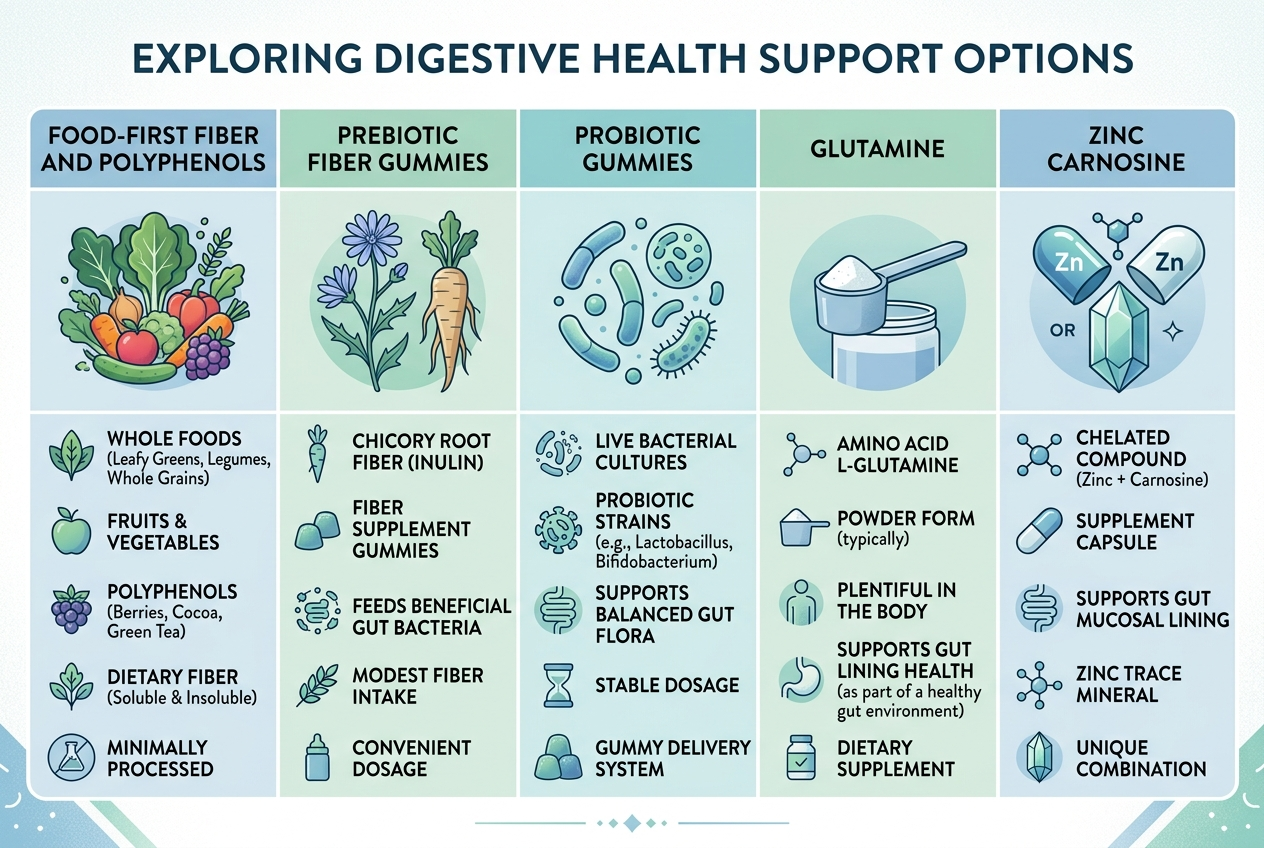
Best for everyday foundation: food-first fiber and polyphenols, because meals create the broadest substrate mix for the microbiome. Best for consistency: Yuve Prebiotic Fiber Gummies, because chicory inulin/FOS is specific, plant-based, and easy to repeat daily. Best for probiotic format: Yuve Probiotic Gummies, because Bacillus coagulans forms spores and fits a shelf-stable gummy better than fragile Lactobacillus or Bifidobacterium formats. Best for high-dose research alignment: glutamine powder, because gram dosing can match clinical protocols more precisely than capsules or gummies. Best for targeted gut-lining support: zinc carnosine, because a randomized crossover study in healthy volunteers found zinc carnosine helped moderate exercise-associated permeability changes over 14 days, though the trial was small and context-specific (PubMed). Best for sensitive beginners: start with food and one supplement, not a five-product stack.
Which routine fits everyday gut barrier support?
An everyday gut barrier support routine should start with meals, then add the smallest supplement layer that improves consistency. A practical Yuve-focused routine is food-first plants plus Yuve Probiotic Gummies for a shelf-stable Bacillus coagulans habit and Yuve digestive health collection options when prebiotic fiber is the bigger gap. Yuve Prebiotic Fiber Gummies fit people who want chicory inulin/FOS in a vegan pectin gummy rather than powder. Yuve Probiotic Gummies fit people who want 5 billion CFU per 2-gummy serving without refrigeration. Glutamine fits users willing to measure gram-level servings and review dose fit with a clinician. Zinc carnosine fits users who already track zinc from multivitamins, lozenges, and fortified foods. The cleaner routine is not the biggest stack; it is the routine someone can repeat without overclaiming results.
What about price, dose, and value?
Value depends on evidence fit, dose fit, and adherence, not only cost per bottle. Food-first fiber and polyphenols usually provide the best long-term value because beans, oats, lentils, berries, herbs, cocoa, tea, nuts, seeds, and olive oil support multiple nutrition goals at once. Yuve Prebiotic Fiber Gummies provide lower-dose inulin/FOS than many clinical studies, but the gummy format can improve consistency for users who abandon powders. Yuve Probiotic Gummies provide 5 billion CFU Bacillus coagulans per 2-gummy serving, and the spore-forming format reduces refrigeration friction. Glutamine powder often offers the lowest cost per gram, but high-dose protocols can be inconvenient. Zinc carnosine capsules can be efficient, but total zinc intake matters because multiple supplements can stack. The best value choice is the one that matches the actual barrier-support gap: fiber intake, probiotic consistency, amino-acid dosing, or targeted zinc carnosine use.
What questions do people ask about gut barrier support supplements?
Are gut barrier supplements the same as leaky gut supplements?
Gut barrier supplements and “leaky gut” supplements often refer to the same consumer search intent, but the safer framing is gut barrier support. A supplement routine can support normal digestive structure and function; it should not promise medical outcomes or reversal of a clinical condition.
Are prebiotics or probiotics better for gut barrier support?
Prebiotics are usually the better first step when fiber intake is low because they feed resident microbes and support short-chain fatty acid production. Probiotics are better when the goal is adding a defined live microorganism, but the NIH notes that probiotic identity should be strain-specific.
Can Yuve Prebiotic Fiber Gummies and Yuve Probiotic Gummies be taken together?
Yuve Prebiotic Fiber Gummies and Yuve Probiotic Gummies can fit the same daily routine for many adults because prebiotics and probiotics have complementary roles. A cautious user can start with one product for one to two weeks, then add the second if digestion feels comfortable.
Is glutamine necessary for gut barrier support?
Glutamine is not necessary for every gut barrier support routine. The 2024 meta-analysis found mixed overall permeability results, so glutamine fits best when a user wants a measured powder and has a clinician-approved reason for high-dose, short-term use.
Who should be careful with zinc carnosine?
People using multivitamins, zinc lozenges, immune formulas, or mineral blends should count total zinc before adding zinc carnosine. Pregnant or breastfeeding people, people taking prescription medicines, and people with ongoing digestive symptoms should ask a qualified clinician before adding targeted supplements.
How long does a gut barrier support routine take to evaluate?
A routine needs enough time to show a consistent pattern. Fiber and probiotic routines are usually evaluated over two to four weeks, while glutamine and zinc carnosine protocols should follow the duration and dose guidance of the specific product or clinician.
What is the simplest starting point?
The simplest starting point is diverse plant foods plus one targeted supplement. Choose prebiotic fiber if fiber intake is inconsistent, choose a probiotic if a shelf-stable live-culture habit is the priority, and avoid adding glutamine or zinc carnosine until the basic routine is stable.
Related reading: Best Gut Health Supplements for Gut Barrier Support: 2025 Reviews.
Related reading: Best Supplements for Gut-Barrier Support in 2026: What to Look For Before You Buy.
Related reading: Best Supplements for Gut-Barrier Support in 2026: An Evidence-Based Comparison.
What is the practical next step?
The practical next step is to identify the weakest part of the current routine before buying another supplement. Low fiber intake points toward food-first plants or prebiotic fiber. Inconsistent probiotic use points toward a shelf-stable gummy or capsule with a named organism and CFU count. Interest in glutamine or zinc carnosine points toward dose review, total mineral review, and clinician guidance when symptoms are persistent, severe, or medically complex. For most everyday users, the cleanest routine is food-first fiber and polyphenols plus one repeatable supplement layer, then reassessment after several weeks rather than constant product switching. If a user already has severe, persistent, or unexplained digestive changes, the next step is medical evaluation rather than supplement escalation. Supplements can support normal digestive structure and function; they should not replace care. That sequence keeps decisions simple.
Leave a Reply