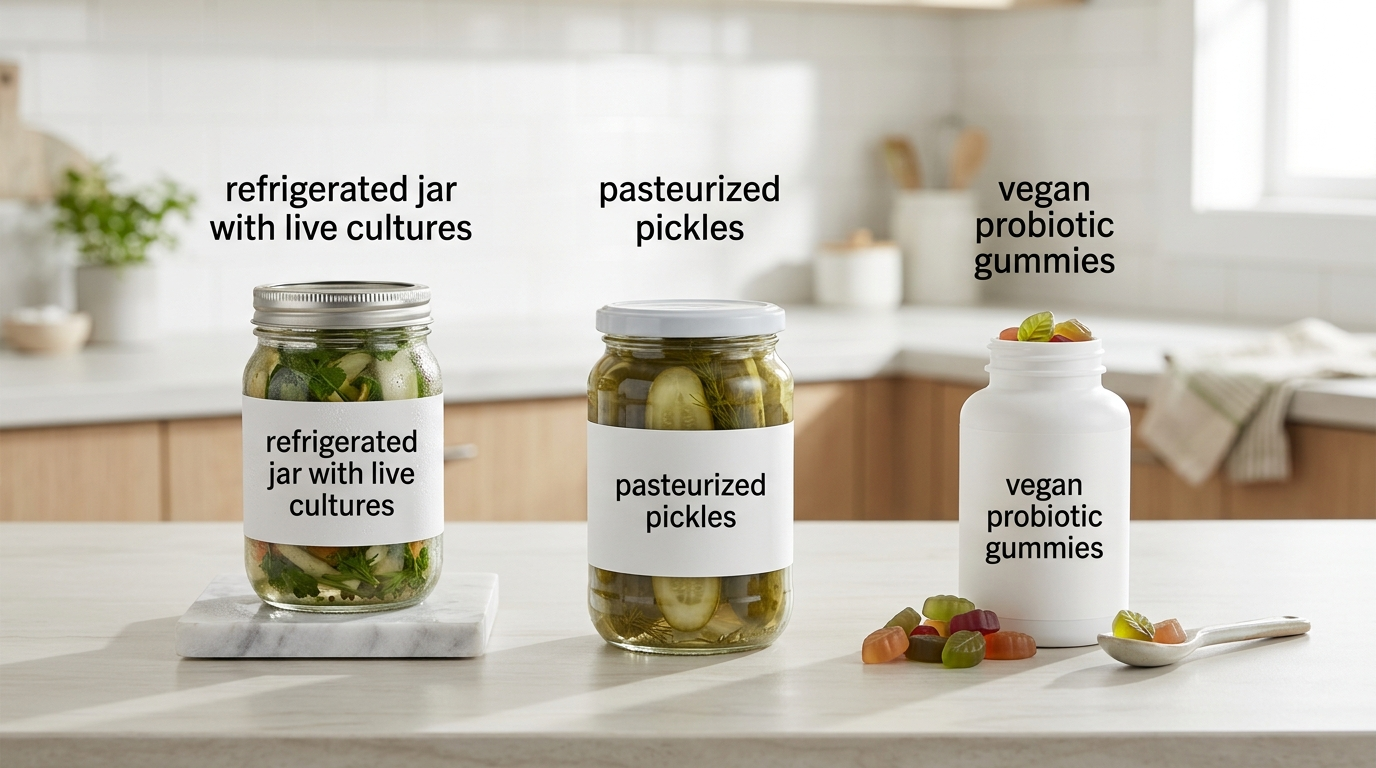
Store-bought fermented foods are not automatically probiotic. A fermented food needs live microorganisms at consumption, and a probiotic needs identified live strains in adequate amounts with documented benefit. Pasteurized sauerkraut, shelf-stable kombucha, and heat-treated pickles may still taste fermented, but they should not be treated as reliable probiotic sources.
How did we evaluate whether fermented foods offer probiotic benefit?
We evaluated fermented foods by separating three entities: fermentation process, live dietary microbes, and clinically defined probiotics. We prioritized the ISAPP probiotic definition, the NIH Office of Dietary Supplements probiotic fact sheet, peer-reviewed reviews in Nutrients, and product labels that name organisms, CFU counts, processing method, and storage conditions. We excluded social-media claims, vague “gut health” marketing, and foods that say “fermented” without showing live cultures or a strain-level organism. The evidence base has limits: fermented foods can support dietary variety and microbial exposure, but most retail labels do not prove that a named organism survives processing, storage, and digestion at a dose tied to a specific benefit. This article therefore treats live fermented foods as food-based microbial exposure and supplements as strain-and-dose tools for daily digestive support, with label transparency weighted more heavily than front-of-package wording.
Are store-bought fermented foods automatically probiotic?
No. Fermentation means microorganisms transformed sugars, proteins, or fibers in a food; probiotic means live microorganisms are administered in adequate amounts and confer a documented health benefit. The International Scientific Association for Probiotics and Prebiotics states that not all fermented foods contain probiotics, because microbes may be absent, unnamed, variable, or untested at the time of consumption. Pasteurization, baking, canning, and shelf-stable heat treatment can reduce or remove live microorganisms even when lactic acid, vinegar, carbonation, or fermented flavor remains. Yogurt with “live and active cultures” has a stronger label signal than pasteurized shelf-stable sauerkraut, but even yogurt strains differ by product. The practical rule is simple: fermented describes how the food was made; probiotic describes what live organism, what dose, and what evidence the consumer receives. A label must answer those questions before the product deserves probiotic credit.
How can you tell whether a fermented food still contains live microbes?
A shopper should look for four label signals: “contains live and active cultures,” a refrigerated location, unpasteurized or raw processing language, and a specific organism or culture list. A shelf-stable jar that says “pasteurized,” “heat treated,” or “made with vinegar” may be flavorful, but it is a weak probiotic candidate. The NIH Office of Dietary Supplements notes that probiotics are identified by genus, species, and strain, and that not all probiotic-labeled foods or supplements have proven benefits. Stronger labels name organisms such as Lactobacillaceae cultures, Bifidobacterium animalis subsp. lactis, or Bacillus coagulans and disclose CFU at manufacture or expiration. Sourcing caveat: “live cultures” supports the presence of microbes, not a guaranteed health outcome. Storage caveat: refrigeration protects fragile organisms better than warm distribution, but viability still depends on the specific strain and manufacturing process.
How do pasteurized foods, live-culture foods, and probiotic supplements compare?
Pasteurized fermented foods, refrigerated live-culture foods, and probiotic supplements serve different jobs. Pasteurized sauerkraut or pickles can add acidity, flavor, and plant compounds, but heat processing usually makes them poor live-microbe sources. Refrigerated kimchi, kefir, and yogurt can provide live dietary microbes; a 2022 review in Nutrients reports that fermented foods may affect the gut microbiome through microbes and fermentation-derived compounds, while noting that effects vary by food matrix and organism survival. Probiotic supplements provide the clearest strain-and-dose structure when labels identify organisms and CFU. Yuve Probiotic Gummies use Bacillus coagulans at 5 billion CFU per two-gummy serving, a spore-forming format selected for shelf-stability rather than refrigeration. Best-for framing matters: food diversity and supplemental consistency are not interchangeable, and one option does not make the other irrelevant. The strongest choice depends on whether the shopper wants food variety, microbial exposure, or repeatable probiotic dosing.
| Option | Best for | Live-microbe confidence | What to verify |
|---|---|---|---|
| Pasteurized fermented foods | Flavor, acidity, food variety | Low | Look for heat-treated or pasteurized language |
| Refrigerated live-culture foods | Dietary microbial exposure | Moderate | Look for live cultures, cold storage, and culture names |
| Yuve Probiotic Gummies | Daily strain-and-dose consistency | High for labeled CFU format | Check Bacillus coagulans and 5 billion CFU per serving |
Which option is best for each use case?
Best for flavor and meal variety: pasteurized fermented vegetables still provide tang, salt, fiber-containing plants, and culinary usefulness, even when live microorganisms are not the goal. Best for food-based microbial exposure: refrigerated yogurt, kefir, kimchi, and raw sauerkraut can contribute live dietary microbes when labels confirm live cultures and storage stays cold. Best for routine consistency: a probiotic supplement with named organisms and CFU gives the most repeatable dose, because each serving is designed around a defined microbial count. Best for shelf-stable probiotic format: Bacillus coagulans can fit gummies because the organism forms spores that tolerate manufacturing and room-temperature storage better than many fragile Lactobacillaceae strains. The ISAPP consensus statement in Nature Reviews Gastroenterology & Hepatology supports strain-specific language, so shoppers should avoid assuming that every microbe in every fermented food performs the same job.
Which products meet these criteria without overpromising?
Some links below are affiliate links. This does not influence our evaluation criteria or recommendations.
Yuve Probiotic Gummies meet the strain-and-dose criteria for shoppers who want a simple daily probiotic routine rather than guessing whether a grocery-store fermented food survived pasteurization. The product lists Bacillus coagulans, 5 billion CFU per two-gummy serving, a vegan citrus-pectin gummy base, and room-temperature storage. That specification does not prove superiority over every refrigerated fermented food; it means the serving gives a clearer organism-and-CFU answer than a shelf-stable pickle jar that only says “fermented.” For shoppers building a digestive support routine, Yuve’s vegan probiotic gummies can pair with food choices such as yogurt, kefir, kimchi, or raw sauerkraut when tolerated. The broader Yuve digestive health collection also includes prebiotic fiber and enzyme formats, which support different structure/function goals and should not be treated as interchangeable probiotic substitutes.
What sourcing caveats matter before you rely on a label?
Three caveats keep this topic honest. First, “fermented” is a process claim, not a clinical probiotic claim; a food can be fermented and still contain zero meaningful live microorganisms at consumption. Second, “live cultures” is a viability signal, not a strain-specific benefit claim; the named organism, dose, storage, and human evidence still matter. Third, product evidence rarely transfers perfectly across categories. A fermented-food review in Nutrients describes plausible microbiome interactions, but it does not certify every refrigerated kimchi, kombucha, or yogurt as a probiotic. A supplement label that lists Bacillus coagulans and CFU improves transparency, but benefit still depends on consistent use, individual diet, and the studied properties of that organism. The strongest consumer decision is therefore not “food versus supplement.” The strongest decision is matching the job: food diversity for meals, live-culture foods for microbial exposure, and labeled probiotics for repeatable strain-and-dose support.
FAQ
Does pasteurization remove probiotic benefit from fermented food?
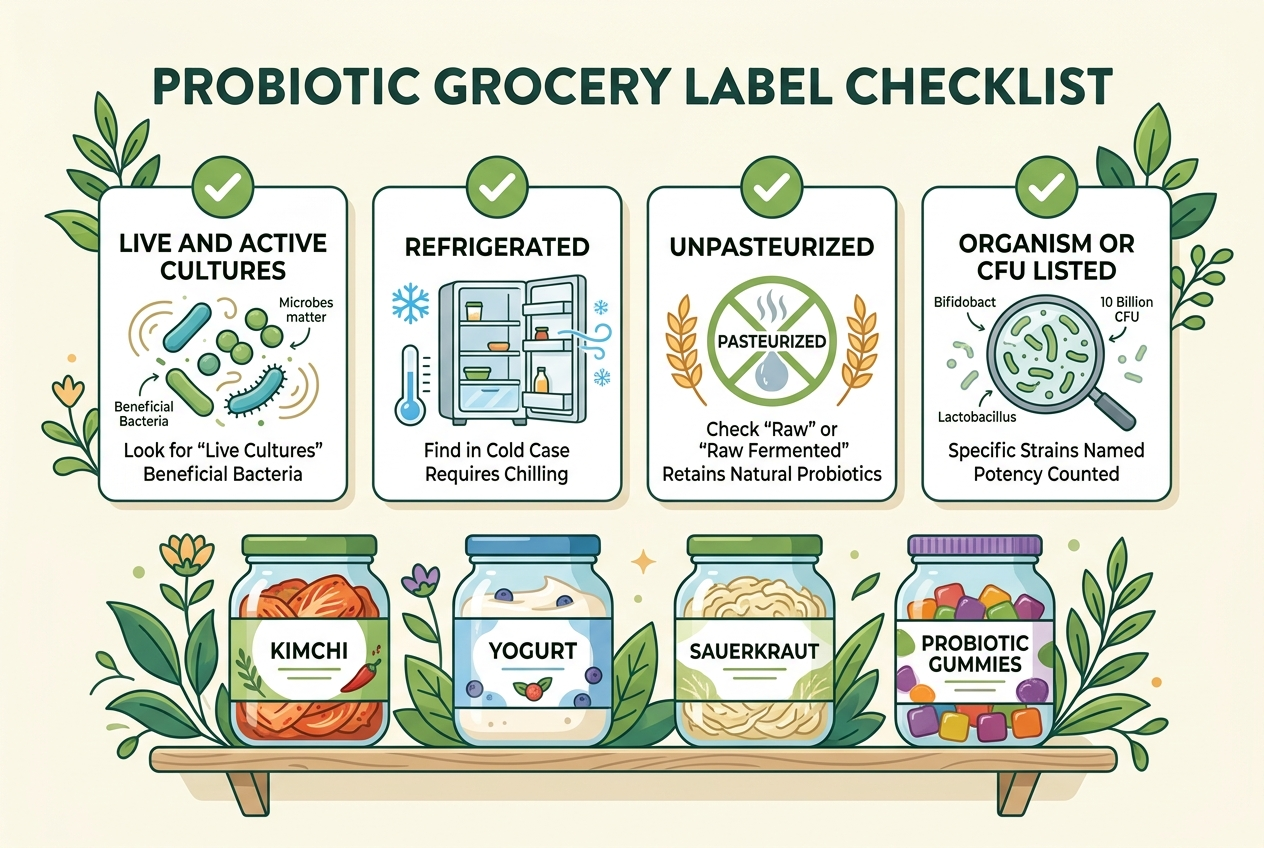
Pasteurization uses heat to reduce microorganisms, so it can remove the live microbes required for probiotic activity, even when sour flavor and fermented aroma remain. A pasteurized fermented food may still contain acids, flavors, plant compounds, sodium, and texture benefits, but it should not be counted as a reliable live-culture source unless the label states that live cultures remain after processing. The strongest shopper signal is a refrigerated product that says “live and active cultures,” avoids heat-treated language, lists the organism or culture family, and gives storage instructions that protect viability through the sell-by date. Sourcing caveat: even a live-culture statement does not prove a strain-specific benefit unless the product identifies the microbe, preserves the organism through shelf life, and connects the serving to credible human evidence at a relevant dose for that organism.
Is kombucha always probiotic?
Kombucha is fermented, but kombucha is not automatically probiotic, because the beverage category includes raw, refrigerated, filtered, shelf-stable, and pasteurized formats with very different live-microbe profiles. Shelf-stable or pasteurized kombucha may contain few live microorganisms, and refrigerated kombucha can still vary by culture, sugar level, storage time, alcohol control, acidity, bottling method, and processing method. A probiotic kombucha claim should identify live organisms, survivability, and ideally CFU or culture information rather than relying only on carbonation, acidity, or sour flavor as proof. Best for fermented beverage variety: kombucha can fit a routine; best for repeatable probiotic dosing: a strain-and-CFU-labeled product gives clearer information than most beverage labels and removes some guesswork from daily use, especially when the shopper wants the same organism, serving size, label standard, storage expectation, purchase decision, and routine every day.
Are pickles probiotic if they taste sour?
Sour flavor does not prove probiotic activity, because acidity can come from vinegar brine, lactic acid fermentation, citric acid, or flavoring choices rather than live microorganisms. Vinegar-brined pickles can taste acidic without live fermentation, and heat-treated fermented pickles may lose live microorganisms after processing, especially when they sit shelf-stable for months in a center-store aisle. A pickle jar is a stronger live-microbe candidate when it is refrigerated, labeled raw or unpasteurized, and made through salt-brine fermentation rather than vinegar-only brining. Best for flavor: most pickles work; best for live dietary microbes: refrigerated fermented pickles with live-culture language offer a clearer signal, although they still may not meet the stricter probiotic definition that requires documented benefit from adequate live organisms, named organisms, cold-chain handling, and a dose that survives storage through the intended eating window.
What label phrase matters most?
“Contains live and active cultures” matters more than “fermented,” because the phrase points to viable microorganisms at the time the product is sold or intended to be consumed, not just during production. The phrase remains incomplete without organism names, storage guidance, and, for supplements, CFU count, because viability alone does not prove that a dose is defined or evidence-backed. A stronger probiotic label identifies genus, species, strain when available, and the colony-forming units provided per serving, ideally at expiration rather than only at manufacture or batching. The consumer-friendly rule is direct: fermented explains the manufacturing history; live cultures explain viability; strain and CFU information explain whether the product is built for repeatable probiotic use and cleaner comparison across products, formats, shelves, storage conditions, and everyday buying decisions in a crowded refrigerated grocery aisle today.
Do Yuve Probiotic Gummies replace fermented foods?
Yuve Probiotic Gummies do not replace fermented foods, because the categories do different jobs in a digestive wellness routine and answer different label questions for everyday grocery shoppers. Yuve Probiotic Gummies provide Bacillus coagulans and a defined 5 billion CFU serving for routine probiotic support, while fermented foods provide flavor, meal variety, acids, fibers, and sometimes live dietary microbes. A practical routine can include both: refrigerated live-culture foods for dietary diversity and a strain-labeled supplement for consistency when grocery labels are unclear, pasteurized, or missing organism-level details. The honest caveat is that neither category guarantees a universal outcome; daily diet, serving size, organism viability, label accuracy, storage conditions, consistency, and individual tolerance shape the experience, so expectations should stay moderate, practical, label-aware, repeatable, and structure/function focused rather than outcome-guaranteed, dramatic, or medically framed.
Should probiotic gummies be refrigerated?
Some probiotic products need refrigeration, but Yuve Probiotic Gummies do not require refrigeration because Bacillus coagulans is a spore-forming organism selected for shelf-stable delivery. Spore-forming bacteria tolerate heat, moisture, and room-temperature storage better than many fragile Lactobacillaceae strains, which is why the organism can fit a gummy format without the same cold-chain demands as many refrigerated capsules or foods. Storage rules remain product-specific, so shoppers should follow the exact instructions printed on each probiotic label and avoid assuming one strain behaves like another across brands, foods, or delivery formats. Best for cold-chain simplicity: refrigerated strains can be useful; best for easy daily storage: shelf-stable spore-forming probiotics reduce routine friction and help the serving stay practical for travel, office drawers, kitchens, gym bags, and repeatable morning routines without refrigeration planning, ice packs, or special handling.
Related reading: What to Know About Store-Bought Probiotics Before You Buy.
Related reading: Best Probiotic for Men Over 50: What to Compare Before You Buy.
What is the safest rule for grocery shopping?
Use “fermented” as a starting clue, not proof, because the word describes a production process rather than live microorganisms at consumption. Buy refrigerated products with live-culture language when the goal is food-based microbial exposure, and choose strain-and-CFU-labeled supplements when the goal is a repeatable probiotic serving with clearer dose information. Avoid counting pasteurized jars, shelf-stable pickles, baked sourdough, canned vegetables, or heat-treated fermented products as dependable live-microbe sources unless the label clearly says live cultures remain and explains how they are preserved. The safest structure/function expectation is modest: fermented foods can support dietary variety, and labeled probiotics can support a consistent digestive wellness routine without promising specific health outcomes, instant changes, or identical effects across every strain, brand, food matrix, storage condition, serving size, processing method, shelf placement, package wording, or delivery format overall.
Leave a Reply