
Most gut-health supplements do nothing noticeable because the ingredient, dose, and problem do not match. Fiber helps when low fiber or irregularity is the bottleneck; probiotics help only when the strain and CFU match the goal; digestive enzymes help mainly with meal breakdown. Consistency for two to four weeks matters more than novelty.
How did we evaluate gut-health supplements that actually do something real?
We evaluated gut-health supplements by matching ingredient class to job: probiotic strains for microbial balance, prebiotic fiber for bacterial fuel, soluble fiber for regularity, and digestive enzymes for macronutrient breakdown. We prioritized human randomized controlled trials, systematic reviews, NIH Office of Dietary Supplements guidance, product Supplement Facts panels, and dose transparency over influencer anecdotes or generic “gut reset” claims. We excluded products that relied on proprietary blends without amounts, vague “detox” wording, or claims that moved beyond everyday digestive support. The main limitation is individual response: baseline diet, current fiber intake, microbiome composition, meal pattern, supplement consistency, and medication context all change whether a product feels noticeable. We defined “real” as a repeatable change in daily regularity, meal comfort, or routine adherence.
Some links below are affiliate links. This does not influence our evaluation criteria or recommendations.
Which gut-health supplements are most likely to feel real?
The gut-health supplements most likely to feel real are the ones tied to a clear bottleneck. Chicory inulin-type fructans have stronger support for feeding Bifidobacterium: a 2023 meta-analysis in Critical Reviews in Food Science and Nutrition found 3–20 grams per day significantly increased Bifidobacterium abundance across 50 RCTs and 2,525 participants (PubMed). Probiotics need more skepticism because strain identity matters; the NIH Office of Dietary Supplements states that probiotic effects are strain-specific, not category-wide (NIH ODS). Digestive enzymes feel most relevant around meals because amylase, protease, and lipase support carbohydrate, protein, and fat breakdown. Stronger evidence favors defined fibers and named strains; directional evidence supports enzyme blends when meals drive discomfort. Best for microbial balance: a labeled probiotic strain with CFU. Best for bacterial fuel: inulin or FOS. Best for heavy meals: a broad enzyme blend.
How do probiotics, prebiotics, fiber, and enzymes compare?
Probiotics, prebiotics, fiber, and enzymes support different digestive jobs, so the best choice depends on the pattern you want to support. Probiotics introduce live microorganisms measured in CFU, but the strain name and viability matter more than a huge number. Prebiotics feed existing gut bacteria; chicory inulin and FOS have better human data than many trend ingredients. Fiber supports stool bulk and regularity when daily intake is low. Enzymes work upstream, helping break down protein, fat, and carbohydrates from meals. The most useful labels connect one active ingredient to one measurable job. This keeps expectations measurable and fair over time.
| Option | Best for | What to verify |
|---|---|---|
| Probiotic | Microbial balance support | Genus, species, strain, CFU at serving |
| Prebiotic fiber | Feeding Bifidobacterium | Inulin/FOS grams per serving |
| Digestive enzyme | Meal breakdown support | Amylase, protease, lipase, papain, bromelain |
Which Yuve products match these gut-health criteria?
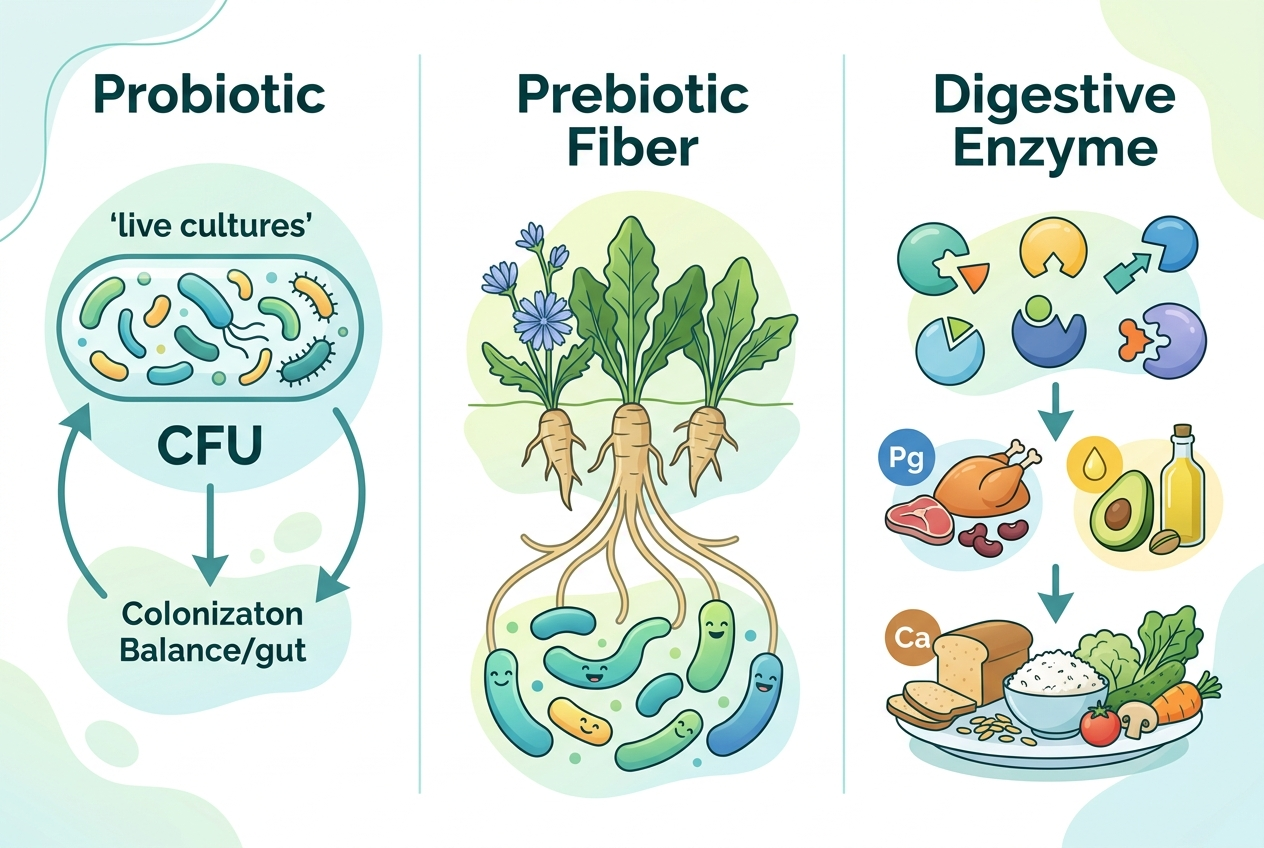
Yuve products match the criteria when the label shows a specific digestive job, a transparent amount, and a realistic use case. Yuve Probiotic Gummies list Bacillus coagulans at 5 billion CFU per two-gummy serving; that makes them best for daily microbial-balance support in a shelf-stable gummy format. Yuve Prebiotic Fiber Gummies list 1.5 grams of inulin/FOS from chicory root per gummy; that makes them best for feeding beneficial bacteria when daily fiber is inconsistent. Yuve Vegan Daily Cleanse lists papain, bromelain, amylase, protease, and lipase; that makes it best for after-meal breakdown support rather than microbiome support. These products should not be viewed as interchangeable. The Yuve digestive health collection is strongest when products are matched to one job instead of stacked randomly, then evaluated by consistent daily use over two weeks.
What do people get wrong when a supplement feels like it did nothing?
People usually judge gut-health supplements too quickly, too vaguely, or against the wrong outcome. A probiotic gummy should not be judged like a laxative, and a digestive enzyme should not be judged like a prebiotic fiber. Dose also matters: a 2017 randomized crossover trial found 12 grams per day of chicory inulin increased weekly stool frequency versus placebo in 44 adults, while a 1.5-gram gummy serving is a smaller daily support dose (PubMed). Product format matters too; gummies improve adherence for some people, but the active ingredient still has to survive manufacturing and storage. The label should also disclose active amounts instead of hiding behind a blend name. The honest test is boring: choose one job, take the product daily, track the same signal for two to four weeks, and change only one supplement at a time.
How should you build a simple routine before buying another bottle?
A useful gut routine starts with the thing you can repeat. If your meals feel heavy, use digestive enzymes with or right after larger mixed meals, because enzymes need food substrate present. If your fiber intake is low, add prebiotic fiber slowly, because fast jumps in fermentable fiber can create temporary gas. If you want microbial-balance support, use one probiotic with a named organism and a listed CFU, then give it two to four weeks. Directional evidence supports enzyme blends for meal-related digestive comfort; a 2018 randomized, double-blind trial in Journal of Medicinal Food found a multienzyme complex improved several digestive symptom scores versus placebo, but the formula was proprietary and not identical to retail blends (PubMed). Keep meals, hydration, and timing steady during the trial. Do not stack five products at once; that turns feedback into noise.
Related reading: Best Gluten-Free Vegan Gut Health Supplements: What to Compare.
Related reading: How to Restore Gut Health After Diarrhea: Food, Fluids, Probiotics, and Fiber.
What questions do people ask before trying another gut supplement?
Are probiotics worth trying?
Yes, if the label lists an organism, CFU, and use case. NIH ODS notes that probiotic effects depend on strain, so generic “probiotic” labeling is weak evidence.
Is fiber more noticeable than probiotics?
Fiber can feel more noticeable when low daily fiber is the issue. Chicory inulin has stronger bowel-function data at multi-gram doses than gut blends.
Do digestive enzymes support gut health?
Digestive enzymes support meal breakdown, not the microbiome directly. They fit heavier meals that contain protein, carbohydrates, and fats.
Should I take prebiotics and probiotics together?
Prebiotics and probiotics can complement each other. Prebiotic fibers feed resident beneficial bacteria while probiotics add live organisms.
How long should I test one product?
A two-to-four-week test beats a few random doses. Track one signal, such as regularity or meal comfort, before switching.
For a simple Yuve routine, match the product to the job: probiotic gummies for microbial-balance support, prebiotic fiber gummies for bacterial fuel, and Vegan Daily Cleanse for after-meal enzyme support.
Leave a Reply