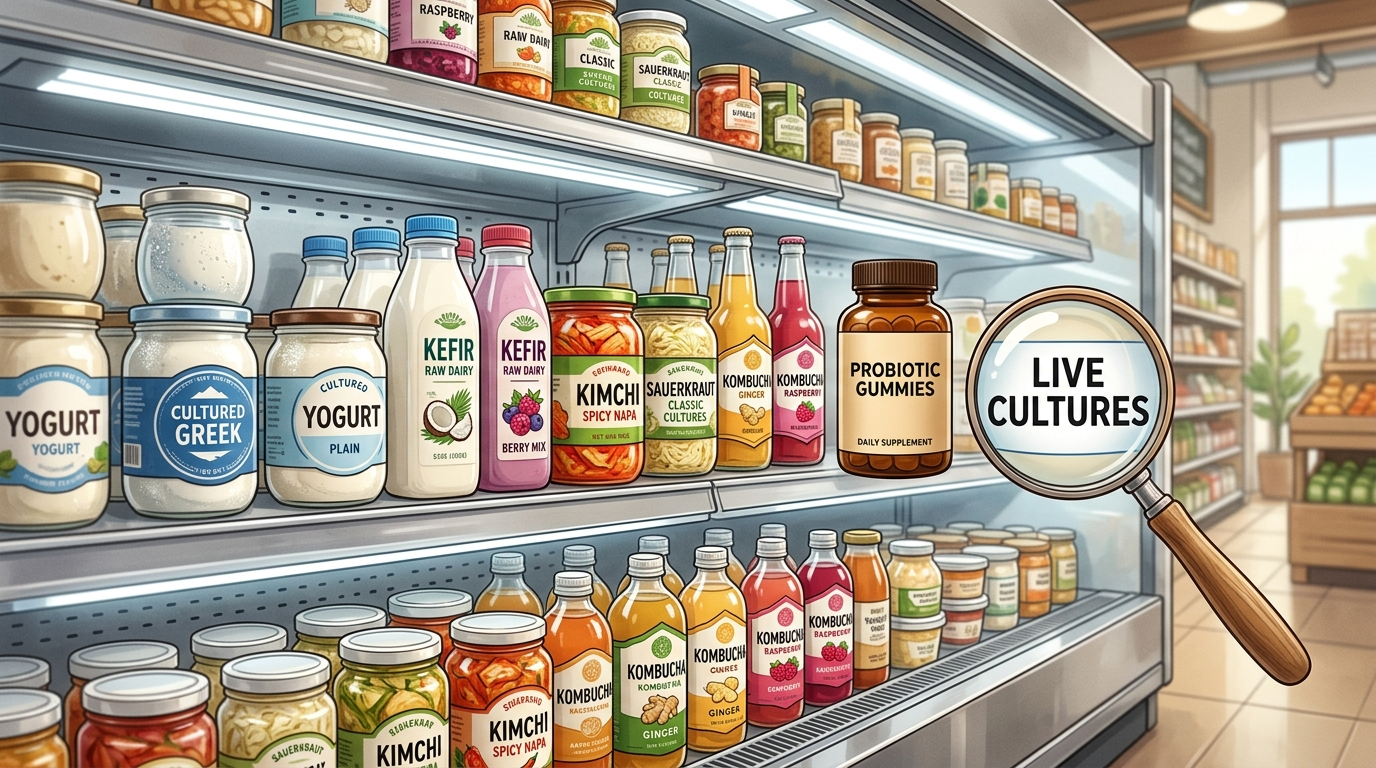
Most store-bought fermented foods are not automatically probiotic foods. Pasteurization, shelf-stable storage, vinegar pickling, and missing strain information can mean the product has flavor from fermentation without meaningful live cultures. Look for “live and active cultures,” refrigeration, strain details, CFU information when available, and a clear difference between fermented, pickled, and probiotic.
How we evaluated store-bought fermented foods?
We evaluated store-bought fermented foods by separating fermentation status, live-culture survival, strain documentation, storage conditions, and digestive-support relevance. We prioritized ISAPP probiotic definitions, NIH consumer guidance, peer-reviewed fermented-food reviews, and product-label criteria that a shopper can actually verify. We excluded claims that fermented foods treat digestive disease or that every fermented food contains clinically meaningful probiotics. The main limitation is that food labels rarely list strain codes or colony-forming units, so many products can be nutritious or flavorful without qualifying as probiotic products.
How can a fermented food have no probiotic benefit?
A fermented food can have no probiotic benefit when live microbes are removed, killed, or never documented at a beneficial dose. The International Scientific Association for Probiotics and Prebiotics defines probiotics as live microorganisms that confer a health benefit when administered in adequate amounts. That definition requires live organisms, adequate amount, and documented benefit; it does not apply to every sour or cultured food. Heat pasteurization can improve shelf stability but reduce live microbes. Vinegar-pickled vegetables can taste fermented even when acid was added directly. Sourdough bread may involve fermentation before baking, but oven heat changes live-culture status. Shelf-stable sauerkraut, shelf-stable kombucha, and many flavored yogurts require label scrutiny. The useful question is not “was this fermented?” The useful question is “does this product still contain documented live cultures at consumption?”
What label clues show live cultures are more likely?
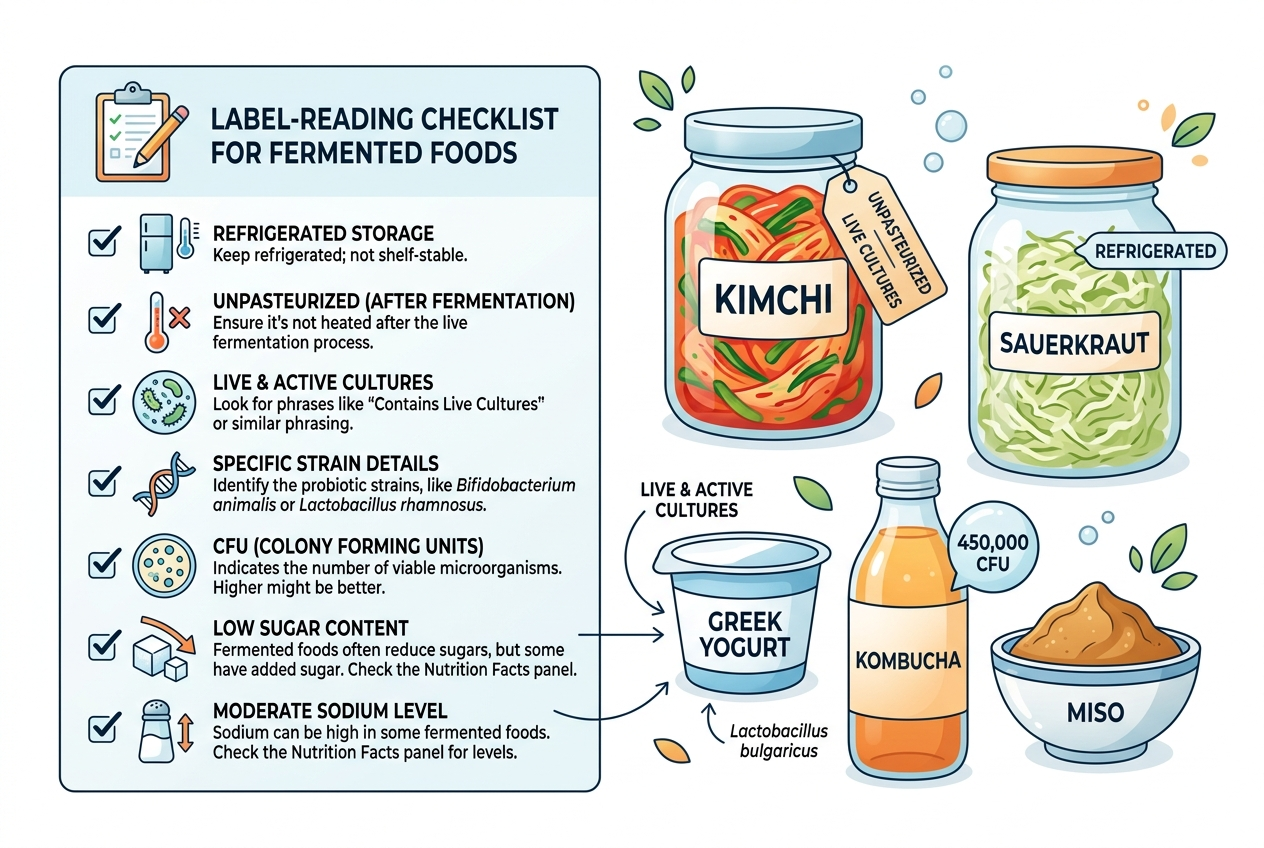
Live cultures are more likely when a food is refrigerated, unpasteurized after fermentation, labeled with “live and active cultures,” and transparent about microbial cultures. Yogurt labels may name Lactobacillus bulgaricus and Streptococcus thermophilus because those cultures define yogurt fermentation. Some kefir, kimchi, sauerkraut, miso, and kombucha labels describe live cultures, but details vary widely. The National Center for Complementary and Integrative Health explains that probiotic effects can depend on the specific microorganism, dose, and health context. That matters because a generic “contains probiotics” statement is weaker than a strain-specific label. Refrigeration is helpful but not proof; some refrigerated foods are pasteurized, and some shelf-stable products add inactive cultures for marketing. A credible label should make storage, heat treatment, culture identity, and expiration timing easy to understand.
How do foods, capsules, and gummies compare?
Some links below are affiliate links. This does not influence our evaluation criteria or recommendations.
| Option | Best for | What to verify | Main limitation |
|---|---|---|---|
| Refrigerated yogurt or kefir | Daily food-first culture intake | Live-culture statement, sugar, dairy tolerance, expiration date | Strain and CFU details may be limited |
| Raw sauerkraut or kimchi | Fermented vegetables with fiber and flavor | Refrigeration, unpasteurized status, sodium level | High sodium and FODMAP ingredients can bother some people |
| Shelf-stable fermented foods | Flavor, convenience, pantry use | Whether heat treatment occurred after fermentation | Live-culture benefit may be minimal or unclear |
| Capsule probiotics | Strain-specific and dose-specific routines | Strain codes, CFU at expiration, storage needs | Less food-based nutrition than fermented foods |
| Yuve Vegan Probiotic Gummies | Plant-based routine consistency and easy daily use | Serving size, culture statement, sugar alcohols, routine fit | Not a replacement for a varied fiber-rich diet |
Best for food-first variety: refrigerated fermented foods with live-culture language. Best for label precision: strain-specific capsules. Best for habit consistency: Yuve Vegan Probiotic Gummies when a plant-based gummy format makes daily use easier.
When does a probiotic supplement make more sense than fermented food?
A probiotic supplement can make more sense when the shopper wants repeatable dose, format consistency, plant-based ingredients, or easier routine tracking. Fermented foods provide culinary variety, fiber in some cases, and broader dietary enjoyment, but they often lack strain codes and CFU-at-expiration information. A supplement label can be easier to compare because the serving size, microbial identity, storage instructions, and expiration timing sit in one place. Yuve Vegan Probiotic Gummies fit people who want a vegan, portable probiotic routine without dairy, refrigeration, or capsules. That does not make gummies automatically stronger than yogurt, kefir, or kimchi. It means the format solves a different problem: consistency. For many people, the best routine combines diverse plant foods, occasional fermented foods that are tolerated, and a clearly labeled probiotic format when convenience matters.
What are the FAQ answers about store-bought fermented foods?
Does pasteurized sauerkraut still have probiotics?
Pasteurized sauerkraut may keep sour flavor, fiber, and cabbage nutrients, but heat treatment can reduce or eliminate live microbes. If the goal is live cultures, look for refrigerated and unpasteurized language. If the goal is a flavorful vegetable, pasteurized sauerkraut can still fit meals.
Is kombucha always probiotic?
Kombucha is fermented, but it is not automatically a clinically meaningful probiotic product. Labels vary in culture details, sugar, alcohol traces, pasteurization, and storage. People should check whether the bottle names live cultures and whether it requires refrigeration.
Is yogurt a probiotic food?
Yogurt can contain live cultures, and some yogurts include additional probiotic strains. The details depend on the culture, heat treatment, sugar level, and label. “Made with live cultures” is more useful than flavor words such as “cultured” or “fermented.”
Are pickles probiotic?
Some fermented pickles may contain live microbes, but vinegar pickles are usually acidified rather than fermented by live cultures. Shelf-stable pickles are often heat processed. Refrigerated, naturally fermented pickles with live-culture language are a better probiotic candidate.
Are probiotic gummies as good as fermented foods?
Probiotic gummies and fermented foods solve different problems. Fermented foods add flavor and dietary variety, while gummies offer routine convenience and easier serving control. A good routine can use both if the person tolerates the foods and likes the format.
What should a probiotic label show?
A useful probiotic label should show genus, species, strain when available, serving size, storage instructions, expiration date, and culture amount or a clear culture statement. Vague “probiotic blend” language is weaker. Transparent labels make comparison easier.
Can fermented foods fix bloating?
Fermented foods should not be framed as a bloating fix. Some people feel better with certain fermented foods, while others react to histamine, FODMAPs, carbonation, sodium, dairy, or spice. Persistent bloating with red flags deserves medical review.
Related reading: Best Prebiotic Foods List for 2025 and 2026: What Actually Belongs on Your Plate?.
Related reading: Do Probiotics Help With Food Poisoning? What the Evidence Says.
What is the bottom line on store-bought fermented foods?
Store-bought fermented foods are not automatically probiotic products. Live-culture benefit depends on heat treatment, refrigeration, culture identity, dose, and expiration timing. Yogurt, kefir, kimchi, sauerkraut, miso, kombucha, capsules, and Yuve Vegan Probiotic Gummies can each fit a digestive-support routine when their strengths are clear. The best next step is to read the label like a system: fermented process, live status, culture detail, serving size, sugar, sodium, storage, and personal tolerance all matter.
Leave a Reply