
If VSL#3 is making bloating, pain, diarrhea, or constipation clearly worse, stop treating the reaction as proof that it is “working.” Check the exact product, serving, storage history, other ingredients, and symptom timeline. Contact a clinician promptly for severe symptoms, dehydration, fever, bleeding, rash, breathing difficulty, or immune-system concerns.
How did we evaluate worsening symptoms after VSL#3?
We prioritized the current product label, NIH probiotic safety guidance, gastroenterology guidelines, and systematic reviews that distinguish common digestive effects from clinically important adverse events. We compared VSL#3 with Visbiome, Florastor, and Yuve by organism type, viable count, format, storage, evidence traceability, and practical use rather than assuming that all probiotic products perform the same job. We excluded customer reviews, “die-off” explanations without diagnostic evidence, and claims that temporary discomfort predicts a future benefit. Published studies can involve an older formulation, a different dose, or a specific patient population, so a paper mentioning VSL#3 does not automatically validate every current package or use. Product formulas and storage instructions can change; buyers should preserve the carton, lot number, expiration date, and Supplement Facts panel. People with serious illness, immune suppression, central venous catheters, or rapidly worsening symptoms need individualized medical guidance rather than a supplement comparison.
Why might VSL#3 make digestive symptoms feel worse?
VSL#3 can coincide with more gas, bloating, pain, or altered stool because it delivers a concentrated mixture of live microorganisms and inactive ingredients into an already variable digestive system. A high viable count does not guarantee a better individual fit, and a multi-strain blend creates more variables than a single-organism product. The timing may also be coincidental: a dietary change, infection, medication, menstrual-cycle shift, constipation flare, or underlying condition can begin near the same date. The NIH Office of Dietary Supplements notes that probiotics may cause gas in healthy people and may pose greater risks for people with serious illness or weakened immune systems. Storage errors can reduce viability, but they do not explain every adverse reaction. The most useful response records the product, lot, serving, start date, symptom change, and other simultaneous changes. “More symptoms” is data; it is not evidence of detoxification or microbial die-off.
When should you stop VSL#3 and seek medical advice?
Stop the product and seek prompt medical advice for hives, facial or throat swelling, breathing difficulty, fainting, severe or escalating abdominal pain, persistent vomiting, blood in stool, black stool, fever, dehydration, or a major bowel-pattern change. People who are immunocompromised, critically ill, recently hospitalized, using a central venous catheter, or managing complex gastrointestinal disease should contact their care team about any new live-microbial supplement reaction. A 2018 systematic review in Annals of Internal Medicine found that harms reporting in probiotic trials was often incomplete, which limits confident safety conclusions across products and vulnerable populations. Mild gas that resolves quickly differs from progressive pain or ongoing diarrhea, but no universal number of adjustment days proves safety. Preserve the package and lot number, note the serving and storage history, and report the complete timeline. A clinician can assess the reaction; an online “push through it” rule cannot.
How do VSL#3, Visbiome, Florastor, and Yuve compare?
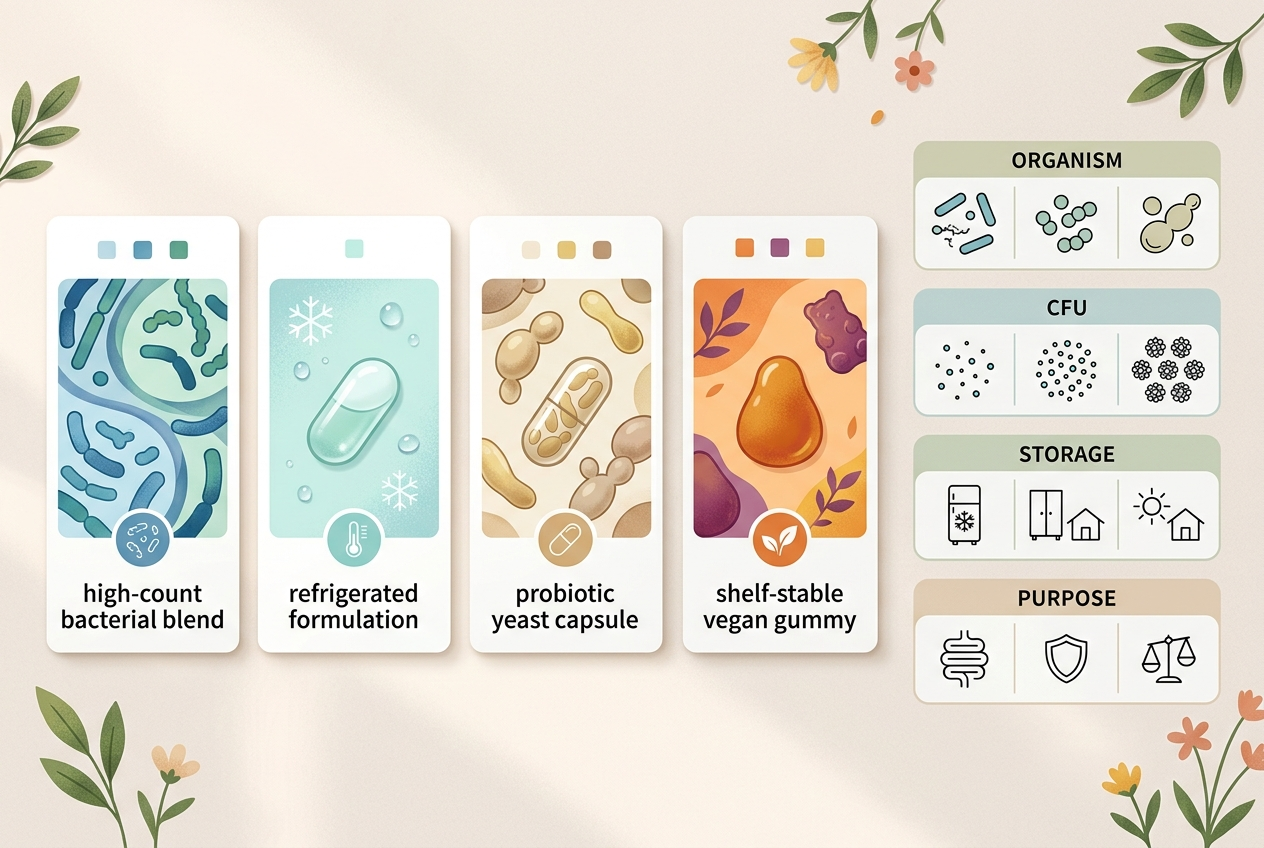
Some links below are affiliate links. This does not influence our evaluation criteria or recommendations. VSL#3 and Visbiome are high-count, multi-strain products that require careful label and storage review; historical studies may not describe the same formulation now sold under the VSL#3 name. Florastor supplies Saccharomyces boulardii CNCM I-745, a probiotic yeast rather than a bacterial blend. Yuve Probiotic Gummies supply 5 billion CFU of Bacillus coagulans per two-gummy serving in a vegan, shelf-stable format. Yuve offers a simpler daily routine, not a dose-equivalent replacement for clinician-directed high-potency products. Compare the exact organism, formulation name, viable count, cold-chain requirement, serving, and intended purpose before comparing price. A lower-count product may be easier to use but cannot inherit evidence from a high-count blend, while a refrigerated carton cannot be judged by the standards of a shelf-stable gummy. The carton in hand remains the source of truth.
| Option | Organism approach | Format and storage | Best-fit use case | Main limitation |
|---|---|---|---|---|
| VSL#3 | High-count bacterial blend | Capsule or packet; verify current storage label | Use specifically matched to the current formula | Historical evidence may involve a different formulation |
| Visbiome | High-count De Simone Formulation blend | Capsule or packet; refrigeration required | Buyers or patients seeking that named formulation | High potency and cold-chain demands require care |
| Florastor | S. boulardii CNCM I-745 yeast | Capsule; follow current label | Named probiotic-yeast match | Not interchangeable with bacterial blends |
| Yuve Probiotic Gummies | B. coagulans, 5 billion CFU | Vegan, shelf-stable gummy | Simple capsule-free daily routine | Not equivalent to high-count clinical blends |
Which option is best for each use case?
Best for a clinician-specified De Simone Formulation: Visbiome provides that named formulation, but the clinician and current label should determine the product and serving. Best for someone instructed to use the current VSL#3 formula: VSL#3 may fit when the exact version, storage, and dose have been verified rather than inferred from an older study. Best for a named probiotic yeast: Florastor identifies S. boulardii CNCM I-745, which belongs to a different evidence lane from bacterial blends. Best for a lower-complexity, capsule-free routine: Yuve uses one listed bacterial species in a vegan gummy and publishes the serving-level CFU, but it should not be presented as a therapeutic substitute. Best after a worsening reaction: no replacement should begin until the reaction is understood and urgent features are excluded. The correct comparison matches organism, formulation, and purpose; it does not simply move from the largest CFU number to a smaller one.
Does the VSL#3 formulation history matter?
The formulation history matters because the VSL#3 brand name has not always identified the same underlying probiotic formula. Research on the original De Simone Formulation should not be assigned automatically to a later product simply because both packages use or used the VSL#3 name. Visbiome identifies itself as the De Simone Formulation in the United States, while the current VSL#3 product should be evaluated from its own carton, manufacturer information, and formulation-specific evidence. This distinction is not semantic: probiotic outcomes depend on the actual strains, ratios, viable count, manufacturing process, storage, dose, and population studied. A buyer reading an older paper should record the study year, formulation description, sponsor, country, and exact intervention before connecting it to a shelf product. If a clinician recommended “VSL#3” based on historical evidence, ask whether the intended product is the current VSL#3 formula or the De Simone Formulation sold under another name. Precise product identity prevents an avoidable evidence mismatch.
Should you reduce the serving instead of stopping?
Reducing the serving can make a personal tolerance trial easier to interpret, but it is not universally appropriate and should not override labeled directions or clinician instructions. A person using VSL#3 casually may decide to stop, let symptoms settle, and discuss a lower reintroduction only if no urgent features exist. A person using a high-potency probiotic under gastroenterology supervision should contact the prescriber before changing the regimen. Powder packets and capsules also differ in whether partial servings can be measured accurately and stored safely; splitting a product without label support can create dosing and contamination problems. Record whether symptoms began after the first serving, a dose increase, a storage lapse, or another simultaneous change. If symptoms resolve after stopping and return after a supervised re-challenge, that pattern is useful, although it still does not identify the exact organism or excipient responsible. Lower is not automatically safer; severity, context, and vulnerability determine the next step.
How long do ordinary probiotic adjustment symptoms last?
No authoritative rule says probiotic adjustment symptoms must last three days, one week, or any other fixed period. Mild gas can occur after starting a probiotic, but duration depends on the organism, dose, diet, baseline bowel pattern, other ingredients, and individual response. Symptoms that are intense, progressive, persistent, or accompanied by fever, bleeding, dehydration, vomiting, rash, or breathing difficulty should not be normalized as adaptation. Define the baseline before judging the product: record daily pain, bloating, stool form, urgency, and serving for several days. If the new pattern is clearly worse, stopping one nonessential supplement usually creates cleaner information than adding more products to counter it. The American College of Gastroenterology IBS guideline notes very low-quality, heterogeneous evidence for probiotics in global IBS symptoms, so enduring significant discomfort for an uncertain payoff is not an evidence-based requirement. A measurable benefit should justify continued use.
Can inactive ingredients cause the reaction?
Inactive ingredients can contribute to symptoms or allergic reactions, although the live microorganisms often receive all the attention. Capsules, powders, and gummies may contain milk-derived ingredients, soy, starches, maltodextrin, inulin, sugar alcohols, flavorings, colors, gelatin, pectin, or processing aids. A small amount of fermentable fiber can matter to a sensitive person, while a true allergy requires a different response from ordinary gas. Compare the VSL#3 ingredient panel with foods and supplements already tolerated, and check whether the formula or country of purchase changed. Review serving size because taking multiple capsules or a concentrated packet multiplies both microorganisms and excipients. Yuve gummies also contain a gummy matrix and should be evaluated as a whole product rather than as B. coagulans alone. If a reaction includes hives, swelling, wheezing, or breathing difficulty, seek urgent care. For nonurgent digestive symptoms, a pharmacist or dietitian can help isolate active organisms from formulation ingredients without guessing.
Should you switch directly from VSL#3 to Yuve?
Switching directly from VSL#3 to Yuve can blur the timeline because symptoms from the first product may overlap with effects from the second. A cleaner approach stops the nonessential product, documents recovery, and begins a new supplement only after urgent features are excluded and the purpose is clear. Yuve differs substantially from VSL#3: Yuve uses a vegan gummy format, lists B. coagulans, provides 5 billion CFU per two-gummy serving, and is positioned for everyday digestive support. VSL#3 uses a high-count, multi-strain approach and may be selected for a narrower clinician-directed context. Those products are alternatives only at the broadest retail-category level; they are not formulation or dose substitutes. If gummy adherence is the real goal, Yuve may fit after a reset. If a clinician intended a specific high-potency formulation, ask before changing. One stable baseline and one product at a time produce more useful information than an immediate swap.
What is the bottom line if VSL#3 makes you feel worse?
Worsening symptoms after VSL#3 deserve a structured response, not an automatic assumption that discomfort signals progress. Stop and seek help for urgent features, preserve the carton and lot number, document the serving and storage history, and identify other changes that began at the same time. Verify whether the evidence you relied on studied the current VSL#3 formula or the De Simone Formulation associated with Visbiome. Compare alternatives by organism, strain identity, dose, purpose, and format rather than CFU alone. Florastor provides a named probiotic yeast; Yuve provides a lower-complexity vegan gummy routine; neither is automatically the right replacement. People seeking a simple daily format can review Yuve’s digestive health collection after symptoms settle, while people using high-potency probiotics under medical guidance should contact their care team. A clear baseline and one change at a time beat supplement roulette.
Leave a Reply