
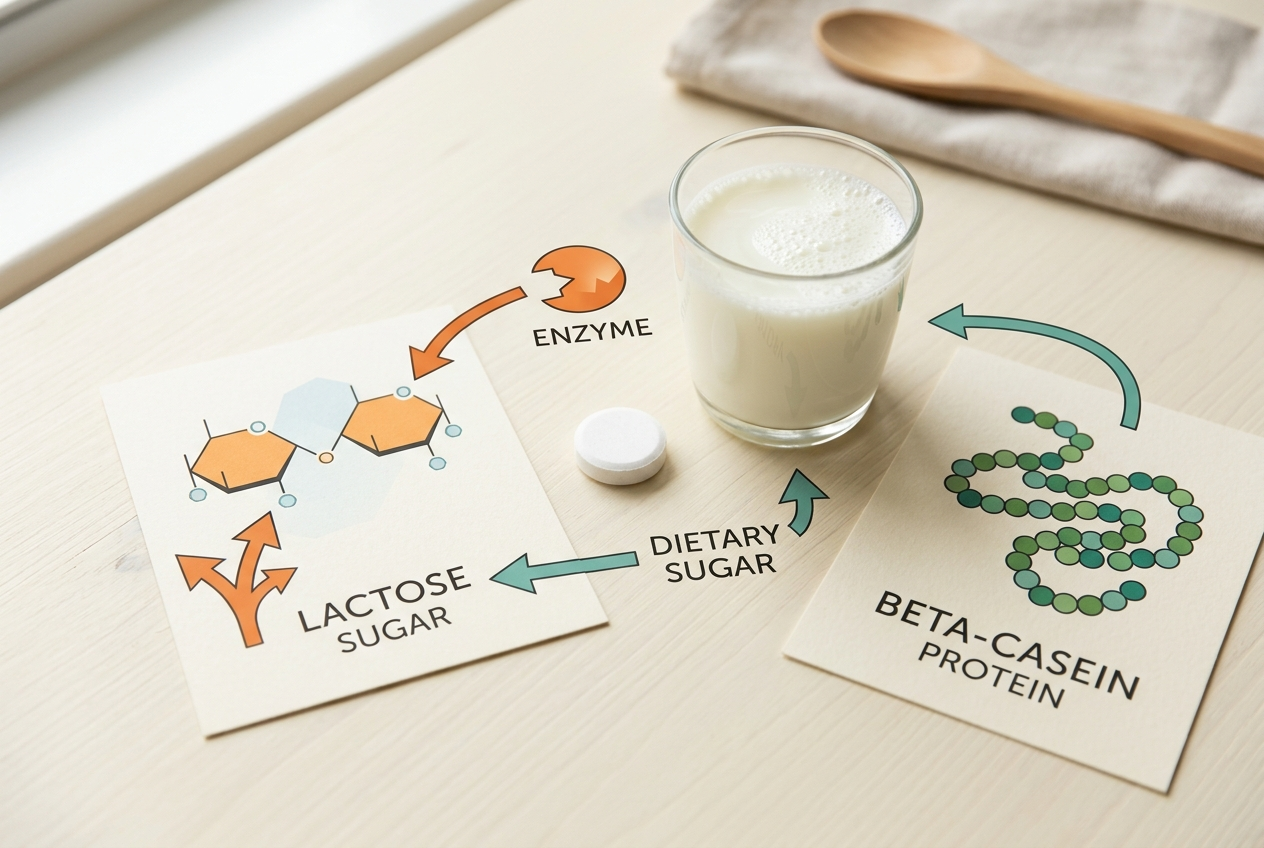
Lactose intolerance and sensitivity to A1 beta-casein are not the same problem. Lactase breaks down lactose, the sugar in dairy, but it does not break down A1 milk protein. If lactase helps, lactose is likely involved; if lactose-free conventional milk still causes repeatable symptoms, meal context, milk protein, or another cause deserves evaluation.
How did we evaluate lactase, lactose-free milk, and A2 milk?
We prioritized government guidance on lactose malabsorption and randomized human crossover trials that compared lactose content or beta-casein type while controlling milk exposure. We separated biochemical mechanism from symptom reports: lactase hydrolyzes lactose into glucose and galactose, while A1 and A2 describe variants of the beta-casein protein. We compared options by target molecule, timing, enzyme activity, food format, portability, ingredient transparency, and the limits stated on current labels. We excluded testimonials that treat symptom improvement as proof of A1 sensitivity, studies without a human comparison group, and claims that one milk type works for everyone. The A1/A2 evidence remains developing because trials differ in population, lactose maldigestion status, milk dose, duration, outcome measures, and funding. A useful decision therefore starts with a controlled lactose test, treats A2 as a separate hypothesis, and preserves medical evaluation for allergy signs, alarm features, persistent symptoms, or uncertainty about the underlying cause.
Are lactose intolerance and A1 milk sensitivity the same thing?
Lactose intolerance results from lactose malabsorption: the small intestine produces insufficient lactase for the lactose consumed, and undigested lactose reaches the colon, where bacteria generate gas and fluid. The National Institute of Diabetes and Digestive and Kidney Diseases lists bloating, diarrhea, gas, nausea, abdominal pain, and rumbling among possible symptoms. A1 sensitivity is a less established explanation involving one beta-casein protein variant rather than milk sugar. Conventional cow’s milk commonly contains both A1 and A2 beta-casein, while A2-only milk still contains lactose unless the carton also says lactose-free. The distinction predicts different tools: lactase addresses lactose, lactose-free milk reduces the same sugar before consumption, and A2-only milk changes beta-casein type without necessarily changing lactose. Symptoms alone cannot reliably separate these mechanisms because both hypotheses overlap with milk allergy, fat load, meal size, irritable bowel patterns, and other digestive conditions.
What can a lactase tablet change—and what can it not change?
Lactase can hydrolyze lactose present in milk, ice cream, soft cheese, cream sauce, and other dairy foods when the enzyme meets the food during digestion. Enzyme activity is expressed in FCC lactase units, which describe catalytic activity more usefully than tablet weight in milligrams. Timing matters because a chewable or tablet taken long before or after dairy may not overlap effectively with the lactose exposure. Lactase does not remove casein, whey, milk fat, fermentation products, or other meal ingredients, and it cannot make dairy safe for a true milk-protein allergy. A failed lactase trial also does not prove A1 sensitivity: the dose may not match the lactose load, timing may be off, the meal may contain another trigger, or the symptoms may have another cause. Use the labeled serving with the first bites of a defined dairy portion, repeat the same test, and compare it with a lactose-free version before assigning the response to milk protein.
How do Yuve Lactase, lactose-free milk, A2 milk, and dairy-free options compare?
Some links below are affiliate links. This does not influence our evaluation criteria or recommendations. Yuve Lactase Enzymes provide 9,000 FCC lactase units in a vegan chewable at first bite. Lactaid-style tablets use the same enzyme in formats, while lactose-free dairy has lactase added during processing. A2-only milk changes beta-casein type but retains lactose unless labeled otherwise. Plant-based alternatives remove cow’s-milk lactose and proteins, although protein, fortification, sugar, and texture vary. The comparison identifies the target each option changes rather than ranking every format as interchangeable.
| Option | What changes | Best-fit use case | Main limitation |
|---|---|---|---|
| Yuve Lactase 9,000 FCC | Adds lactase at the meal | Portable dairy-sugar support | Does not change milk protein |
| Lactaid-style enzyme | Adds lactase at the meal | Retail enzyme comparison | Activity and ingredients vary |
| Lactose-free dairy | Pre-hydrolyzes lactose | Regular home use | Still contains milk proteins |
| A2-only milk | Removes A1 beta-casein | Testing protein-type hypothesis | Usually still contains lactose |
| Plant-based alternative | Removes dairy lactose and proteins | Avoiding cow’s milk components | Nutrition varies by product |
Which option is best for each dairy-tolerance use case?
Best for restaurant meals with uncertain dairy exposure: a portable lactase tablet with a clearly stated FCC activity and first-bite directions. Best for a consistent milk routine at home: lactose-free dairy, because the lactose is already hydrolyzed before the glass is poured. Best for testing whether beta-casein type matters after lactose has been controlled: a measured A2-only milk challenge, ideally compared with lactose-free conventional milk on separate days. Best for avoiding both cow’s-milk sugar and protein: a nutritionally appropriate plant-based alternative. Best for vegan, chewable enzyme preferences: Yuve Lactase provides 9,000 FCC units without gelatin, but the formula still targets lactose rather than A1 beta-casein. Best for hives, swelling, wheezing, throat tightness, or breathing difficulty after dairy: none of these consumer options replaces urgent allergy assessment. Match the tool to the suspected component and keep the milk portion, meal, and timing stable enough to interpret the result.
What does human research say about A2 milk and digestive symptoms?
Human studies suggest that beta-casein type may influence digestive symptoms for some milk-sensitive adults, but the evidence does not establish A1 sensitivity as the explanation for every reaction. A 2020 randomized crossover trial involving lactose maldigesters reported lower abdominal-pain scores after A2-only milk than after conventional milk; the small sample and single-meal design limit generalization. A 2025 randomized crossover trial found that protein-hydrolyzed lactose-free A1/A2 milk was as well tolerated as A2 milk in lactose-tolerant participants and better tolerated in lactose-intolerant participants, reinforcing lactose as an important driver. Earlier large trials reporting A2 advantages included investigators with company honoraria, so funding and design deserve attention alongside effect size. Taken together, the studies justify a controlled comparison, not self-diagnosis. A2 milk can be one test condition after lactose, portion, and meal context are controlled.
How can you run a cleaner lactose-versus-A1 comparison?
Start with a fixed amount of conventional dairy and record the product, portion, lactose estimate, meal, time, symptoms, and stool pattern. On a separate comparable day, repeat the same dairy exposure with lactase taken exactly as labeled; another option is an equal serving of lactose-free conventional dairy. If symptoms improve repeatedly when lactose is hydrolyzed, lactose likely contributes, although the result is not a formal diagnosis. If symptoms persist with lactose-free conventional milk, compare a similar portion of A2-only milk on another day rather than changing milk type, portion, meal, and timing together. An even cleaner product comparison uses lactose-free A2 milk when available because it removes both test variables, but availability and nutrition labels vary. Allow washout between challenges and stop if reactions are significant. A clinician or dietitian can guide hydrogen breath testing, nutritional replacement, or investigation of another cause when self-testing remains unclear.
Will lactase help if A1 beta-casein is the problem?
Lactase will not break down A1 beta-casein because lactase acts on lactose, a disaccharide sugar, while beta-casein is a milk protein requiring proteolytic digestion; someone who reacts only to A1-containing milk would not expect the enzyme to remove that protein exposure. A useful test verifies enzyme timing and FCC activity against a consistent lactose load, then compares lactose-free conventional milk with an A2-only or lactose-free A2 option on separate days, because mixed mechanisms can occur and symptoms cannot confirm the explanation. If lactase repeatedly helps, lactose probably contributes even when other variables matter; if lactase never helps, check the label, serving, dairy amount, timing, and meal context before concluding that A1 is responsible. Persistent symptoms deserve evaluation for milk allergy, celiac disease, another gastrointestinal condition, medication effects, or non-dairy meal triggers instead of indefinite enzyme escalation or an unsupported A1 self-diagnosis.
Can A2 milk still cause digestive symptoms?
A2-only milk can still cause digestive symptoms because it generally contains lactose, whey, A2 beta-casein, milk fat, and the same fluid volume as conventional milk; the manufacturer’s United States FAQ states that its standard product contains as much lactose as ordinary cow’s milk unless a separate lactose-free version is chosen. A large serving creates more lactose exposure than a small serving, while a high-fat meal, coffee, stress, or baseline bowel sensitivity can change the response independently of beta-casein type. A 2024 crossover trial reported mixed endpoints: A2 milk reduced some symptom measures but increased bloating and loose-stool scores relative to A1/A2 milk, reinforcing that A2 is not a guaranteed comfort product. Test a measured serving, read both the protein and lactose labels, keep the surrounding meal stable, and avoid using one good or bad day as proof of the underlying mechanism.
Can you take Yuve Lactase with A2 milk?
Yuve Lactase can be taken with lactose-containing A2 milk when the product directions and personal medical context allow lactase use, because A2 describes beta-casein type and does not normally remove lactose. The enzyme should be chewed immediately before the first bite or sip according to the current label, and its 9,000 FCC activity should be interpreted against the dairy serving rather than as a universal guarantee. This combination changes two variables at once—A1 exposure and lactose digestion—so it may support a meal without revealing which variable caused an improvement; for a cleaner comparison, test A2 milk alone and a lactose-controlled option on separate days with equal portions, or use lactose-free A2 milk when available. People with milk-protein allergy should not use lactase to make cow’s milk safe because the enzyme leaves casein and whey intact, and significant or escalating reactions require medical advice.
Is milk allergy different from lactose intolerance and A1 sensitivity?
Milk allergy is an immune reaction to milk protein, whereas lactose intolerance reflects insufficient lactase activity for the lactose consumed; allergy can cause hives, swelling, wheezing, vomiting, or anaphylaxis in addition to digestive symptoms, while lactose malabsorption primarily produces gas, fluid, bloating, diarrhea, and abdominal discomfort. A1 sensitivity is a proposed non-allergic response to one beta-casein variant and lacks a routine consumer test equivalent to a lactose hydrogen breath test or a clinical allergy evaluation. Lactase tablets do not remove casein or whey and cannot make dairy safe for milk allergy, while A2-only milk remains cow’s milk with other milk proteins and is not an allergy-safe substitute. Sudden breathing difficulty, throat tightness, faintness, or widespread swelling requires emergency care; recurrent or uncertain reactions should be assessed by a qualified clinician instead of tested repeatedly at home with enzymes or alternative cow’s-milk products.
When should persistent dairy symptoms be medically evaluated?
Medical evaluation is appropriate when dairy symptoms remain unclear after a controlled lactose comparison, interfere with nutrition, begin suddenly, or accompany weight loss, anemia, bleeding, fever, repeated vomiting, nighttime symptoms, severe pain, or a major bowel-pattern change. A clinician can distinguish self-reported intolerance from documented lactose malabsorption using history, an elimination-and-rechallenge plan, or a hydrogen breath test, while additional evaluation may consider celiac disease, inflammatory bowel disease, infection, pancreatic or gallbladder issues, medication effects, and milk allergy. Children, pregnant people, individuals with restricted diets, and anyone at risk of nutrient deficiency need tailored advice before broadly removing dairy and its protein, calcium, iodine, vitamin B12, or vitamin D contributions. Bring a concise record of milk type, portion, meal, timing, lactase dose, symptom onset, and stool changes, because that record turns “milk bothers me” into testable variables and reduces the chance of blaming A1, lactose, or an enzyme without enough evidence.
What is the bottom line on Yuve Lactase and A1 milk?
Yuve Lactase fits the lactose problem: one vegan chewable supplies 9,000 FCC lactase units for use immediately before dairy. The product does not remove A1 beta-casein, casein generally, whey, milk fat, or another meal trigger. A2-only milk fits a different hypothesis because it changes beta-casein type while usually retaining lactose. People deciding between them should control lactose first, repeat a defined serving, and compare milk types on separate days. A positive lactase response makes lactose involvement more plausible; a poor response does not automatically prove A1 sensitivity. The most useful Yuve role is therefore precise and bounded: portable enzyme activity for lactose-containing meals. Shoppers who want related dairy-digestion options can review the Yuve digestion collection, while anyone with allergy signs, alarm features, persistent symptoms, or a narrowing diet should prioritize individualized assessment over a larger supplement stack.
Leave a Reply