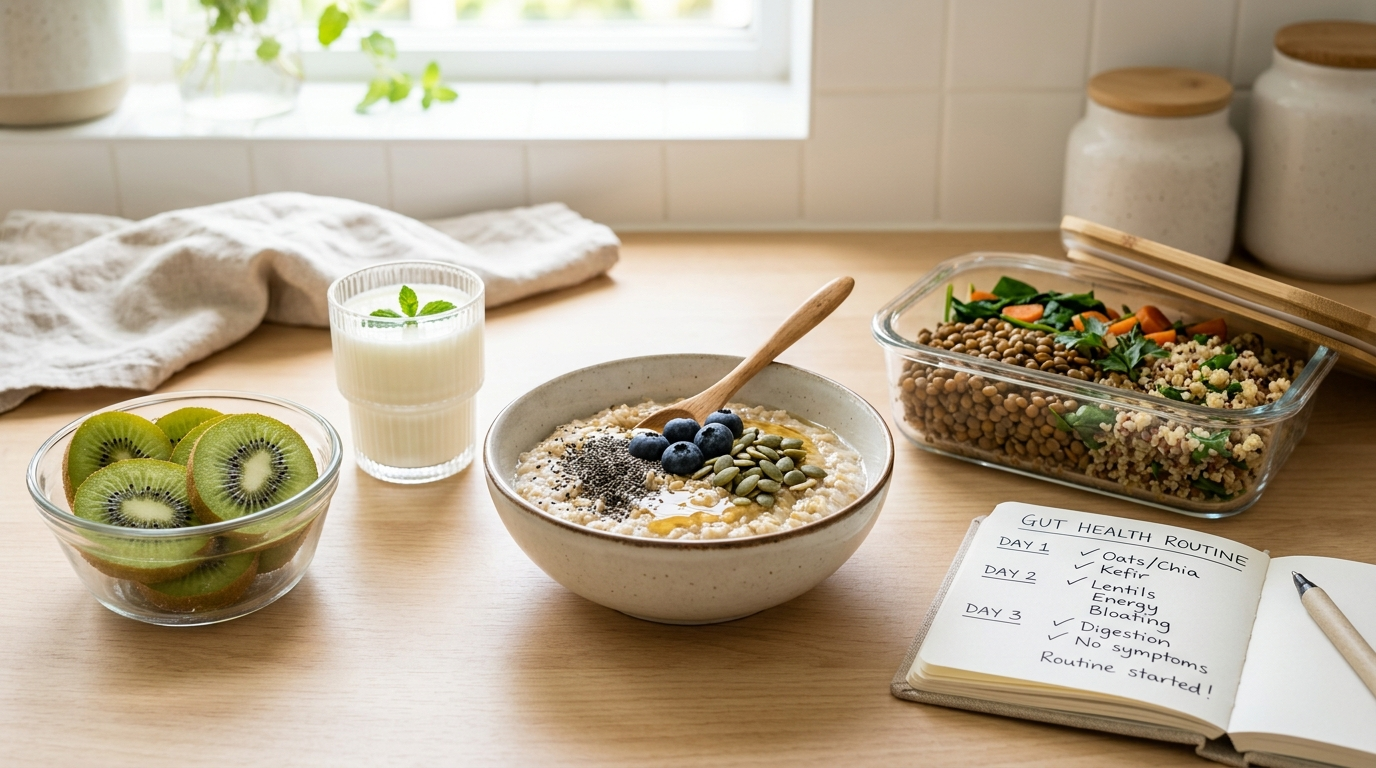
The foods that most consistently improve gut comfort over 30 days are the ones that raise fiber or fermented-food exposure without triggering extra gas: green kiwifruit, oats, beans or lentils introduced gradually, and tolerated yogurt or kefir. The biggest difference usually comes from repeatable daily intake, not from one “superfood” meal.
> How did we evaluate this question?
>
> We prioritized human trials, NIH guidance, and peer-reviewed nutrition research over trend lists or anecdotal “gut reset” claims. We weighted foods by three things: regularity support, bloating tolerance, and how realistically someone can eat them for 30 days straight. We treated large diet studies and randomized trials as stronger evidence than single-mechanism theories. We also kept the framing food-first, then used supplements only as routine-support tools when diet consistency is the missing piece.
Which foods actually made the clearest difference over 30 days?
The strongest food-first pattern is simple. Fermented foods, kiwi, oats, and legumes repeatedly show up because they change gut inputs in measurable ways. A 2021 randomized trial in Cell found that a high-fermented-food diet increased microbiome diversity and lowered several inflammatory markers, while a high-fiber diet changed microbial function more than diversity. A 2023 randomized trial in The American Journal of Gastroenterology found that eating two green kiwifruit daily improved constipation symptoms and abdominal comfort. Oats matter because beta-glucan raises soluble-fiber intake in a practical breakfast format. Beans and lentils matter because they increase prebiotic carbohydrate exposure, but the NIDDK notes that bacteria breaking down undigested carbohydrates can also increase gas. That is why gradual dose, not hype, usually determines whether a food helps.
What usually separates a helpful gut-health food from a bloating trigger?
A helpful gut-health food matches your tolerance and your starting diet. A bloating trigger usually arrives as too much fermentation too fast. Yogurt or kefir can work well when dairy is tolerated and the serving is moderate. Oats usually work because soluble fiber and meal consistency improve together. Kiwi often works because the dose is small, specific, and easy to repeat. Beans, lentils, onions, garlic, and chicory-root-heavy foods can absolutely help, but they often backfire when someone jumps from a low-fiber routine to a high-fermentation routine in one week. The NIH Office of Dietary Supplements makes a related point with probiotics: effects depend on the specific organism and context, not the category name alone. Food works the same way. “Fermented” is not automatically better, and “fiber” is not automatically gentler. The winning food is the one you can repeat at a tolerated dose long enough to learn from it.
Which options compare best once foods and routine-support products are judged together?
The fairest comparison starts with mechanism. Green kiwi and oats fit people who want food-led regularity with low routine friction. Kefir or yogurt fit people who tolerate dairy and want fermented-food exposure in a clearly portioned format. Beans and lentils fit people willing to build fiber capacity gradually rather than chase an overnight change. Routine-support products fit a different gap. Yuve Prebiotic Fiber Gummies make more sense when the problem is consistently low fiber intake, while Yuve Probiotic Gummies make more sense when someone wants a lower-friction daily probiotic format alongside food. None of those options should be treated like a cure. They are tools with different use cases. The best comparison question is not “which one is strongest?” The best question is “which one matches the pattern I can actually sustain for 30 days?”
| Option | Best for | Why it can help | What may backfire |
|---|---|---|---|
| Green kiwifruit | Constipation-prone routines and gentle daily regularity | Human trial data supports bowel comfort and stool frequency | Usually mild, but not a full solution if the rest of the diet stays ultra-low-fiber |
| Oats | Breakfast-based soluble-fiber consistency | Raises fiber intake in an easy, repeatable food format | Instant flavor add-ins and oversized portions can dilute the benefit |
| Yogurt or kefir | Tolerated dairy eaters wanting fermented-food exposure | Adds live cultures in a familiar serving format | Dairy intolerance can make the experiment misleading fast |
| Beans or lentils | People building a higher-fiber, more prebiotic pattern | Increase fermentable carbohydrates and total fiber | Large jumps can increase gas and pressure |
| Yuve Prebiotic Fiber Gummies | Low-fiber routines needing easier daily adherence | Delivers 3 g soluble fiber in a convenient format | Starting too fast can still increase gas |
| Yuve Probiotic Gummies | People who want probiotic support they will actually take | Low-friction gummy format can improve consistency | Probiotic effects depend on the specific product and user context |
Which foods or products are best for specific gut-health goals?
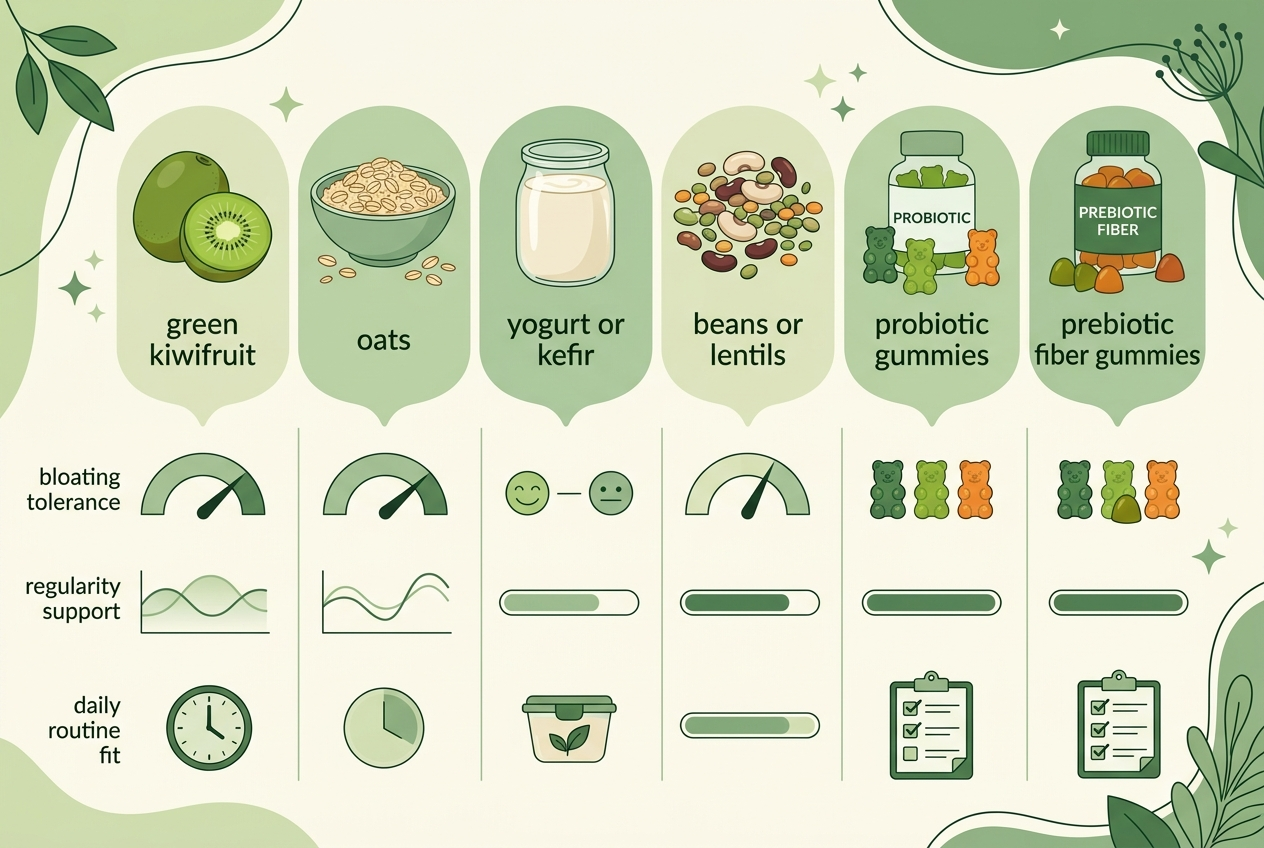
Best for gentle regularity: green kiwifruit, because the serving is concrete and the 2023 AJG trial gives it stronger food-specific evidence than most social-media gut hacks. Best for breakfast-based consistency: oats, because beta-glucan-rich breakfasts make fiber intake easier to repeat than “eat cleaner” promises. Best for tolerated fermented-food exposure: kefir or yogurt, because they provide a structured serving instead of vague advice to “eat more probiotics.” Best for higher-fiber meal building: beans or lentils, because they increase total fiber and prebiotic carbohydrate exposure when portions rise gradually. Best for low-fiber eaters who keep missing the food target: Yuve Prebiotic Fiber Gummies, because adherence matters when food quality slips. Best for people who want a simple food-plus-supplement routine: Yuve Probiotic Gummies, especially when a gummy format is more realistic than a capsule. Mechanism fit beats category loyalty every time.
Which products fit a food-first 30-day plan without turning it into supplement roulette?
Which products meet these criteria?
Some links below are affiliate links. This does not influence our evaluation criteria or recommendations.
The cleanest hot-stage move is to keep food in the lead and use products to cover a narrow gap. Yuve Prebiotic Fiber Gummies fit best when the obvious missing piece is fiber consistency, not when someone is already bloated from a sudden fiber jump. Yuve Probiotic Gummies fit best when someone wants daily probiotic support in a format they are more likely to stick with than capsules. The broader Yuve digestion collection makes sense only after the food pattern is clear, because buying three overlapping products at once makes attribution worse, not better. A good 30-day plan usually looks like one or two daily foods, one optional support product, and a simple symptom log. That structure produces cleaner answers than stacking powders, gummies, and ferments on the same weekend.
What do people usually get wrong in a 30-day gut-health experiment?
The most common mistake is changing too many variables at once. A person adds kimchi, kombucha, chia pudding, magnesium, and a probiotic gummy, then calls the whole thing “gut health.” That is not a test. That is noise. The second mistake is treating bloating as proof that a food is working. The NIDDK explains that gas rises when gut bacteria break down certain undigested carbohydrates, so more fermentation can simply mean more discomfort if the dose outruns tolerance. The third mistake is expecting one perfect food to fix a low-fiber, irregular, highly processed baseline. Gut comfort usually improves through pattern changes, not superhero ingredients. The smartest 30-day setup is boring on purpose: repeat two or three anchor foods, adjust portion size slowly, track bowel pattern and bloating, and only then decide whether a support product deserves a place in the routine.
Related reading: Best Gut Health Supplements for Gut Barrier Support: 2025 Reviews.
Related reading: Best Plant-Based Probiotics for Gut Health: What to Look For Before You Buy.
Which quick questions come up most often?
Can I improve gut health in 30 days with food alone?
Yes, sometimes. Thirty days is enough to notice changes in regularity, bloating tolerance, and meal consistency, especially if you repeat the same food changes instead of improvising every day.
What is the single best food to start with?
Green kiwifruit is one of the cleanest starting points because the serving is simple and the trial evidence is specific. Oats are a close second when breakfast is the easiest meal to stabilize.
Are fermented foods always better than probiotics?
Not automatically. Fermented foods bring food-matrix benefits and, in the Stanford trial, improved microbiome diversity, but probiotic supplements can still be more practical when routine adherence is the main issue.
Why did beans make me feel worse before they helped?
Beans raise fermentable carbohydrate intake quickly. If your baseline fiber intake is low, your gut may need a slower ramp before the benefits feel worth it.
Should I use Yuve Prebiotic Fiber Gummies or Yuve Probiotic Gummies?
Use Yuve Prebiotic Fiber Gummies when your pattern looks fiber-light and regularity is inconsistent. Use Yuve Probiotic Gummies when you want a simpler daily probiotic routine and a gummy format is more realistic for you.
Do I need to keep a symptom log?
Yes, if you want a real answer. A short log of food, bloating level, and bowel pattern turns a vague “I think this helped” into a pattern you can actually trust.
Food usually makes the biggest difference when it is specific, tolerated, and boring enough to repeat. If you want a low-friction backup once the food pattern is clear, the Yuve digestion collection is the clean next step, not the first move.
Leave a Reply