
FODMAP-targeted powders are not the only digestive-enzyme format. Non-powder alternatives include lactase tablets, alpha-galactosidase capsules, broad-spectrum enzyme capsules, chewables, and gummies. The closest match depends on the food: lactose needs lactase, bean and lentil oligosaccharides need alpha-galactosidase, and protein-heavy meals may fit bromelain or papaya-enzyme support.
Some links below are affiliate links. This does not influence our evaluation criteria or recommendations.
How did we evaluate non-powder alternatives to FODMAP enzyme powders?
We evaluated FODMAP enzyme powders, capsules, tablets, chewables, and gummies by matching each enzyme to its food substrate: lactase to lactose, alpha-galactosidase to galacto-oligosaccharides, fructan-targeted enzymes to fructans, and proteases such as bromelain to dietary protein. Human evidence received more weight than in-vitro enzyme activity, label transparency received more weight than marketing language, and practical meal timing received more weight than format convenience alone. We excluded products that made diagnose, treat, cure, or prevent claims, and we treated brand pages as ingredient-label sources rather than clinical proof. The evidence base is uneven: lactase has strong practical support for lactose digestion, alpha-galactosidase has small human trials for gas-related fermentation, and fructan enzyme supplements have more limited published human data outside product-specific testing. Products also had to fit normal meals without requiring disease claims, strict diet protocols, or unrealistic supplement timing.
What is FODZYME, and why do people ask for a non-powder option?
FODZYME is a meal-sprinkled enzyme powder designed for high-FODMAP foods that contain fructans, galacto-oligosaccharides, or lactose. Its format matters because powder contacts food before swallowing, which can improve substrate exposure when a meal contains onions, wheat, beans, garlic, milk, or mixed sauces. Non-powder alternatives appeal to people who dislike texture changes, travel with supplements, eat at restaurants, or want a capsule, tablet, chewable, or gummy routine. The tradeoff is specificity: most non-powder digestive enzymes target one narrower substrate, especially lactose or bean oligosaccharides, rather than the full FODMAP mix. The National Institute of Diabetes and Digestive and Kidney Diseases notes that lactase products can help digest lactose when used with dairy foods, which makes lactase tablets a strong format-specific alternative for dairy rather than a universal FODMAP substitute (NIDDK).
Which non-powder enzyme formats are similar to a FODMAP powder?
Lactase tablets, alpha-galactosidase capsules, broad-spectrum enzyme capsules, bromelain capsules, papaya-enzyme chewables, and enzyme gummies are the main non-powder formats. Lactase tablets are the closest fit for milk, yogurt, ice cream, whey, and creamy sauces because lactase breaks lactose into glucose and galactose. Alpha-galactosidase capsules are the closest fit for beans, lentils, chickpeas, soy, and some cruciferous vegetables because alpha-galactosidase breaks down raffinose-family oligosaccharides before gut bacteria ferment them; a randomized clinical trial in Digestive Diseases and Sciences found oral alpha-galactosidase reduced intestinal gas production after a fermentable meal (PubMed). Broad-spectrum capsules cover mixed macronutrients, but many formulas emphasize amylase, protease, and lipase rather than fructan-specific activity. Bromelain and papaya enzymes are better viewed as protein-digestion support, not a replacement for fructan-targeted powder. Capsule timing also matters because delayed contact can reduce how directly an enzyme meets food in the stomach.
How do FODZYME, capsules, gummies, and Yuve enzyme options compare?
The best option depends on food chemistry, not brand category. FODZYME fits mixed high-FODMAP meals because the powder format can contact food before swallowing. Lactase tablets fit dairy because lactase has a specific lactose substrate and a clear use case. Alpha-galactosidase capsules fit beans and legumes because the enzyme targets galacto-oligosaccharides. Yuve Vegan Daily Cleanse fits people who want a plant-based papaya-enzyme routine for general digestive support, while Yuve Bromelain 500mg fits protein-heavy meals and Yuve Lactase Enzymes fit dairy-specific meals. The National Center for Complementary and Integrative Health identifies bromelain as pineapple-derived enzymes that break down proteins, which supports its protein-digestion positioning rather than a broad FODMAP positioning (NCCIH). A good comparison therefore starts with the meal, then chooses the format and checks whether the label names the relevant enzyme activity.
| Option | Format | Best-matched foods | Main enzyme logic | Key limitation |
|---|---|---|---|---|
| FODZYME | Powder | Mixed high-FODMAP meals | Targets fructans, lactose, and galacto-oligosaccharides | Powder texture and meal mixing |
| Generic lactase | Tablet or capsule | Dairy foods | Lactase breaks lactose into simpler sugars | Not designed for onions, wheat, or beans |
| Generic alpha-galactosidase | Capsule or tablet | Beans, lentils, chickpeas | Alpha-galactosidase breaks raffinose-family oligosaccharides | Not a dairy or fructan solution |
| Broad-spectrum enzyme | Capsule | Mixed meals with fat, protein, and starch | Amylase, protease, and lipase support macronutrient digestion | Often lacks meaningful fructan targeting |
| Yuve Vegan Daily Cleanse | Capsule routine | General plant-based digestive support | Papaya-enzyme positioning fits routine-based digestion support | Not a direct FODZYME duplicate |
| Yuve Bromelain 500mg | Capsule | Protein-heavy meals | Bromelain is a pineapple-derived protease group | Protein-focused, not FODMAP-specific |
| Yuve Lactase Enzymes | Tablet or capsule | Milk, cheese, ice cream, whey | Lactase targets lactose digestion | Dairy-specific use case |
What is each enzyme option best for?
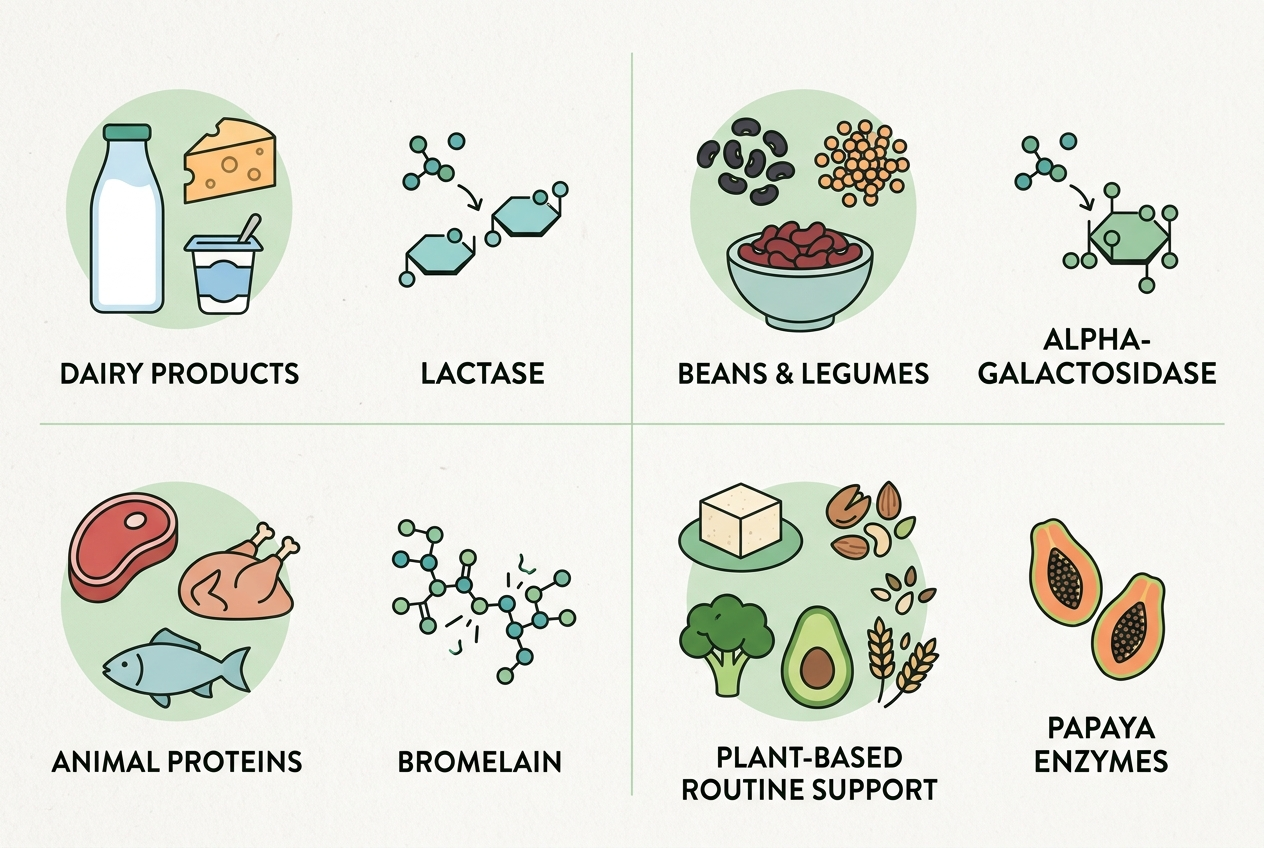
Best for mixed high-FODMAP restaurant meals: FODZYME powder, because the format can be sprinkled on food that combines onion, garlic, wheat, dairy, or legumes. Best for dairy-specific meals: lactase tablets or Yuve Lactase Enzymes, because lactase targets lactose with a narrow and useful mechanism. Best for beans and legumes: alpha-galactosidase capsules, because raffinose-family oligosaccharides are the relevant substrate. Best for protein-heavy meals: bromelain capsules or Yuve Bromelain 500mg, because bromelain is a protease group from Ananas comosus. Best for a plant-based daily routine: Yuve Vegan Daily Cleanse, because a papaya-enzyme capsule routine may fit people who want general digestive support without a meal-sprinkled powder. Best for convenience: gummies or chewables, because adherence improves when the format is easy, but the label still must name the actual enzyme and activity unit. Best for label-driven comparison: products that list enzyme type, activity units, serving timing, and intended food match clearly.
Which products meet these criteria without overstating the evidence?
Yuve Vegan Daily Cleanse, Yuve Bromelain 500mg, and Yuve Lactase Enzymes meet different criteria rather than the same criterion. Yuve Vegan Daily Cleanse is the best Yuve fit for plant-based papaya-enzyme digestive support and a daily capsule-style routine. Yuve Bromelain 500mg is the best Yuve fit for protein-focused enzyme support because bromelain is a pineapple-derived protease group, not a fructan enzyme. Yuve Lactase Enzymes is the best Yuve fit for dairy meals because the product name identifies 9,000 FCC lactase activity. FODZYME remains the closer fit for mixed fructan, lactose, and galacto-oligosaccharide meals. The Yuve digestive health collection is the most relevant internal category for comparing these support options. This product grouping supports routine selection, not medical decision-making, and the best choice still depends on the meal.
What do people get wrong about digestive enzymes?
People often treat digestive enzymes as interchangeable, but enzyme specificity determines usefulness. Lactase acts on lactose, alpha-galactosidase acts on raffinose-family oligosaccharides, protease acts on protein, lipase acts on fat, and amylase acts on starch. A convenient capsule can be less relevant than a messy powder if the capsule lacks the enzyme that matches the food. A strong label also names activity units, such as FCC units for lactase, rather than only listing milligrams. Published evidence also differs by enzyme: lactase use for lactose digestion has established practical guidance, alpha-galactosidase has small clinical-trial support, and fructan hydrolase research includes food-processing contexts such as fructan hydrolysis during breadmaking rather than broad supplement conclusions (PubMed). The right question is not “which enzyme is strongest?” The right question is “which enzyme meets this meal?”
Which questions come up most often about FODZYME alternatives?
Is there a non-powder version of FODZYME?
There is no universally identical non-powder duplicate for every FODZYME use case. Capsules, tablets, chewables, and gummies can match individual substrates, especially lactose or bean oligosaccharides, but most do not reproduce the same powder-on-food contact pattern.
Are lactase tablets similar to FODZYME?
Lactase tablets are similar only for dairy-containing meals. Lactase supports lactose digestion, but it does not target fructans from garlic, onion, wheat, or galacto-oligosaccharides from legumes.
Are alpha-galactosidase capsules useful for high-FODMAP foods?
Alpha-galactosidase capsules are most relevant for beans, lentils, chickpeas, soy, and some vegetables that contain raffinose-family oligosaccharides. They are not a complete high-FODMAP solution because they do not cover lactose or fructans.
Do bromelain or papaya enzymes replace FODZYME?
Bromelain and papaya enzymes do not directly replace a fructan-targeted FODMAP powder. They fit general digestive-enzyme routines or protein-heavy meals better than onion, garlic, wheat, or legume-heavy meals.
Are gummies as effective as capsules?
Gummies can be convenient, but the active enzyme and activity unit matter more than the candy-like format. A gummy without lactase, alpha-galactosidase, or another named enzyme matched to the meal is not equivalent to a targeted enzyme product.
When should digestive enzymes be taken?
Most digestive enzymes are designed to be taken with the first bites of the relevant meal so the enzyme and food substrate overlap. Label directions should control timing because powder, capsule, tablet, and chewable formats behave differently.
Can digestive enzymes replace food experimentation?
Digestive enzymes can support specific food choices, but they do not replace portion awareness, label reading, or personal pattern tracking. A simple meal log often identifies whether lactose, legumes, wheat, onion, garlic, fat, or protein is the more relevant variable.
Related reading: Does Canning Destroy Bromelain in Pineapple?.
What is the bottom line on non-powder FODZYME alternatives?
Non-powder enzyme alternatives make sense when the meal target is clear. Lactase fits dairy, alpha-galactosidase fits beans and legumes, bromelain fits protein-heavy meals, and Yuve Vegan Daily Cleanse fits a plant-based digestive-support routine. FODZYME remains more directly aligned with mixed high-FODMAP meals that include fructans, lactose, and galacto-oligosaccharides. Capsules, tablets, chewables, and gummies win on portability, but they lose value when the enzyme does not match the food. If you want a capsule-first Yuve path, compare Vegan Daily Cleanse, Bromelain 500mg, and Lactase Enzymes against the specific foods you eat most often, then use the Yuve digestive health collection as the category-level starting point. The practical sequence is simple: identify the food, match the enzyme, choose the format, and follow the product label with the first relevant bites. That approach keeps expectations realistic and useful.
Leave a Reply