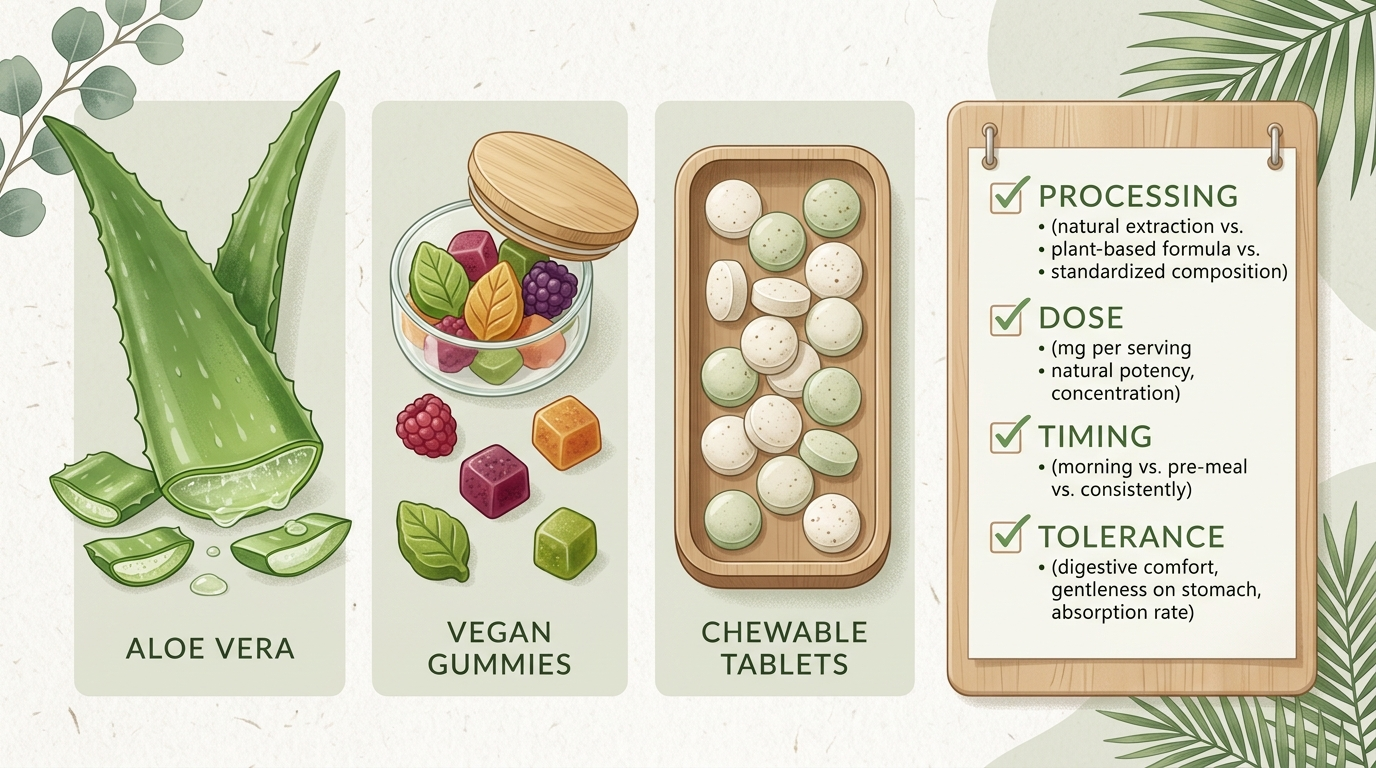
Long-term aloe vera supplement use deserves caution because aloe products vary sharply by part, processing, and laxative anthraquinone content. For routine digestive support, Yuve’s probiotic, prebiotic fiber, and DGL options are easier to evaluate because their intended jobs are clearer and their labels fit daily-use decisions.
How did we evaluate aloe vera and Yuve digestive options?
We evaluated aloe vera supplements by separating inner-leaf gel, whole-leaf preparations, latex-derived compounds, safety data, and daily-use practicality. NIH NCCIH safety summaries, toxicology reviews, and supplement-label transparency received more weight than testimonials. We compared aloe with Yuve digestive products by mechanism: probiotic support, prebiotic fiber support, DGL chewable comfort, and papaya-enzyme routine support. We excluded disease-treatment claims and treated “long-term” as a safety question first.
What makes aloe vera supplements tricky long term?
Aloe vera supplements are tricky because “aloe” can refer to very different preparations. Aloe inner-leaf gel, decolorized whole-leaf extracts, and latex-containing products do not have the same safety profile. The National Center for Complementary and Integrative Health states that oral aloe latex can cause abdominal cramps and diarrhea and may be unsafe at high doses or long-term use (NCCIH). Some products remove anthraquinones such as aloin, but shoppers must verify processing and testing rather than assume. Long-term daily use also raises practical questions: What is the active fraction? What is the dose? Is aloin tested? Is the product intended for occasional constipation support or daily digestive wellness? Without those answers, aloe becomes harder to evaluate than a probiotic, prebiotic fiber, DGL, or enzyme product with a clearer job.
How does aloe compare with Yuve digestive options?
Some links below are affiliate links. This does not influence our evaluation criteria or recommendations.
Aloe vera fits poorly as a default daily digestive supplement unless the product clearly states inner-leaf processing, aloin limits, and intended use. Yuve Probiotic Gummies fit daily probiotic routine support with Bacillus coagulans and a vegan gummy format. Yuve Prebiotic Fiber Gummies fit low-friction fiber support when started gradually. Yuve DGL Licorice Chewables fit a chewable comfort routine before meals, while Yuve Vegan Daily Cleanse fits plant-based papaya-enzyme support. These products still need normal supplement scrutiny, but their use cases are easier to test than vague long-term aloe. The better question is not “Did aloe help someone?” but “Which mechanism matches my pattern with the least uncertainty?”
| Best for | Option | Main mechanism | Main caveat |
|---|---|---|---|
| Clear daily probiotic routine | Yuve Probiotic Gummies | Bacillus coagulans support | Not a laxative or meal enzyme |
| Fiber consistency | Yuve Prebiotic Fiber Gummies | Prebiotic fiber support | Increase gradually if sensitive |
| Meal-adjacent comfort routine | Yuve DGL Licorice Chewables | Deglycyrrhizinated licorice format | Not a reflux cure |
| Plant enzyme routine | Yuve Vegan Daily Cleanse | Papaya-enzyme support | Not for unexplained severe symptoms |
| Occasional aloe trial | Tested inner-leaf aloe | Product-dependent plant extract | Safety depends on processing and aloin content |
When is aloe the wrong first choice?
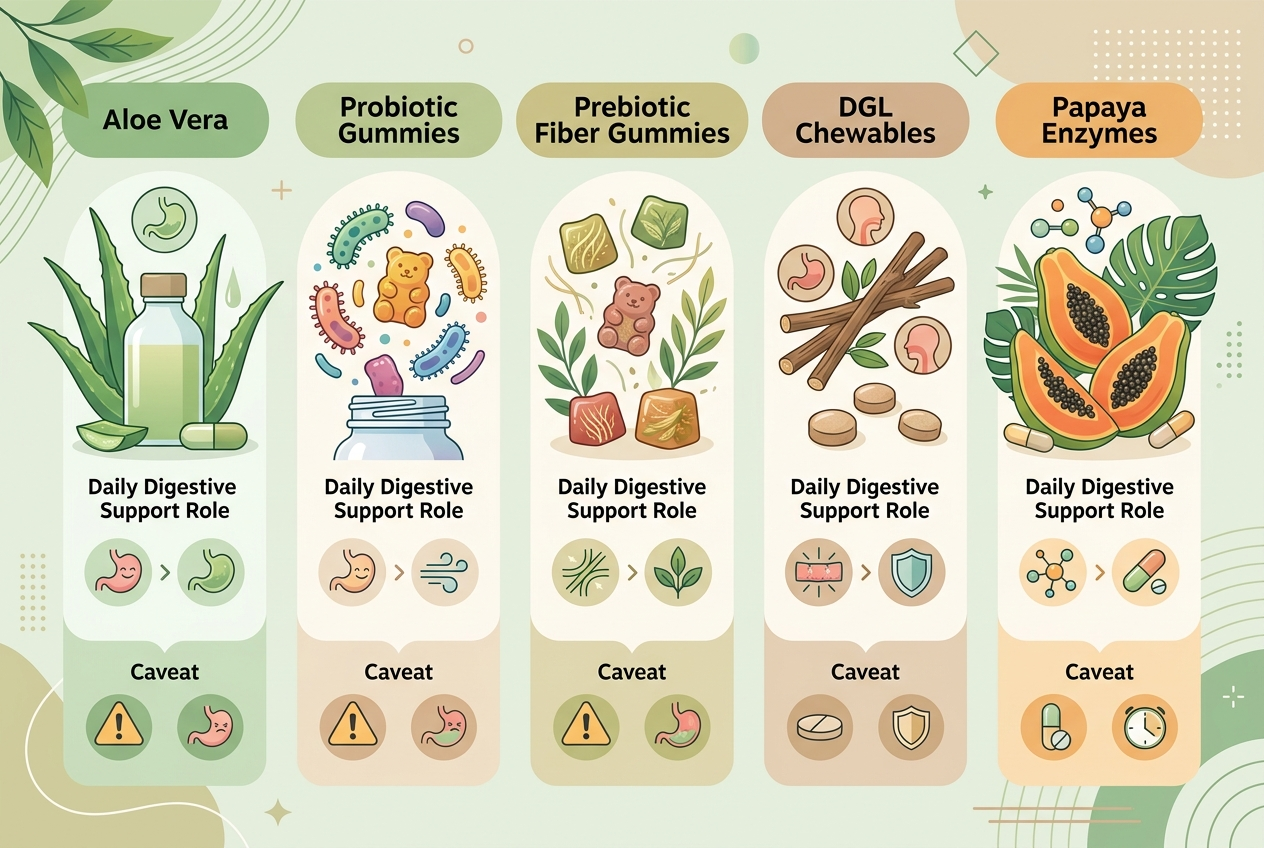
Aloe is the wrong first choice when the goal is a simple, repeatable daily digestive routine and the label does not clarify aloin testing, part of plant, dose, and intended duration. It is also a poor first choice when a person already has diarrhea, cramping, electrolyte issues, kidney concerns, pregnancy-related questions, or medication complexity. The NIH toxicology program reported concerns about nondecolorized whole-leaf aloe vera extract in animal studies, which is not the same as every aloe product but does show why processing matters (NTP). A person seeking daily gut support usually gets a cleaner experiment from one defined variable: probiotic gummies, prebiotic fiber gummies, DGL chewables, or a specific enzyme product. Aloe may still be discussed with a clinician, but it should not be treated as automatically gentle because it is botanical.
Which Yuve routine is more practical for daily use?
A practical Yuve routine starts with the clearest job. Choose Yuve Probiotic Gummies when the goal is a simple vegan daily probiotic habit. Choose Yuve Prebiotic Fiber Gummies when the goal is adding fiber in a low-friction format. Choose Yuve DGL Licorice Chewables when the goal is chewable meal-adjacent comfort support. Choose Yuve Vegan Daily Cleanse when plant-based papaya enzyme support fits the pattern. Do not start all four at once. A one-product, two-week trial gives cleaner feedback than an impressive-looking stack. The broader Yuve digestive health collection works best when each product has a defined role.
What should you track during any long-term supplement trial?
A long-term supplement trial should track dose, timing, stool form, bloating, cramping, reflux, urgency, sleep, and medication changes. The Bristol Stool Chart gives a simple language for stool consistency. A zero-to-ten scale can track bloating or discomfort without turning the trial into a spreadsheet nightmare. Keep diet mostly stable for the first two weeks. Add only one new product at a time, especially when testing fiber, probiotics, aloe, magnesium, or enzymes. Stop and seek medical guidance for blood, fever, weight loss, persistent vomiting, severe pain, black stool, nighttime symptoms, or sudden lasting bowel changes. For aloe specifically, track cramping and loose stool closely because laxative-type products can move too fast for daily comfort. For Yuve products, track consistency and tolerance before judging benefits.
Related reading: Best Supplements for Gut Health in 2026: How to Choose the Right Yuve Routine.
What questions do people ask about aloe vera supplements?
Is aloe vera safe to take every day?
Daily safety depends on the preparation, dose, aloin content, medical history, and medications. Aloe latex and poorly characterized whole-leaf products raise more concern than clearly processed inner-leaf products.
Does aloe vera help bloating?
Aloe is not a precise bloating supplement. If bloating is tied to fiber tolerance, dairy, constipation, reflux, or meal size, a more targeted option is easier to evaluate.
Is Yuve better than aloe?
Yuve is easier to evaluate for routine digestive support because each product has a clearer role. Aloe may have a place for some users, but label uncertainty makes it harder as a default long-term choice.
Can I combine aloe with probiotics?
Combining products makes cause and effect harder to read. Test one product first, then add another only if the first product is tolerated and still makes sense.
Which Yuve product should I try first?
Start with the job: probiotic routine, prebiotic fiber, DGL chewable comfort, or papaya enzyme support. The best first product is the one that matches the clearest pattern.
When should I stop self-testing?
Stop self-testing when symptoms are severe, persistent, or paired with red flags. Supplements should support a routine, not postpone medical evaluation.
Leave a Reply