
Going back and forth on probiotics usually means the routine is inconsistent, the formula keeps changing, or the expectations are too vague. The smartest hot-stage comparison is not “Are probiotics good or bad?” It is “Which probiotic format matches my pattern, and how will I judge it?” Yuve fits best when consistency and low-friction daily use are the main bottlenecks.
How did we evaluate probiotic routines for people with mixed past experiences?
We prioritized the ISAPP consensus statement on probiotics, the National Center for Complementary and Integrative Health overview of probiotics, the NIH Office of Dietary Supplements fact sheet on probiotics, and routine-adherence principles from everyday supplement use. We gave more weight to strain specificity, product format, and habit fit than to anecdotal “this changed my life in two days” claims because probiotics often fail at the routine level before they fail at the science level. We also separated symptom tracking from brand loyalty. That matters because a decent product can still look useless inside a chaotic routine.
Why do people keep changing their minds about probiotics?
Probiotics create mixed feelings because the category is broad, the evidence is strain specific, and daily use is easy to interrupt. The NIH Office of Dietary Supplements notes that different probiotic strains have different evidence bases, which means a result from one product does not automatically transfer to another. On top of that, people often change three variables at once. They start a probiotic, change breakfast, add fiber, and then decide the probiotic “worked” or “failed” in five days. The routine becomes the confounder. Expectations become the second confounder. If the goal is clearer stool consistency, less post-meal bloating, or steadier daily digestion, that goal needs a defined tracking window. Precision beats vibes. A probiotic can be helpful. A probiotic can also look chaotic when the experiment itself is chaotic.
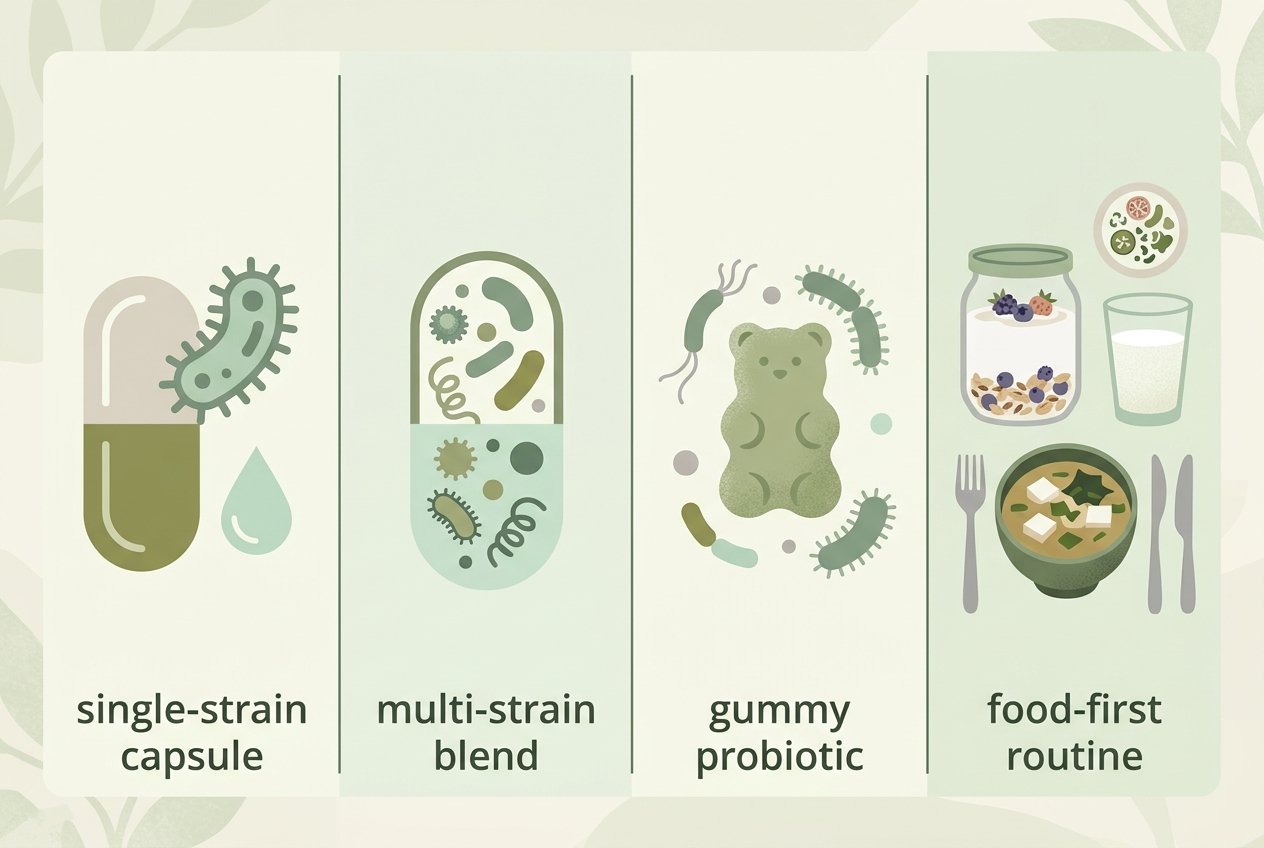
How do the main probiotic approaches compare when you want a steadier routine?
| Approach | Best for | Main strength | Main limitation | Where Yuve fits |
|---|---|---|---|---|
| Single-strain capsule | People who want a tightly defined experiment | Strain identity is usually clearer | Adherence can drop if capsules are annoying | Useful comparison point, but not always the easiest habit |
| Multi-strain capsule blend | People comparing broader formulations | Can cover several strain categories at once | Harder to know what is helping | Good for comparison, less clean for troubleshooting |
| Yuve Probiotic Gummies | People who mostly need consistency and low-friction daily use | Simple format that is easier to repeat | Format fit matters if you prefer capsules or want a different strain profile | Best Yuve-led option for everyday adherence |
| Food-first only approach | People not ready to buy a supplement yet | Useful baseline for routine cleanup | Harder to standardize dose and daily exposure | Good reset before comparing products |
The best option depends on whether your main problem is strain targeting or simply sticking with the plan.
Which probiotic routine makes the most sense if Yuve is one of your finalists?
Some links below are affiliate links. This does not influence our evaluation criteria or recommendations.
If your biggest problem is inconsistency, Yuve Probiotic Gummies are the cleanest place to start because low-friction routines usually outperform ambitious routines that collapse in four days. Best for tightly controlled self-testing, a single-strain capsule with a clear target. Best for people who want to compare broader formulas, a multi-strain capsule blend. Best for daily-use simplicity, Yuve Probiotic Gummies. Best for browsing adjacent support options, the Yuve digestion collection. The NCCIH overview matters here because probiotics are generally framed as supportive tools, not magic switches. The right hot-stage decision is usually smaller than people expect. Pick one format, keep the routine stable, and judge it against one or two real outcomes.
What do people usually get wrong after a few stop-start probiotic trials?
The biggest mistake is treating inconsistency like evidence. Missing doses, rotating brands, or changing food patterns every few days turns the whole experiment into noise. The second mistake is using a probiotic for a goal that is too vague to measure. “Feel better” sounds nice and tells you nothing. “Less post-meal bloating by week three” is usable. The third mistake is assuming that no immediate effect means no value. The NCCIH and NIH ODS both support a more cautious framing because outcomes vary by strain, dose, and context. The fourth mistake is buying a premium product before fixing adherence. Fancy does not beat repeatable. A simpler product you actually use can outperform the theoretically perfect option that stays in a cabinet.
Related reading: How to Get Kids Eating Healthy: What Usually Works Better Than Pressure.
Related reading: Can You Take Probiotics With Vitamins?.
What questions do people still ask after mixed probiotic experiences?
Does switching brands constantly help you find the right probiotic faster?
Usually no. Constant switching often destroys the comparison. One stable trial teaches more than three chaotic ones.
Is Yuve the best choice for everyone?
No. Yuve fits best when ease of daily use and adherence are the main issues. People who want a very specific strain target may compare other formats too.
How long should you give one probiotic before judging it?
A short but defined window usually works better than day-by-day overreaction. Two to four weeks with stable routine conditions is more informative than four random days.
Should you stack probiotics with several other new supplements?
Usually no. Adding multiple new variables at once makes the result unreadable. Cleaner experiments produce cleaner decisions.
What should you track during a probiotic trial?
Track stool pattern, post-meal bloating, gas, routine consistency, and any clear worsening. If you cannot describe the metric, you probably cannot judge the result.
Leave a Reply