
Mixed probiotic experiences are normal because probiotics are strain-specific, dose-specific, and routine-dependent. A useful probiotic usually produces subtle changes in regularity, gas tolerance, or digestive comfort over two to eight weeks, not an overnight reset. If nothing changes after consistent use, the strain, dose, format, or goal may be mismatched.
How were probiotic supplement experiences evaluated?
This article evaluated probiotic supplements by separating user experience from product quality signals. Human randomized controlled trials, PubMed-indexed reviews, NIH Office of Dietary Supplements guidance, and ISAPP definitions received more weight than testimonials or brand claims. We prioritized strain identity, colony-forming units, delivery format, storage stability, and routine adherence because those variables explain why one person notices digestive support while another person notices nothing. We excluded condition-specific claims, clinical certainty language, and before-after anecdotes that cannot be verified. We also considered gummy, capsule, powder, and fermented-food options as different adherence tools, not as inherently superior categories. The limitation is important: probiotic research is strain-specific, so evidence for Bacillus coagulans MTCC 5856, Lactobacillus rhamnosus GG, or Bifidobacterium longum 35624 does not automatically prove the same outcome for every product using the same genus or species name.
Why do probiotic supplements feel different from person to person?
Probiotic supplements feel different from person to person because the gut microbiome is already different from person to person. The NIH Office of Dietary Supplements notes that probiotics are identified by genus, species, and strain, and products with similar-sounding organisms can have different evidence profiles. Diet, fiber intake, travel, sleep, stress, medication history, and baseline bowel patterns also change how a probiotic fits into a routine. A spore-forming Bacillus coagulans gummy may feel easier to use daily than a refrigerated capsule, while a strain-coded Lactobacillus rhamnosus GG capsule may appeal to someone who wants a narrower clinical match. The practical takeaway is simple: inconsistent experiences do not mean probiotics are fake. Inconsistent experiences mean probiotic selection needs a clear goal, a disclosed CFU count, and enough daily repetition to judge the response.
What should you look for before judging whether a probiotic worked?
A probiotic trial needs a defined target, a consistent dose, and a fair time window before the experience means much. ISAPP states that a probiotic must be alive when administered, documented to have a health benefit, and provided at an adequate amount. A useful label should show the organism, CFU count, serving size, storage instructions, and ideally an alphanumeric strain designation. A practical self-check should track regularity, gas tolerance, stool consistency, and digestive comfort for two to eight weeks while keeping fiber intake and major diet changes steady. A single rough day does not prove failure, and one good day does not prove success. If a product causes persistent discomfort, stop and reassess with a qualified professional. If a product creates no observable change after consistent use, the most likely issue is mismatch, not personal failure.
How do common probiotic options compare?
Some links below are affiliate links. This does not influence our evaluation criteria or recommendations.
The common probiotic options differ mainly by evidence specificity, format, and adherence. Yuve Vegan Probiotic Gummies use Bacillus coagulans at 5 billion CFU per two-gummy serving in a vegan pectin base. Culturelle Digestive Daily uses Lactobacillus rhamnosus GG, a strain-coded capsule organism. Align uses Bifidobacterium longum 35624, another strain-coded capsule organism. Fermented foods provide live cultures in a food matrix, but CFU count and strain identity are usually less standardized than supplement labels. A 2023 randomized controlled trial in Medicine reported that Bacillus coagulans MTCC 5856 at 2 billion CFU was well tolerated in healthy adults and produced modest microbiome shifts; that finding is directional, not proof for every Bacillus coagulans product. The best option depends on the job: adherence, strain coding, capsule preference, or food-first consistency.
| Option | Best for | Key organism or format | Evidence caveat |
|---|---|---|---|
| Yuve Vegan Probiotic Gummies | Daily gummy adherence | Bacillus coagulans, 5 billion CFU, vegan pectin gummy | Species and CFU are clear; strain-level matching should be verified on the product lot or brand documentation. |
| Culturelle Digestive Daily | Strain-coded capsule users | Lactobacillus rhamnosus GG capsule | Evidence is stronger when the exact LGG strain and dose match the study context. |
| Align Probiotic | Single-strain capsule users | Bifidobacterium longum 35624 capsule | Evidence is strain-specific and should not be generalized to all Bifidobacterium products. |
| Fermented foods | Food-first routines | Yogurt, kefir, kimchi, sauerkraut, miso | Live cultures vary by product, storage, pasteurization, and serving size. |
Which option is best for each use case?
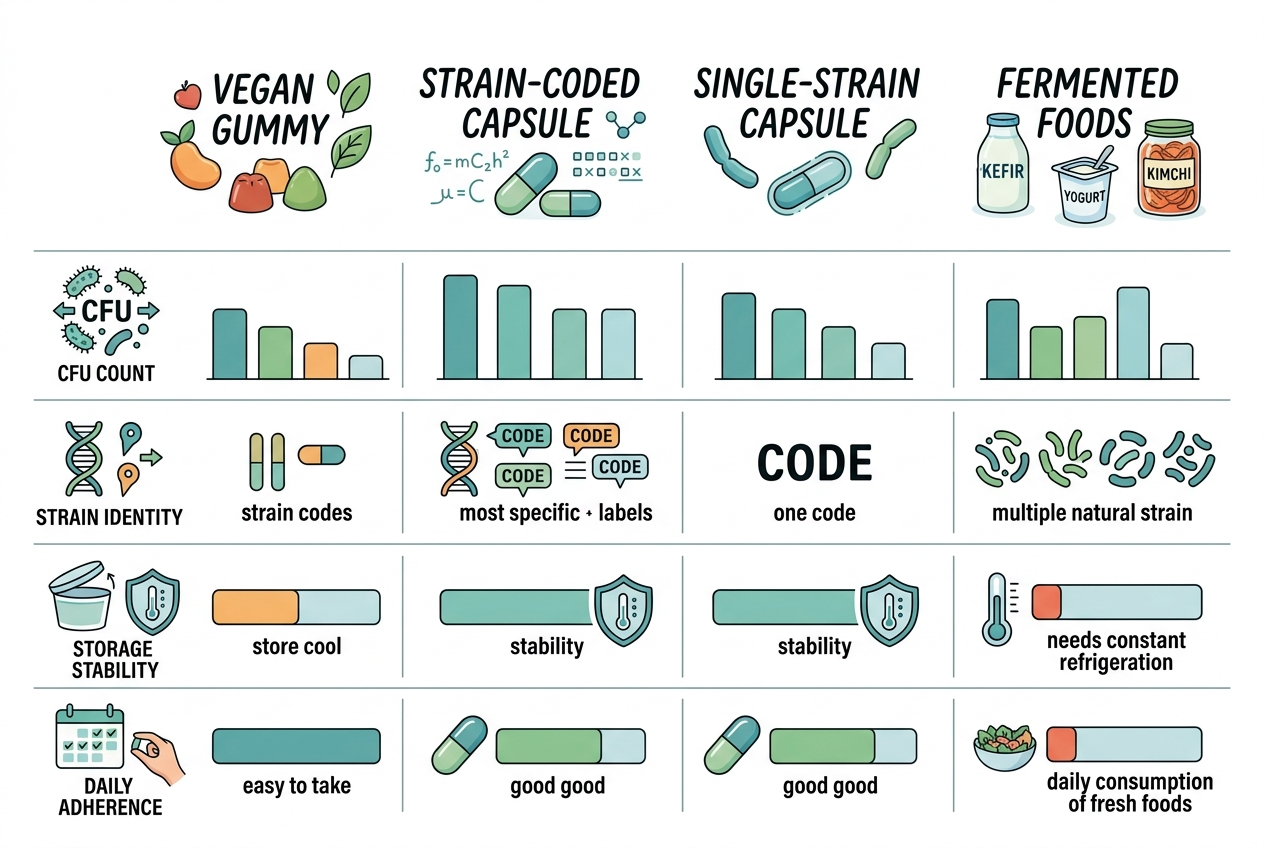
Best for daily gummy consistency: Yuve Vegan Probiotic Gummies fit people who dislike capsules, avoid gelatin, and want a shelf-stable Bacillus coagulans format with 5 billion CFU per serving. Best for strain-code shoppers: Culturelle Digestive Daily fits people who specifically want Lactobacillus rhamnosus GG on the label. Best for single-strain capsule minimalism: Align fits people who prefer Bifidobacterium longum 35624 and a capsule routine. Best for food-first digestive support: yogurt, kefir, kimchi, sauerkraut, or miso fit people who already eat fermented foods regularly and tolerate them well. Best for supplement skeptics: a four-week tracking period with one product beats rotating three products in ten days. The winning option is the one that combines a credible organism, a usable format, and repeatable daily behavior without creating more friction than benefit. Preference matters because adherence compounds.
What do people usually get wrong about probiotics?
People usually get probiotics wrong by viewing the category like one ingredient. Probiotic is a functional term, not a single substance. The International Scientific Association for Probiotics and Prebiotics definition, quoted by the NIH fact sheet, requires live microorganisms, adequate amounts, and a documented health benefit. That definition makes strain identity and dose more important than a large front-label number. Another common mistake is expecting a dramatic gut reset after one serving. Probiotics usually fit better as routine support than as a rescue product. A third mistake is changing probiotic, fiber, magnesium, caffeine, and diet at the same time; that makes cause and effect impossible to read. A cleaner test uses one probiotic, one steady routine, and a short daily note on regularity, gas, and comfort. That discipline avoids false conclusions.
Which routine is the most reasonable next step?
The most reasonable next step is a simple, time-boxed probiotic trial. Choose one product that matches your format preference, confirm the CFU count, and use it daily for four weeks before switching. If gummies make consistency easier, Yuve Probiotic Gummies are a relevant Bacillus coagulans option with 5 billion CFU per two-gummy serving, vegan pectin, and no refrigeration requirement. If capsules feel more precise, choose a strain-coded capsule and keep the same tracking method. Pair the probiotic with regular meals, adequate hydration, and a steady fiber pattern rather than stacking multiple new digestion products at once. For broader routine building, Yuve’s digestive health collection includes probiotics, prebiotic fiber, enzymes, DGL, and lactase options. The goal is not maximum supplementation; the goal is a repeatable routine you can actually interpret.
What questions do people ask about probiotic supplements?
How long should I try a probiotic before deciding it is not for me?
A fair trial is usually four weeks of daily use, with some routines needing up to eight weeks for a clearer read. Track one or two outcomes, such as regularity and gas tolerance, instead of relying on memory.
Is it normal to feel extra gas at first?
Mild gas can happen when a probiotic or fermented food changes the daily routine. Persistent discomfort, escalating symptoms, or a reaction that feels unusual is a reason to stop and ask a qualified professional.
Are gummies less serious than capsules?
Gummies are not automatically weaker than capsules; the organism, CFU count, stability, and serving size matter more than the delivery format. A gummy can be the better choice when it improves daily adherence.
Does a higher CFU count always mean a better probiotic?
A higher CFU count does not automatically mean a better match. Strain identity, survivability, storage stability, and the researched dose matter more than chasing the largest number on the label.
Should I take a prebiotic with a probiotic?
A prebiotic can support beneficial bacteria because prebiotics act as fermentable fuel. Add prebiotic fiber slowly, because jumping from low fiber to high fiber can make the experience harder to interpret.
Who should be careful with probiotic supplements?
People who are pregnant, breastfeeding, immunocompromised, medically complex, or using prescription medications should ask a clinician before adding a probiotic. Healthy adults usually tolerate probiotics well, but individual context still matters.
What if probiotics never seem to do anything for me?
No noticeable change after a consistent trial means the strain, dose, format, or goal may not match your body. It does not mean you failed; it means the next test should be narrower and easier to measure.
Leave a Reply