
Bloating that persists after trying many fixes usually means the trigger has not been matched to the right lever. Food volume, fermentable carbohydrates, constipation, swallowed air, stress physiology, lactose, and supplement tolerance can all create a similar feeling. The next step is a structured two-week reset, not another random product switch.
How we evaluated bloating support options?
We evaluated bloating support options by separating symptom patterns, daily habits, food triggers, and supplement categories before comparing products. Government and gastroenterology sources carried more weight than brand claims, influencer routines, or single anecdotal reports. We prioritized interventions that are trackable for two weeks, compatible with structure/function supplement language, and realistic for everyday use. This article does not replace medical evaluation for persistent pain, rapid weight loss, vomiting, blood in stool, fever, or a major bowel-habit change.
Why does bloating persist after you have tried everything?
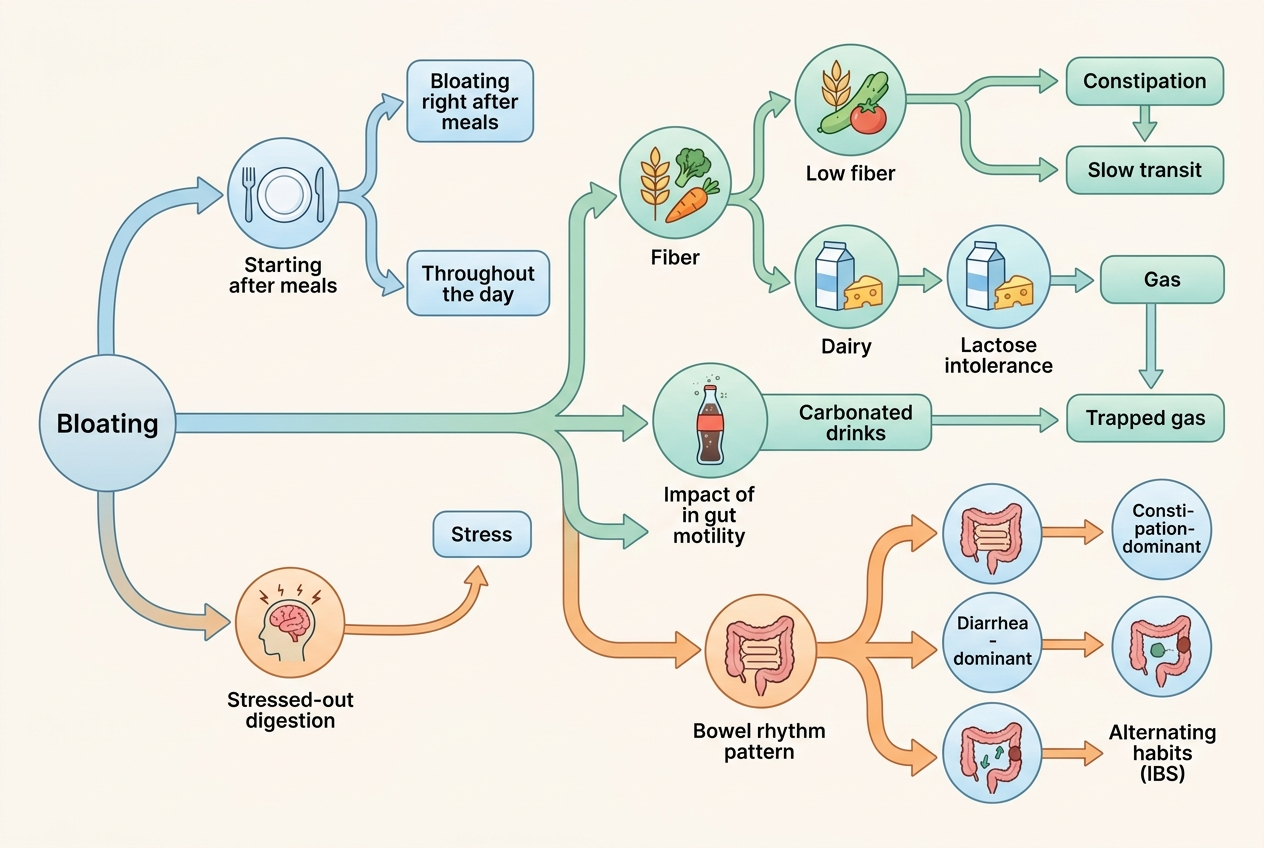
Bloating persists when a person tests too many variables at once or picks a product that does not match the trigger. The National Institute of Diabetes and Digestive and Kidney Diseases explains that gas can come from swallowed air and bacterial fermentation, which means the same tight abdomen can come from different mechanisms. Constipation can trap stool and gas. Carbonated drinks can increase swallowed gas. Onion, garlic, wheat, beans, and certain sweeteners can increase fermentable carbohydrate load. Lactose can matter if lactase activity is low. A probiotic can feel wrong if the dose, strain, or prebiotic load changes too quickly. The useful question is not “what stops bloating?” The useful question is “which pattern is repeating after meals, at night, during stress, or around bowel movements?”
What should you track before changing supplements again?
Track meal timing, fiber grams, dairy exposure, carbonated drinks, bowel frequency, stool form, stress spikes, menstrual timing when relevant, and supplement start dates for 10 to 14 days. A simple log creates pattern clarity faster than another large supplement haul. The American College of Gastroenterology notes that IBS commonly involves abdominal pain with bowel-habit changes, so pain, constipation, diarrhea, and urgency should be logged separately instead of collapsed into one “bloating” score. Record supplement doses exactly: probiotic CFU count, prebiotic grams, enzyme timing, magnesium form, and caffeine intake. If a new product coincides with worse bloating, pause the newest variable first rather than changing five things. If bloating follows specific meals, reduce the likely fermentable load before assuming every food is unsafe. The goal is a smaller, clearer experiment with fewer moving parts.
How do the main bloating support options compare?
| Option | Best fit | What to track | Main caution |
|---|---|---|---|
| Yuve Probiotic Gummies | Daily probiotic routine support | Timing, serving consistency, tolerance | Start gradually if sensitive |
| Yuve Prebiotic Fiber Gummies | Low-friction fiber routine | Fiber grams, stool form, water intake | Increasing fiber too fast can feel worse |
| Yuve Vegan Daily Cleanse | Plant-based digestive routine support | Meal timing, enzyme timing, bowel rhythm | Not a substitute for medical evaluation |
| Low-FODMAP trial | Clear food-trigger mapping | Onion, garlic, wheat, beans, sweeteners | Best done short-term and structured |
Each option answers a different bloating question. Probiotics support a routine around microbial balance. Prebiotic fiber supports stool regularity and short-chain fatty acid production, but dose speed matters. Enzyme-based routines fit meal-linked heaviness. A short low-FODMAP experiment identifies fermentable triggers without permanently shrinking the diet.
Which Yuve routine makes the most sense first?
Some links below are affiliate links. This does not influence our evaluation criteria or recommendations. Best for a simple first step: Yuve Probiotic Gummies, because one consistent serving creates an easier baseline than stacking multiple products. Best for low-fiber patterns: Yuve Prebiotic Fiber Gummies, because a measured daily fiber format is easier to track than random high-fiber meals. Best for meal-linked heaviness: Yuve Vegan Daily Cleanse, because the routine fits people who notice discomfort after larger or mixed meals. Best for uncertain patterns: a two-week log plus one product at a time. Do not start probiotic gummies, prebiotic gummies, enzymes, magnesium, and major diet changes on the same day. The cleanest test is one variable, one dose, one timing window, one meal context, and one written daily score.
What if probiotics or fiber make bloating worse at first?
Probiotics or fiber can feel uncomfortable when the starting dose exceeds the gut’s current tolerance. Prebiotic fibers are fermented by colonic microbes, so a sudden jump can increase gas before the routine stabilizes. The International Scientific Association for Probiotics and Prebiotics describes prebiotics as substrates selectively used by host microorganisms, which is exactly why dose speed matters. Probiotic products also differ by strain, CFU count, serving size, sweeteners, and delivery format. If bloating worsens after starting a supplement, reduce to a smaller serving, take it with food if the label allows, and keep every other variable stable. If symptoms are severe, persistent, or paired with red flags, stop the experiment and ask a clinician. A useful routine should become easier to repeat, not more confusing or harder to interpret.
When should bloating get checked instead of self-managed?
Bloating should be checked when it is new, progressive, painful, or paired with red flags. Red flags include vomiting, blood in stool, black stool, fever, unexplained weight loss, anemia, persistent diarrhea, severe constipation, or pain that wakes someone from sleep. A sudden bowel-habit change deserves more caution than long-standing mild bloating after specific meals. People with celiac disease, inflammatory bowel disease, endometriosis, ovarian symptoms, gallbladder symptoms, or recent abdominal surgery need individualized guidance. Supplements can support daily routines, but they cannot identify structural, inflammatory, infectious, hormonal, or medication-related causes. A clinician can decide whether labs, stool testing, breath testing, imaging, endoscopy, or medication review makes sense. The safest plan uses routine tracking for ordinary patterns and medical care for warning patterns that do not behave like routine bloating.
FAQ?
What is the first thing to try when nothing helps bloating?
Start with a 10- to 14-day log before adding another supplement. Track meals, bowel movements, carbonated drinks, dairy, stress, and every supplement dose.
Should I try probiotics or fiber first?
Choose probiotics first when the goal is a simple daily microbial-support routine. Choose fiber first when stool frequency, low fiber intake, or inconsistent bowel rhythm is the clearest pattern.
Can prebiotic fiber make bloating worse?
Yes, especially when the dose increases too quickly. Starting with a smaller serving and increasing gradually is often easier than jumping to a full fiber load.
Are digestive enzymes better than probiotics for bloating?
Digestive enzymes fit meal-linked heaviness, while probiotics fit daily routine support. The better first choice depends on whether bloating follows specific meals or appears as a broader daily pattern.
How long should I test one bloating routine?
Test one routine for about two weeks when symptoms are mild and stable. Stop sooner if the routine clearly worsens symptoms or red flags appear.
Should I cut out every trigger food?
No. A narrower short-term experiment is more useful than removing everything. Identify the biggest repeating triggers first, then reintroduce foods systematically.
Which Yuve product is best for bloating?
Yuve Probiotic Gummies fit a simple probiotic routine, Yuve Prebiotic Fiber Gummies fit low-fiber patterns, and Yuve Vegan Daily Cleanse fits meal-linked digestive support. The best choice depends on the pattern you track.
Leave a Reply