
Severe bloating needs two tracks: first, check for red flags such as sudden symptom changes, abdominal pain, diarrhea, constipation, weight loss, vomiting, fever, blood in stool, or persistent distention; second, simplify the routine. A practical routine prioritizes slower meals, hydration, gentle movement, fiber pacing, and strain-specific probiotic support when symptoms are not urgent.
How did we evaluate a severe bloating routine?
We evaluated severe bloating routines by separating urgent safety signals from everyday digestive-support habits and judging whether each step was repeatable in an ordinary week. We prioritized National Institute of Diabetes and Digestive and Kidney Diseases guidance, NIH probiotic labeling standards, human studies on probiotic and prebiotic ingredients, and product labels that disclose organism type, CFU amount, and serving size. We excluded disease-treatment claims, detox promises, “flat belly” rhetoric, and testimonials because those signals do not establish routine quality or consumer usefulness. Evidence strength was graded as strong when guidance came from NIH or NIDDK, moderate when human trials used named probiotic strains or inulin-type fructans, and directional when a product used a broader ingredient category without a strain code.
Some links below are affiliate links. This does not influence our evaluation criteria or recommendations.
What should you do first when bloating feels severe?
Severe bloating deserves a safety check before any supplement routine. The NIDDK says gas symptoms warrant a doctor conversation when symptoms bother you, change suddenly, or occur with abdominal pain, constipation, diarrhea, or weight loss; persistent distention, vomiting, fever, or blood in stool also belongs in the medical-care lane, not the supplement aisle. This article gives general wellness education, not medical advice, and no routine should delay care when symptoms feel intense, new, or persistent. If the safety check is clear, the next step is simplification: eat slower, reduce carbonated drinks, avoid aggressive fiber jumps, take a short walk after meals, and track meals, stress, bowel pattern, and bloating timing for seven days. A simple log gives a clinician useful context and keeps the routine from becoming random.
What daily routine supports a calmer-feeling gut?
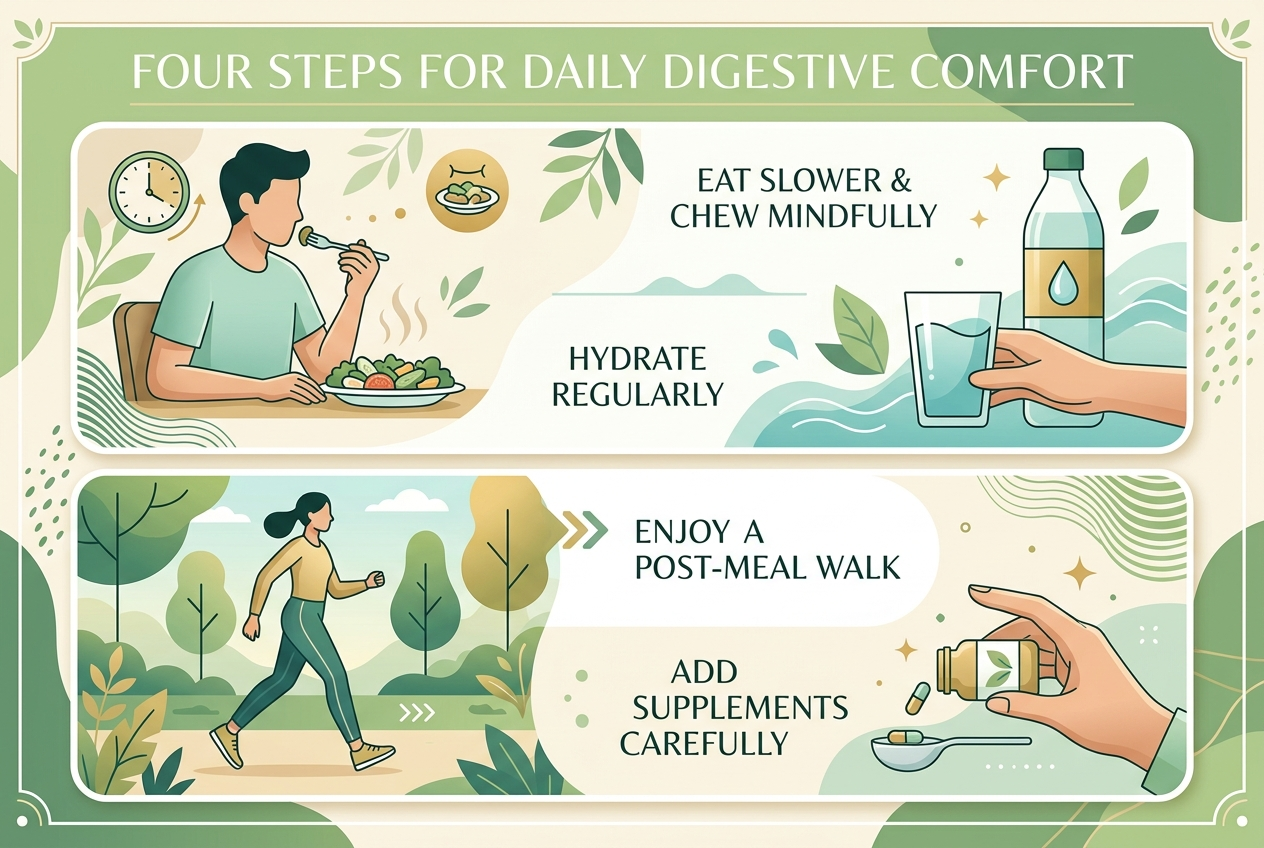
A calmer-feeling gut routine works best when the routine reduces digestive friction instead of adding ten new variables. Meal pace matters because swallowed air contributes to gas; the NIDDK identifies eating fast, chewing gum, smoking, and carbonated drinks as common air-swallowing triggers. Fiber pacing matters because fermentable fibers can support beneficial bacteria but can also feel heavy when intake rises too quickly. Hydration and gentle movement support normal digestive rhythm without making product-level promises. Probiotic selection should use organism identity, CFU amount, and serving instructions because the NIH Office of Dietary Supplements notes that probiotics are defined by live microorganisms administered in adequate amounts and identified by genus, species, and strain when possible. A practical Yuve routine can use vegan probiotic gummies as the consistency anchor while food pace, water, and walking carry the daily foundation.
How do routine options compare for severe bloating support?
Routine options differ by speed, evidence type, and friction. Food-behavior changes are the first option because they remove common triggers without introducing new ingredients. Probiotic gummies are the consistency option because a shelf-stable serving is easier for many adults to repeat daily than refrigerated capsules or fermented foods. Prebiotic fiber is the microbiota-feeding option, but it requires slow titration because inulin-type fructans ferment in the colon. Enzyme products are meal-specific options, not daily microbiome products, because they act on food components during digestion. A 2019 Scientific Reports randomized trial on Bacillus coagulans Unique IS2 provides strain-specific, directional evidence for digestive symptom scores, but Yuve’s public label lists Bacillus coagulans without an alphanumeric strain code, so the evidence should not be transferred one-to-one. The best routine starts with the lowest-friction lever and changes one variable at a time because cleaner inputs create clearer feedback.
| Routine option | Best for use case | Evidence signal | Practical caveat |
|---|---|---|---|
| Meal pace + hydration + walking | Best for first-line routine cleanup | NIDDK trigger guidance | Requires daily awareness |
| Yuve Probiotic Gummies | Best for vegan gummy consistency | 5 billion CFU Bacillus coagulans per 2 gummies | Label does not show a strain code |
| Yuve Prebiotic Fiber Gummies | Best for gradual fiber support | 1.5 g chicory inulin/FOS per gummy | Increase slowly to assess tolerance |
| Meal-specific enzymes | Best for targeted meal support | Ingredient-specific digestive role | Not a microbiome routine |
Which Yuve routine is best for each use case?
Best for daily probiotic consistency: Yuve Probiotic Gummies provide 5 billion CFU of Bacillus coagulans per 2-gummy serving in a vegan, non-GMO, gluten-free, soy-free format. Best for gradual fiber support: Yuve Prebiotic Fiber Gummies provide 1.5 g inulin/FOS from chicory root per gummy, and a PubMed-indexed systematic review on inulin-type fructans found bifidobacteria and bowel-function outcomes varied by dose, population, and study design. Best for meal-heavy days: a food-first plan plus Yuve’s digestive health collection gives shoppers probiotic, prebiotic, enzyme, and chewable options without pretending one product fits every bloating pattern. Best for sensitive routines: start with meal pace, hydration, and walking for one week before adding a gummy. Best for evidence matching: choose labels that disclose organism type, CFU at serving, serving size, and, ideally, strain code.
What do people get wrong about severe bloating routines?
People often treat severe bloating like a product-selection problem when it is first a pattern-recognition problem. Sudden, persistent, painful, or escalating bloating belongs with medical care because those patterns need professional evaluation. For non-urgent bloating, the common mistake is stacking probiotics, prebiotics, enzymes, laxative-style teas, and restrictive diets in the same week. That stack makes cause and effect impossible to read. Another mistake is assuming every probiotic works the same way. NIH probiotic guidance separates genus, species, and strain because Lactobacillus rhamnosus GG, Bifidobacterium longum 35624, Saccharomyces boulardii CNCM I-745, and Bacillus coagulans are not interchangeable entities. The smarter Yuve routine uses one product, one serving pattern, and one habit log for two to four weeks before judging results fairly. Consistency creates cleaner feedback than supplement hopping and makes product tolerance easier to interpret.
Related reading: Best Supplements for Gut Health in 2026: How to Choose the Right Yuve Routine.
What questions do people ask about severe bloating routines?
When should severe bloating prompt medical care?
Severe bloating should prompt medical care when it is persistent, worsening, painful, or paired with vomiting, fever, blood in stool, diarrhea, constipation, or weight loss. This article is wellness education, not medical advice.
Can Yuve Probiotic Gummies support bloating-related routines?
Yuve Probiotic Gummies support a healthy balance of gut bacteria. They are not for severe, new, or persistent bloating that needs medical care.
Is probiotic or prebiotic fiber the better first step?
A probiotic supplies live microorganisms, while prebiotic fiber feeds beneficial bacteria. Sensitive routines usually start with one probiotic variable before gradual fiber titration.
How long should a routine run before judging it?
A non-urgent routine should run two to four weeks with one product variable and a simple log. Faster switching makes feedback noisy.
Why can fiber feel uncomfortable at first?
Fermentable fibers such as chicory inulin reach the large intestine and fuel bacterial fermentation. Smaller servings help the body assess tolerance.
Leave a Reply