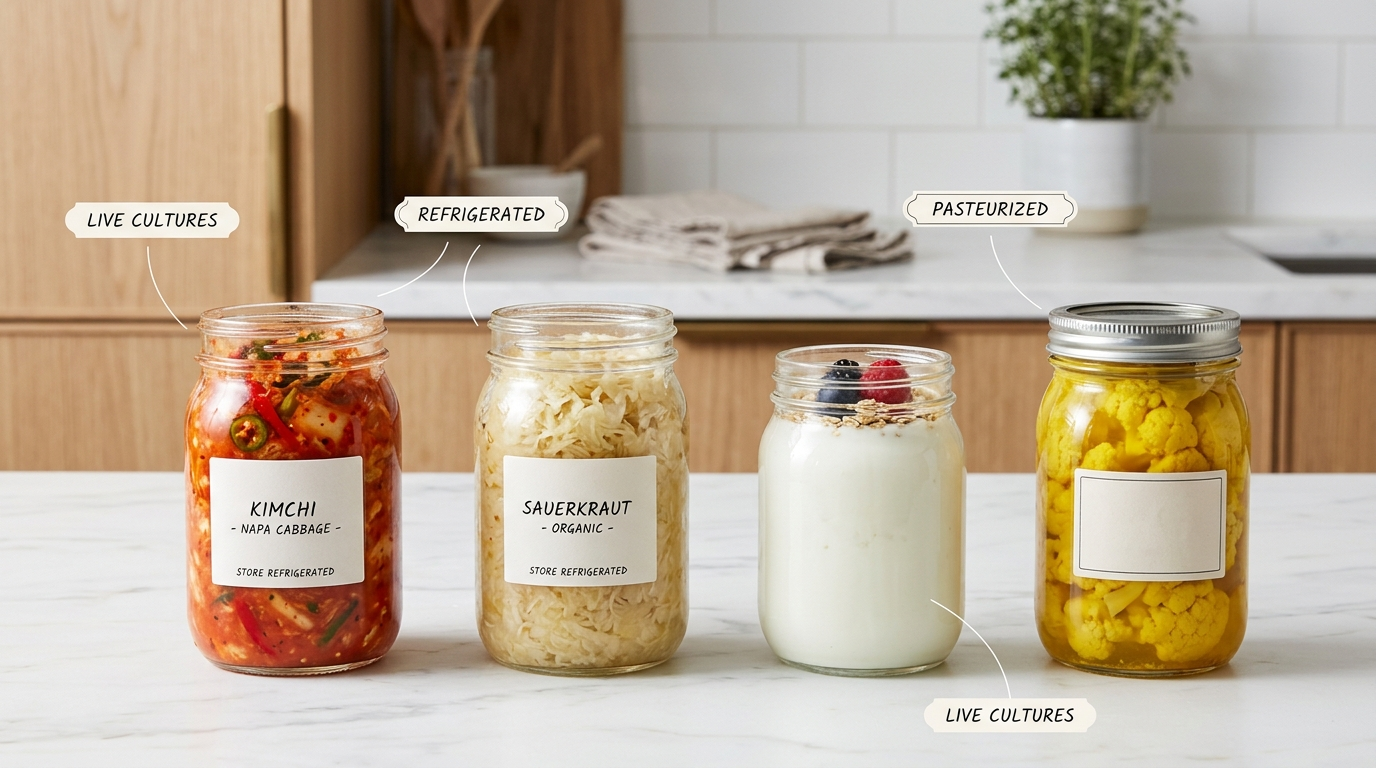
Most shelf-stable “fermented” foods are fermented for flavor, then heat-treated for safety or stability, so they may contain no live dietary microbes at purchase. Look for “live and active cultures,” “contains live cultures,” raw/unpasteurized wording, cold-chain refrigeration, and strain or CFU details. Treat “fermented” as a process claim, not probiotic proof.
How did we evaluate store-bought fermented foods for probiotic benefit?
We evaluated store-bought fermented foods by separating three entities: fermentation process, live dietary microbes, and clinically defined probiotics. We prioritized ISAPP consensus language, NIH/NCCIH consumer guidance, PubMed-indexed fermented-food reviews, and label signals shoppers can verify in a refrigerator case or Supplement Facts panel; we excluded claims such as “artisan,” “small-batch,” or “gut-friendly” without live-culture wording, strain identification, CFU information, or cold-chain storage. Evidence strength varies: probiotic supplements with named strains and human data have clearer support, while fermented foods often provide food-matrix benefits and variable live microbes rather than guaranteed probiotic effects. This article uses “live dietary microbes” for organisms present in food and reserves “probiotic” for microorganisms intended to provide a health benefit at an adequate amount, consistent with the 2014 ISAPP consensus definition, and it favors labels that disclose organism identity, serving amount, and storage conditions.
How can you tell whether a store-bought fermented food still has live microbes?
A store-bought fermented food signals live microbes through storage, label language, and processing clues. Refrigerated sauerkraut, kimchi, kefir, and yogurt are more likely to contain live dietary microbes than shelf-stable jars, canned pickles, or vinegar-brined vegetables. ISAPP states that not all fermented foods contain live microorganisms at consumption, and microbe counts vary by manufacturing and storage conditions. A label that says “pasteurized after fermentation” or sits unrefrigerated for months usually points away from live cultures. A label that says “contains live cultures,” “raw,” “unpasteurized,” or lists Lactobacillus, Bifidobacterium, Streptococcus thermophilus, or CFU counts gives stronger evidence.
| Best for use case | Stronger label signal | Weaker label signal |
|---|---|---|
| Best for live microbes | Refrigerated, live cultures, strain or CFU listed | Shelf-stable, heat-treated, vinegar-brined |
| Best for flavor only | Fermented paste, vinegar pickles, pasteurized kraut | “Gut-friendly” without culture details |
| Best for routine consistency | Named probiotic supplement plus food variety | Random fermented food without dose information |
What does pasteurization change about probiotic benefit?
Pasteurization changes probiotic potential because heat processing reduces or inactivates microorganisms that fermentation created. The food may still contain organic acids, flavor compounds, peptides, or fermentation byproducts, so pasteurized miso soup, shelf-stable sauerkraut, or canned kimchi can remain useful as food. The product should not be treated as a probiotic source unless live organisms remain and the label supports that claim. The International Scientific Association for Probiotics and Prebiotics distinguishes fermented foods from probiotics because many fermented foods do not contain named, tested microorganisms at a known amount. NCCIH also notes that probiotic effects differ by genus, species, and strain, so “contains bacteria” is not the same claim as “contains Lactobacillus rhamnosus GG at a studied dose.” A practical rule works: fermentation describes how food was made; probiotic benefit depends on what survives, which organism survives, and whether a meaningful amount reaches consumption.
Which fermented foods are best for each use case?

Best-for structure makes the label decision easier. Best for live dietary microbes: refrigerated yogurt, kefir, kimchi, and raw sauerkraut with live-culture language. Best for flavor and food diversity: pasteurized miso, shelf-stable pickles, tempeh, sourdough, and vinegar kraut. Best for predictable strain exposure: a supplement that lists organism names, serving size, and CFU through shelf life. A PubMed-indexed review, Fermented Foods, Health and the Gut Microbiome, describes fermented foods as complex matrices that may interact with the gut microbiome through microbes and metabolites, but it does not make every fermented product a probiotic product.
| Use case | Best fit | Why it fits |
|---|---|---|
| Best for live cultures | Refrigerated kefir or yogurt | Often lists live cultures and stays cold |
| Best for plant-based meals | Raw kimchi or refrigerated sauerkraut | Can deliver live dietary microbes with vegetables |
| Best for predictable routine | Named probiotic supplement | Shows serving, format, and organism details |
What should you buy if you want predictable digestive support?
Some links below are affiliate links. This does not influence our evaluation criteria or recommendations.
A shopper who wants predictable digestive support should use fermented foods for variety and choose a probiotic product for routine consistency. NCCIH describes probiotics as live microorganisms intended to have health benefits when consumed, and it cautions that effects are strain-specific rather than interchangeable across all Lactobacillus or Bifidobacterium products. Yuve Probiotic Gummies fit the convenience use case because the gummy format supports daily adherence, the product page gives shoppers a clear probiotic-specific option, and the brand sits inside a broader digestion-support routine. A careful buyer should still check the Supplement Facts panel, serving size, storage instructions, allergens, and personal tolerance before buying any probiotic. For a Yuve-forward routine, compare Yuve Probiotic Gummies with food-based fermented options, then browse the Yuve digestion collection for complementary digestive health products.
Related reading: How to Choose a Gluten-Free Probiotic That Supports Immunity.
What questions do people ask most about fermented foods and probiotics?
Are all fermented foods probiotics?
No. ISAPP defines probiotics as live microorganisms that provide a health benefit at an adequate amount, while many fermented foods lack named strains. A food can be fermented without being clinically probiotic.
Does “pasteurized” mean no live cultures?
Usually, pasteurization means heat processing reduced live microbes. The label should explicitly say “live cultures” if live microbes remain after processing or post-processing culture addition.
Are refrigerated fermented foods always better?
Refrigeration is a strong clue, not proof. Live-culture wording, strain names, and CFU information provide stronger evidence because cold-chain storage mainly protects organisms already present.
Can pasteurized fermented foods still be healthy?
Yes. Pasteurized fermented foods can provide flavor, acids, peptides, and plant nutrients, but they are not reliable probiotic sources. Treat them as food, not dose-controlled probiotic support.
Should I use fermented foods or probiotic gummies?
Use fermented foods for dietary variety and probiotic gummies for routine consistency. The best choice depends on tolerance, label transparency, adherence, and whether you want food diversity or a repeatable supplement routine.
Leave a Reply