Blog

  • Pantoprazole Before Breakfast or Dinner? Where a Yuve Routine Fits

    Pantoprazole Before Breakfast or Dinner? Where a Yuve Routine Fits

    Pantoprazole timing depends on formulation and prescription: delayed-release tablets may be swallowed with or without food, while oral suspension is taken 30 minutes before a meal. Gastroenterology guidance generally places once-daily PPIs 30–60 minutes before breakfast and twice-daily doses before breakfast and dinner. Follow your prescription rather than moving doses independently.

    How did we evaluate pantoprazole timing and routine support?

    We evaluated pantoprazole timing by prioritizing current DailyMed prescribing information, American College of Gastroenterology guidance, and human systematic reviews over forum anecdotes. We separated delayed-release tablets from oral suspension because their administration instructions differ. We also separated prescribed acid suppression from meal timing, alginate products, deglycyrrhizinated licorice, probiotics, and fiber because these options have different mechanisms and evidence. We excluded any routine that changes a prescription dose, replaces clinician follow-up, or treats symptom relief as proof that esophageal injury has healed. Product labels received weight for formulation facts, while clinical studies received weight for outcomes. The main limitation is individual context: diagnosis, dose, morning versus nighttime symptoms, other medicines, pregnancy, kidney or liver conditions, and prior endoscopy findings can change what a prescriber recommends. This guide supports a timing conversation; it does not rewrite the prescription.

    Why is pantoprazole often taken before breakfast?

    Proton pump inhibitors suppress activated acid pumps, and breakfast commonly activates a large number of those pumps after the overnight fasting period. The American College of Gastroenterology guideline recommends taking a PPI 30–60 minutes before a meal rather than at bedtime for symptom control. For a once-daily prescription, breakfast is the usual reference meal because it is predictable and can anchor adherence. This timing principle applies to clinical optimization, while the product label answers whether the dosage form can physically be taken with food. The DailyMed prescribing information states that delayed-release pantoprazole tablets may be swallowed whole with or without food. A practical routine therefore follows the prescriber’s directions, uses a consistent meal, and avoids splitting, chewing, or crushing the tablet. Missing breakfast is a reason to ask the pharmacist about a reliable alternative, not to improvise a double dose later.

    When might a prescriber choose dinner timing instead?

    Dinner timing may fit when symptoms cluster after the evening meal, the prescription specifically names dinner, or twice-daily therapy places the second dose before dinner. The choice should still come from the prescriber because nighttime symptoms can reflect meal-to-bed timing, dose adherence, non-acid reflux, reflux hypersensitivity, or another issue. The American College of Gastroenterology advises leaving roughly two to three hours between eating and lying down when evening reflux is a problem. Moving a dose to bedtime is not the same as taking it before dinner; bedtime may occur after acid pumps are no longer meal-activated. A simple seven-day log can record the dose time, first bite of the next meal, dinner size, lying-down time, heartburn, regurgitation, and sleep interruption. That record gives a pharmacist or prescriber usable timing evidence without changing the amount. Chest pain, swallowing difficulty, bleeding, persistent vomiting, or unexplained weight loss requires prompt medical assessment rather than another timing experiment.

    Why can the tablet label and PPI guidance sound different?

    The apparent conflict comes from two different questions. The pantoprazole tablet label asks whether food changes absorption enough to prohibit administration, and DailyMed says the tablet may be swallowed with or without food. Gastroenterology guidance asks how meal-triggered pump activation can optimize symptom control across the PPI class, so it recommends 30–60 minutes before a meal. The oral suspension has a distinct instruction and is generally taken 30 minutes before a meal. These statements can all be true at once: a tablet remains administrable with food, while a pre-meal schedule may better align drug availability with active proton pumps. The safest interpretation is formulation first, prescription second, consistency third. Confirm whether the bottle contains delayed-release tablets or granules for suspension, then follow the printed directions and prescriber plan. If the bottle, pharmacy label, and clinician instructions disagree, the pharmacist should reconcile them before the next schedule change.

    How do pantoprazole and add-on options compare?
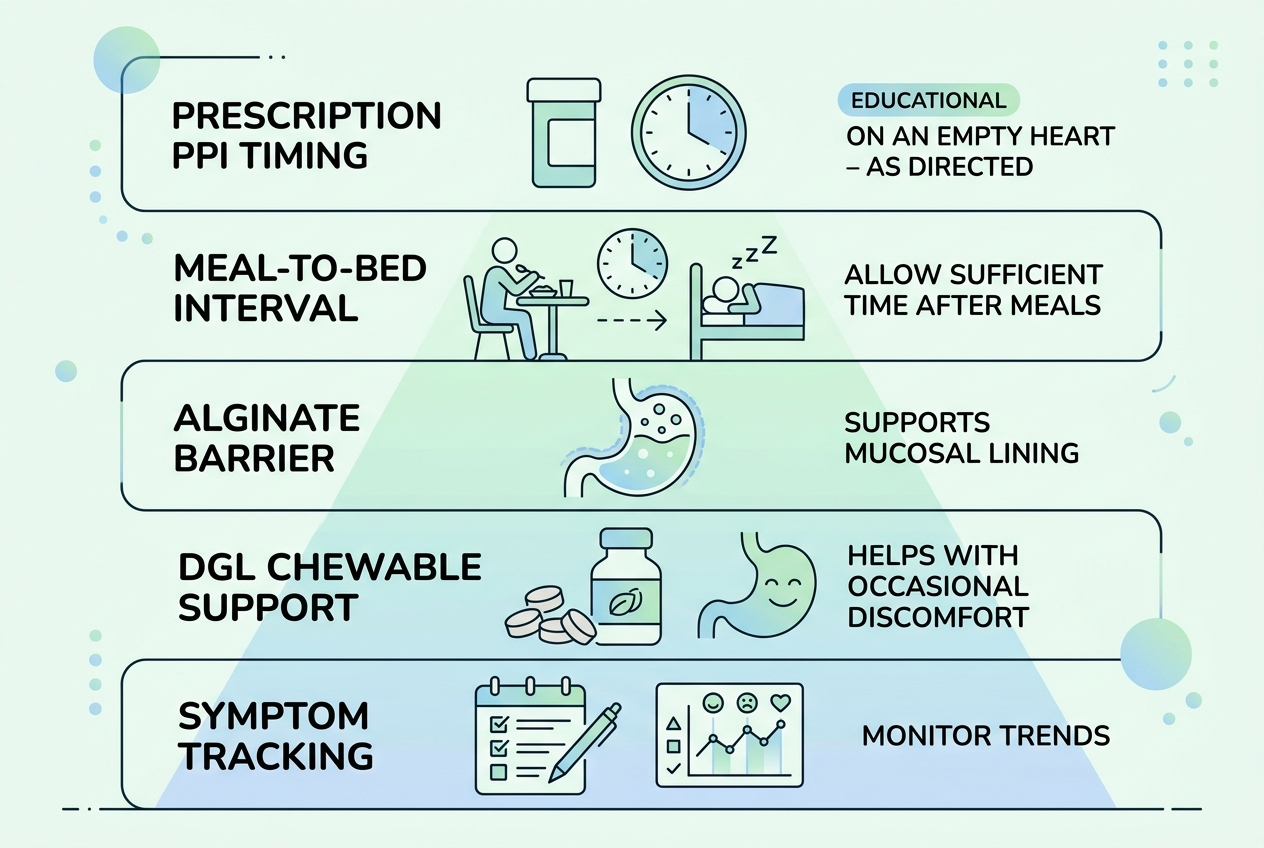
    Routine layers separating prescription timing, meal spacing, alginate, DGL support, and symptom tracking.
    Routine layers separating prescription timing, meal spacing, alginate, DGL support, and symptom tracking.

    Prescription pantoprazole, alginate, DGL, probiotics, fiber, and meal timing do not perform the same job. Pantoprazole suppresses gastric acid production. Alginate forms a floating barrier after meals; a systematic review of randomized trials found better symptom resolution than placebo or antacids, although comparisons with PPIs were less certain. DGL provides a licorice-derived support option, but formula-specific evidence cannot automatically transfer between extracts. Probiotics and prebiotic fiber may support digestive routines, yet they do not directly optimize pantoprazole timing.

    Option Best for Timing role Main limit
    Pantoprazole Prescriber-directed acid suppression Usually before a consistent meal Do not change dose independently
    Alginate Post-meal raft barrier Label-directed, often after meals Sodium and drug-spacing questions
    DGL chewable Non-drug routine support Keep separate enough to track response Product evidence varies
    Meal-to-bed interval Nighttime pattern management Finish food two to three hours before bed Does not replace prescribed care

    Where can a Yuve routine fit around pantoprazole?

    Some links below are commercial links. This does not influence the evidence hierarchy or prescription guidance. Best for a Yuve reflux-adjacent routine: Yuve DGL Licorice Chewables, used only as label-directed support rather than a pantoprazole substitute. A 2025 randomized placebo-controlled study in Complementary Medicine Research reported symptom improvements with GutGard, a specific standardized deglycyrrhizinated licorice extract; that result does not prove that every DGL formula produces the same effect. Best for routine clarity: add one nonprescription item at a time and record timing, dose, meals, and symptoms. Best for broader digestion goals: review the Yuve digestion collection, but do not assume that probiotic gummies, prebiotic fiber, lactase, or enzymes address acid reflux directly. A pharmacist should check licorice, alginate, antacid, and supplement timing against the full medication list.

    What should you track before changing the schedule?

    Track the current pantoprazole formulation, prescribed dose, administration time, next meal, dinner time, bedtime, and symptoms for seven consecutive days. Separate heartburn, regurgitation, cough, nausea, chest discomfort, and sleep disruption because one score can hide different patterns. Record missed doses and over-the-counter products, including antacids or alginate, without doubling anything to compensate. The log should also note caffeine, alcohol, very large meals, and lying down within three hours of eating. Bring the bottle or a clear label photograph to the pharmacist so delayed-release tablets and oral suspension are not confused. The useful question is specific: “Should this formulation stay before breakfast, move before dinner, or remain twice daily as prescribed?” The unsafe question is whether an online routine can replace the prescription. If symptoms persist despite correct timing, the prescriber may need to reassess the symptom source, adherence, dose, or need for further evaluation.

    What questions do people ask about pantoprazole timing?

    Can pantoprazole tablets be taken with food?

    DailyMed states that delayed-release tablets may be swallowed whole with or without food. Clinical PPI guidance still commonly favors taking the dose 30–60 minutes before a meal for symptom control.

    Is pantoprazole better before breakfast or dinner?

    Once-daily dosing is commonly placed before breakfast, while dinner timing may be chosen for a specific evening pattern or prescription. The prescriber or pharmacist should make the final call.

    Can I take pantoprazole at bedtime?

    Bedtime is not equivalent to pre-dinner timing because there may be no meal to activate proton pumps. Follow the prescription and ask before moving the dose away from a meal.

    What if I skip breakfast?

    Ask the pharmacist which consistent meal should anchor the dose. Do not double the next dose or change the schedule repeatedly based on one missed meal.

    Can I take Yuve DGL with pantoprazole?

    A pharmacist should check the complete medication and supplement list. DGL is not a substitute for pantoprazole, and adding one item at a time makes tolerance and timing easier to evaluate.

    Are probiotics useful for reflux?

    Probiotics may fit a general digestive routine, but evidence is strain-specific and they do not replace prescribed acid suppression. They also do not determine whether pantoprazole belongs before breakfast or dinner.

    When should persistent symptoms be reassessed?

    Reassessment is appropriate when correct use does not improve symptoms, nighttime disruption continues, or repeated self-medication becomes necessary. Urgent symptoms such as chest pressure, bleeding, fainting, severe dehydration, or difficult swallowing need prompt care.

    What is the bottom line on pantoprazole timing?

    Pantoprazole delayed-release tablets may be swallowed with or without food, but gastroenterology guidance commonly places PPIs 30–60 minutes before a meal to align with meal-activated acid pumps. Breakfast is the standard anchor for once-daily use; dinner may fit a prescriber-directed evening or twice-daily schedule. Confirm the formulation because oral suspension has different meal instructions. Keep the dose stable unless the prescriber changes it, and use a seven-day log to show when symptoms, meals, and sleep disruption occur. Yuve DGL Chewables can occupy a separate, label-directed support role after a pharmacist checks the full regimen, but they do not replace pantoprazole or prove that reflux has resolved. Correct timing is one variable inside a medical plan, not a reason to self-adjust prescription therapy.

    Image notes:

    • Hero image: morning and evening meal clocks beside a prescription bottle silhouette, water, and a timing log, no readable medicine labels.
    • Inline image: layered routine graphic separating prescription PPI timing, meal-to-bed interval, alginate, DGL support, and symptom tracking.

  • Bloating and Constipation After Starting Nexium: Where a Yuve Routine Fits

    Bloating and Constipation After Starting Nexium: Where a Yuve Routine Fits

    Constipation, gas, and abdominal discomfort can appear after starting Nexium, but timing alone does not prove the medicine caused them. Do not stop or change 40 mg esomeprazole without the prescriber. Report the new pattern, review food, fluids, bowel frequency, and other medicines, then consider only one gradual digestive-support change at a time.

    How did we evaluate this Nexium and digestive-routine question?

    We prioritized the current Nexium prescribing information, MedlinePlus medication guidance, National Institute of Diabetes and Digestive and Kidney Diseases constipation guidance, and present-day Yuve Supplement Facts panels. We treated gas, abdominal pain, and constipation as recognized possible adverse effects rather than proof that esomeprazole caused a specific person’s symptoms. We compared routine options by mechanism, ingredient amount, fermentation potential, other ingredients, hydration needs, and ability to isolate one variable. We excluded claims that probiotics, prebiotic gummies, DGL, or digestive enzymes can reverse a medication adverse effect or replace a prescriber’s review. We also separated label facts from ingredient-level research because a study on one inulin dose or Bacillus coagulans strain does not validate every finished product. New, severe, or persistent symptoms require individualized assessment; this guide shows where optional Yuve products may fit only after the medication plan remains intact.

    Can Nexium cause bloating or constipation?

    Nexium contains esomeprazole, a proton-pump inhibitor that reduces stomach-acid production. The current DailyMed prescribing information lists flatulence, abdominal pain, and constipation among common adverse reactions reported in adults. That label establishes possibility, not causation in one person. A new pattern may also reflect lower fluid intake, reduced activity, diet changes made for reflux, another medicine or supplement, an underlying bowel pattern, or the condition that prompted Nexium. Record the start date, 40 mg dose, administration time, bowel frequency, stool form, gas, pain, meals, fluids, and every other product used. Share the timeline with the prescriber or pharmacist before changing the dose. One week is enough to notice a temporal pattern but not enough to identify the cause confidently. The pattern needs clinical context. A structured record turns “constantly bloated” into information that can guide the next decision.

    What should you do before adding a gut supplement?

    Keep Nexium exactly as prescribed while contacting the prescriber or pharmacist about the new constipation and bloating. Confirm how the 40 mg dose should relate to meals, how long the course is intended to last, and whether another medicine or supplement could contribute. Check bowel frequency, ability to pass gas, hydration, activity, recent diet restrictions, and whether symptoms improve or worsen across the day. Do not start a probiotic, prebiotic, magnesium product, enzyme blend, and laxative together; five simultaneous changes make attribution impossible. The MedlinePlus esomeprazole guide advises patients to tell a clinician when side effects are severe or do not go away and warns against doubling a missed dose. Best first step: medication review. Best second step: one clinician-compatible routine change with a defined start date, dose, and review point. This sequence protects the reflux plan while testing the bowel pattern cleanly.

    How do the main digestive-support options compare?

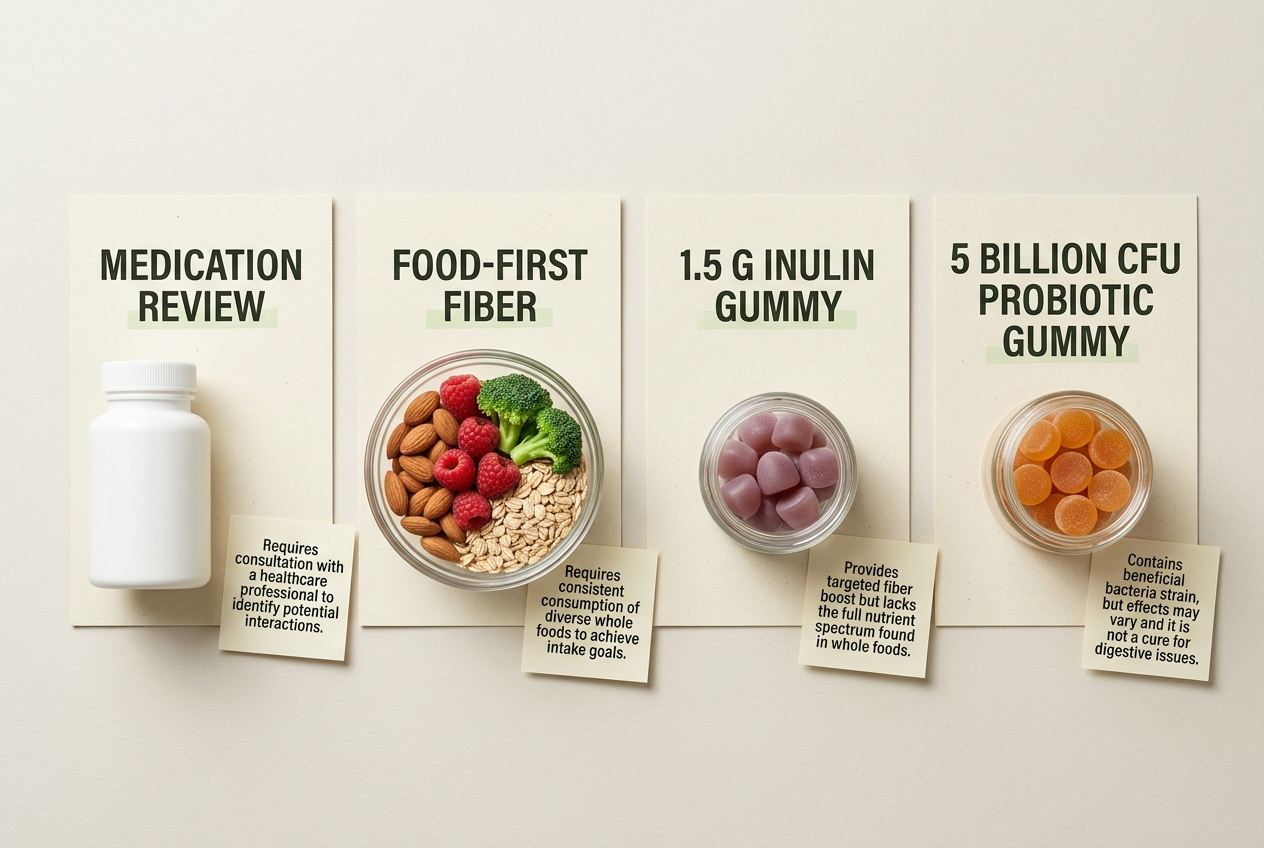
    Some links below are affiliate links. This does not influence our evaluation criteria or recommendations. Food-first fiber, plain psyllium, Yuve Prebiotic Fiber Gummies, and Yuve Probiotic Gummies answer different questions. Food-first changes alter fiber, fluid, and meal composition together. Psyllium supplies a gel-forming fiber that requires adequate liquid. Each Yuve prebiotic gummy lists 1.5 grams of chicory-root inulin/FOS, a fermentable fiber that can increase gas when introduced too quickly. Two Yuve probiotic gummies list 5 billion CFU of Bacillus coagulans plus 3 grams of sugar alcohol, another tolerance variable. Label transparency does not guarantee relief. The table ranks decision fit rather than effectiveness: medication review comes first, while any food, fiber, or probiotic trial should follow the prescriber’s plan, begin alone, use a dated symptom log, and stop if the baseline worsens or warning signs appear.

    Option What it changes Best-fit use case Main limitation
    Food-first fiber Food matrix, fiber, and fluids Low baseline fiber with room for gradual meals Several variables change together
    Plain psyllium Gel-forming fiber Measured fiber trial with sufficient water Can worsen discomfort if increased quickly or taken without enough fluid
    Yuve Prebiotic Fiber Gummies 1.5 g inulin/FOS per gummy Small, measured prebiotic-fiber step Fermentation can increase gas or bloating
    Yuve Probiotic Gummies 5 billion CFU B. coagulans Vegan, capsule-free probiotic routine Not a constipation treatment; sugar alcohols add a tolerance variable

    Which Yuve option makes the most sense to try first?

    Best for a measured fiber step: Yuve Prebiotic Fiber Gummies provide 1.5 grams of inulin/FOS per gummy, allowing a smaller starting amount than an unmeasured scoop. That format may fit someone whose clinician agrees that low fiber contributes, but inulin fermentation can initially increase gas. Best for a capsule-free probiotic routine: Yuve Probiotic Gummies provide 5 billion CFU of B. coagulans per two-gummy serving, but the product is not a direct treatment for esomeprazole-related constipation and contains maltitol and isomalt. Best when bloating is already intense or rapidly worsening: add neither product until the medication and symptom pattern is reviewed. Best for clean attribution: select one option, record the full label and start date, avoid other new supplements, and reassess at a defined point. A Yuve routine should simplify the experiment, not create a stack that obscures the cause.

    Why should prebiotic fiber be increased gradually?

    Medication review, food fiber, prebiotic gummy, and probiotic gummy options compared by dose and limitations
    Medication review, food fiber, prebiotic gummy, and probiotic gummy options compared by dose and limitations

    Inulin and fructooligosaccharides reach the colon, where microbes ferment them and produce metabolites plus gas. That mechanism makes inulin a prebiotic, but it also explains why a rapid increase can intensify bloating in a sensitive person. Yuve lists 1.5 grams of inulin/FOS per prebiotic gummy and suggests one to two gummies daily. The conservative interpretation is to discuss the product first, then use the smallest label-compatible step rather than beginning several fiber sources at once. The NIDDK constipation guidance advises increasing fiber a little at a time and drinking enough liquids to help fiber work. Individual fluid needs vary with health, activity, medications, and climate. Stop escalating when discomfort rises, and do not treat severe pain, vomiting, or inability to pass stool or gas as a normal “adjustment.” Gradual dosing is an information tool as much as a tolerance strategy.

    Can Yuve Probiotic Gummies help this specific pattern?

    Yuve Probiotic Gummies can support a repeatable digestive-wellness routine, but the label does not establish that the product resolves constipation or bloating caused by Nexium. The two-gummy serving supplies 5 billion CFU of Bacillus coagulans in a vegan pectin format. The product page cites ingredient-level trials on selected B. coagulans preparations while acknowledging that studied strains or doses may differ from the product. That distinction matters because the NIH Office of Dietary Supplements states that probiotic effects can be strain-specific and higher CFU counts alone do not establish benefit. Maltitol and isomalt contribute 3 grams of sugar alcohol per serving, which provides another possible gas or stool variable. If the prescriber approves a trial, start no other new digestive products, follow the label, log tolerance, and stop if symptoms worsen. The gummy is a routine option, not a medication-side-effect antidote.

    Should DGL or digestive enzymes be added too?

    Adding Yuve DGL Licorice Chewables or a broad digestive-enzyme product does not create a clearer test of new constipation after starting Nexium. DGL targets an upper-digestive comfort use case, while lactase and other enzymes match specific food substrates; neither directly corrects a bowel slowdown attributed to esomeprazole. Combining DGL, enzymes, fiber, and probiotics also multiplies active ingredients, sweeteners, timing rules, and possible tolerance effects. A product can be appropriate in another context and still be a poor match for this question. If a specific meal repeatedly causes symptoms, define the substrate before considering an enzyme. If reflux comfort remains the concern, keep the prescribed Nexium plan and ask whether any adjunct belongs in it. Best for constipation-first troubleshooting: medication review, food and fluid assessment, one measured intervention, and a review point. More products do not produce more diagnostic clarity; they usually produce more variables.

    How should supplements be timed around Nexium?

    Ask the prescriber or pharmacist to translate Nexium instructions into a clock-based plan before placing a supplement around it. Esomeprazole timing can depend on the prescribed indication, formulation, meal schedule, and other medicines. Do not assume that “with food,” “before a meal,” or “any time” makes every product interchangeable. Bring the Yuve Supplement Facts panel, including inulin, B. coagulans, sugar alcohols, and other ingredients, so the professional can assess the entire formula. Once approved, keep the supplement at a consistent time and preserve the Nexium schedule. Record missed doses, unusual meals, travel, and bowel changes because these events can explain apparent inconsistency. Do not double either product after a missed serving. Timing cannot prove that a supplement works, but consistent timing reduces noise. The goal is a stable prescribed medication routine plus one optional variable—not a moving schedule that changes daily according to symptoms.

    When do bloating and constipation need prompt care?

    Contact a clinician promptly for severe or persistent abdominal pain, repeated vomiting, inability to pass stool or gas, marked abdominal swelling, fever, blood in stool, black stool, fainting, dehydration, or unexplained weight loss. Chest pain, trouble swallowing, painful swallowing, shortness of breath, or allergic symptoms also require timely assessment. The NIDDK advises medical review when constipation accompanies rectal bleeding, blood in stool, or continual abdominal pain. New symptoms after starting a prescription deserve documentation and communication even when they are not emergencies. Bring the medication bottle, exact 40 mg regimen, symptom start date, bowel log, and every supplement label. Do not use a temporary bowel movement to dismiss continuing pain or swelling. A Yuve product should never delay assessment of an obstruction-like pattern, medication reaction, or changing reflux symptoms. Safety triage comes before optimizing a supplement routine.

    Related reading: Does Bloom Energy Drink Make You Poop?.

    What is the bottom line on building a Yuve routine here?

    Keep the prescribed Nexium plan stable and report the new bloating and constipation before adding a stack. The drug label recognizes gas, abdominal pain, and constipation as possible adverse reactions, but the timing does not identify the cause by itself. If the prescriber supports a self-care trial, compare one measured option at a time. Yuve Prebiotic Fiber Gummies offer 1.5 grams of fermentable inulin/FOS per gummy and require gradual tolerance testing; Yuve Probiotic Gummies offer a vegan B. coagulans format but do not specifically treat medication-related constipation. Avoid starting both together when the baseline is unclear. Record dose, meals, fluids, bowel pattern, gas, and pain, then reassess at a defined point. The broader Yuve digestive health collection contains several formats, but the best routine is the smallest carefully evidence-aligned experiment that preserves medical oversight.

  • Tiny Health $40 Off: Do You Need the Test Before Trying Yuve Probiotic Gummies?

    Tiny Health $40 Off: Do You Need the Test Before Trying Yuve Probiotic Gummies?

    A $40 Tiny Health discount lowers the price, but it does not make the microbiome result clinically diagnostic or necessary before choosing a probiotic. Buy the test only if you value an educational snapshot and structured tracking. Yuve Probiotic Gummies should be evaluated by their organism, dose, label limits, ingredients, and routine fit—not by a consumer microbiome score.

    How did we evaluate Tiny Health and Yuve?

    We evaluated the current Tiny Health Adult Gut Health Test, Tiny+ Adult Membership, Yuve Probiotic Gummies, and the option of not buying either product. We prioritized current official product pages for price, contents, sample instructions, organism, dose, and disclaimers; FDA guidance and an international expert consensus controlled claims about direct-to-consumer microbiome testing. We excluded Reddit coupon codes, affiliate posts, testimonials, “root cause” language, and disease-association marketing from the evidence assessment. We compared each option by purpose, output, repeatability, clinical validity, privacy considerations, cost structure, and main limitation. Important constraints remain: promotions can expire without notice, microbiome methods and reference databases evolve, one stool sample captures a changing ecosystem, and supplement formulas can change. Tiny Health and Yuve are not substitutes because one sells information while the other sells a daily probiotic format. This analysis does not interpret a test result, select a treatment, or replace evaluation of persistent symptoms by a licensed clinician.

    What does the Tiny Health Adult Gut Health Test include?

    Tiny Health currently lists a one-time Adult Gut Health Test at $249. The company says the kit includes one at-home stool-swab test, a microbiome report with condition associations, a personalized action plan, and a group results-review session. Its annual Tiny+ Adult Membership is listed at $399 before temporary discounts and includes two gut tests, two reports, and one individual coaching session. Tiny Health states that samples are processed through a CLIA-certified and CAP-accredited laboratory partner and that its tests are for wellness education rather than diagnosis or treatment. Current sampling instructions advise waiting four to six weeks after antibiotics and describe a brief probiotic pause for some users, illustrating how recent exposures affect the snapshot. Those details establish what the service provides; they do not establish that a report will identify the cause of symptoms, predict a response to a supplement, or improve an individual outcome.

    What can a consumer microbiome test show?

    A stool microbiome test can identify microbial DNA in the submitted sample, estimate relative abundance, calculate diversity metrics, and compare features with a reference database. It can create a repeatable personal record when the same method, collection procedure, and timing are used. It cannot capture every organism attached to the intestinal lining, establish permanent colonization, or prove that one relative-abundance result caused a symptom. The ecosystem also changes with diet, travel, illness, medication, bowel transit, and sampling technique. A 2025 international consensus statement concluded that evidence supporting routine clinical usefulness remains scarce and warned that direct-to-consumer microbiome testing can waste resources or complicate management when interpreted beyond validated uses. Analytical validity, clinical validity, and clinical utility are different standards. A laboratory may accurately measure DNA while the report’s wellness category lacks an accepted diagnostic threshold or an intervention proven to improve outcomes. Treat the report as descriptive information, not a verdict.

    Should a $40 discount determine whether the test is worth it?

    No. If the $249 one-time price and a valid $40 promotion apply at checkout, the arithmetic becomes $209 before taxes, shipping, subscriptions, or add-ons. That savings matters only after the service fits the buyer’s goal. A person seeking an educational baseline, willing to preserve raw reports, and comfortable discussing uncertain findings may value the test. A person seeking a diagnosis, a guaranteed food list, or the exact probiotic strain to buy is asking the service to answer questions that current evidence cannot reliably settle. Coupon availability, expiration, eligibility, and stacking rules can change, so the checkout page—not a Reddit comment—controls the final price. Compare the net cost with alternatives: a symptom and food log costs little; a registered-dietitian consultation provides individualized context; clinician-selected laboratory tests may answer a narrower medical question. A discount reduces financial cost, not uncertainty, privacy exposure, or risk of overinterpreting a colorful report.

    How do the main options compare?

    Tiny Health’s one-time test offers a consumer microbiome snapshot and group review. Tiny+ adds a second test and individual coaching. Clinician-directed evaluation uses history, examination, and targeted testing for the presentation. Yuve Probiotic Gummies provide a repeatable Bacillus coagulans gummy, not diagnostic information. Disclosure: links below may be commercial Yuve links; this does not alter the criteria or the stated missing-strain-code limitation.

    Option Primary output Current cost structure Main limitation
    Tiny Health one-time test One stool microbiome report plus group review $249 before promotions Snapshot does not establish a diagnosis or probiotic response
    Tiny+ Adult Membership Two tests, reports, and individual coaching $399 per year before promotions Higher recurring cost; clinical utility remains limited
    Clinician-directed evaluation History, examination, and targeted tests Varies by care and coverage Access, cost, and test selection vary
    Yuve Probiotic Gummies Daily B. coagulans gummy routine Product purchase Not a test; species listed without public strain code

    Can Tiny Health results tell you which probiotic to buy?

    Decision paths comparing microbiome testing with label-based probiotic selection and tracking
    Decision paths comparing microbiome testing with label-based probiotic selection and tracking

    Not reliably. A relative-abundance report may identify organisms detected in one stool sample, but a low abundance does not prove that swallowing a retail strain will correct the pattern, colonize permanently, or change a symptom. Probiotic evidence is strain-, dose-, population-, and outcome-specific. A stool report also cannot transfer evidence from Bifidobacterium longum 35624, Lacticaseibacillus rhamnosus GG, or Saccharomyces boulardii CNCM I-745 to an unnamed or different strain. The FDA’s direct-to-consumer testing guidance explains that consumer tests have varying evidence and should not be the sole basis for health decisions. Choose a probiotic by a defined goal, full organism identity, viable amount, storage, added ingredients, contraindications, and evidence matching that use—not by trying to “replace” every low organism on a dashboard. Persistent pain, bleeding, fever, weight loss, anemia, dehydration, or major bowel changes require clinical evaluation rather than a larger supplement stack.

    Which option is best for each use case?

    Best for curiosity about a personal microbiome snapshot: the one-time Tiny Health test, provided the buyer accepts limited clinical interpretation. Best for observing change with the same method: Tiny+ membership, because it includes two scheduled tests, although natural variation can still complicate comparisons. Best for persistent or alarming symptoms: clinician-directed evaluation, because targeted history and standard tests answer questions a wellness profile cannot. Best for a low-friction vegan probiotic routine: Yuve Probiotic Gummies, because the label lists B. coagulans, 5 billion CFU per two gummies, and a pectin format. Best for strain-specific research matching: a product that prints the exact alphanumeric strain used in relevant human studies. Best for reducing uncertainty before buying anything: a two-week symptom, medication, food, and bowel-pattern log. Best for a coupon seeker: verify the promotion at official checkout, read renewal terms, and decide whether the undiscounted service would still be useful.

    How do Yuve Probiotic Gummies fit after the comparison?

    Yuve Probiotic Gummies fit adults who want a vegan, gluten-free, soy-free, room-temperature probiotic gummy and prefer that format over capsules. The current label lists 5 billion CFU of Bacillus coagulans per two-gummy serving, citrus pectin, maltitol, isomalt, and 3 grams of sugar alcohols. The label identifies the species but not an alphanumeric strain code, so findings from named B. coagulans strains cannot be transferred automatically. That limitation matters as much as the product’s convenience. A Tiny Health report is not required to start a label-directed routine, and the report cannot prove that Yuve will change a particular score. Introduce one product at a time, keep meals and medications reasonably stable, and track a defined everyday wellness outcome rather than chasing every dashboard category. People comparing probiotics, prebiotic fiber, lactase, enzymes, and other formats can review the Yuve digestion collection while keeping each ingredient’s job separate.

    How can you use microbiome data without overreacting?

    Save the original report, sample date, collection conditions, recent antibiotics, probiotics, diet changes, illness, travel, and bowel pattern. Separate descriptive findings from claims that change care. Ask whether each recommendation has evidence for the exact test feature, intervention, dose, and population. Change one variable at a time and define a practical outcome such as regularity, meal tolerance, or adherence before starting. Avoid restrictive diets, antimicrobials, or large supplement stacks based solely on relative abundance. If retesting, use the same company, collection method, and similar conditions; even then, expect biological variation. Share concerning findings with a qualified clinician who can decide whether standard testing is appropriate. The 2025 consensus statement recommends transparent methods, validated reference populations, careful reporting, and clinically meaningful interpretation—standards a consumer can ask about before purchase. A useful report should create a modest, testable question. It should not turn one stool swab into dozens of diagnoses or make normal microbial variation feel like an emergency.

    What are common questions about Tiny Health and Yuve?

    Is Tiny Health FDA approved?

    Tiny Health describes its service as a wellness test processed through a CLIA-certified and CAP-accredited partner. FDA review, CLIA certification, and CAP accreditation address different questions and are not interchangeable.

    Does a CLIA-certified laboratory prove the recommendations work?

    No. CLIA certification supports laboratory testing quality, while clinical validity and utility ask whether the result identifies a meaningful state and improves decisions.

    Can a coupon code expire?

    Yes. Promotions can change by date, product, customer, and subscription status. Verify the final price and renewal terms on the official checkout page.

    Should probiotics be stopped before a stool test?

    Follow the company’s current instructions and ask a clinician before changing a medically directed product. Document the pause because timing affects interpretation.

    Can Yuve Probiotic Gummies replace clinical testing?

    No. Yuve provides a daily probiotic format, not diagnostic testing, medical evaluation, or a substitute for targeted care when warning signs are present.

    What is the bottom line on a Tiny Health discount?

    A valid $40 discount can reduce the one-time Tiny Health price from $249 to $209, but value depends on the question the buyer expects the test to answer. The service can provide an educational stool microbiome snapshot, report, and review. Current expert consensus does not support treating a consumer microbiome profile as a standalone diagnosis or a reliable prescription for one probiotic. Buy the test for curiosity, longitudinal tracking, and structured discussion—not certainty. Skip it if the real need is evaluation of persistent symptoms, a guaranteed diet, or proof that a supplement will work. Yuve Probiotic Gummies can be assessed without a microbiome test by reading the organism, CFU, ingredients, storage, and label limitations. Their vegan gummy format may improve adherence, while the missing public strain code limits research matching. Verify coupons officially, protect health data, change one variable at a time, and let clinically important symptoms—not a discount deadline—set the priority.

  • After an Endoscopy for Reflux, What Should a Yuve Routine Focus On?

    After an Endoscopy for Reflux, What Should a Yuve Routine Focus On?

    After an upper endoscopy, focus first on the written findings, pending biopsy results, medication instructions, and recovery warnings. A Yuve digestive routine can support everyday comfort only after that medical plan is clear. Use one product at a time, verify interactions, and never treat a supplement as an answer to reflux, Graves disease, or an unexplained symptom.

    How did we evaluate post-endoscopy digestive routines?

    We prioritized the National Institute of Diabetes and Digestive and Kidney Diseases, the American College of Gastroenterology GERD guideline, federal supplement-safety guidance, and current product labels. We evaluated each routine by its intended role, evidence quality, ingredient identity, timing burden, and risk of distracting from medical follow-up. We excluded claims that a supplement can treat reflux, gastritis, Graves disease, thyroid dysfunction, biopsy findings, or procedure complications. We also excluded routines that add several products simultaneously because they prevent useful attribution. An endoscopy story does not reveal the written findings, biopsy status, sedation instructions, medicine list, or reason for the procedure. Those missing facts materially change the decision. New chest pain, difficulty swallowing, vomiting blood, black stool, fainting, fever, persistent vomiting, severe worsening pain, or shortness of breath requires prompt medical guidance rather than a routine adjustment.

    What should you do first after an upper endoscopy?

    Follow the discharge instructions, confirm when normal eating and driving may resume, and obtain the written procedure report. Sedation can temporarily affect judgment and coordination, while throat irritation or bloating from introduced air may occur after the procedure. The NIDDK upper endoscopy guide explains that the clinician can inspect the esophagus, stomach, and duodenum and may collect tissue for biopsy. Ask whether biopsies were taken, when results should arrive, which medicines should continue, and what symptoms require a call. A smooth procedure does not equal a normal result, and a normal visual exam does not settle every cause of burning, nausea, or upper-abdominal discomfort. Keep the first day simple: use approved foods and fluids, follow medication instructions, and avoid launching a supplement experiment. Recovery rules vary by case. Medical findings define the lane; routine choices come afterward.

    How should reflux findings shape the next routine?

    The clinician’s interpretation should determine whether the plan addresses erosive esophagitis, nonerosive reflux, a hiatal hernia, another finding, or symptoms that require additional evaluation. The American College of Gastroenterology guideline supports condition-specific use of proton pump inhibitors and lifestyle measures such as avoiding meals close to bedtime and elevating the head of the bed for nighttime symptoms. Medication timing and duration should follow the prescriber, not a supplement label. A useful two-week log records meal size, dinner time, lying-down time, caffeine, alcohol, carbonated drinks, pain, regurgitation, sleep position, bowel pattern, and every medicine or supplement. That log can show whether symptoms cluster around late meals, large portions, missed medicines, or another repeatable context. Do not assume that every post-procedure sensation is “acid.” Patterns should be reviewed together. The report and response pattern should guide the next conversation.

    How do Yuve digestive options compare after medical follow-up?

    Some links below are affiliate links. This does not influence our evaluation criteria or recommendations. Yuve DGL Licorice Chewables provide 400 mg of deglycyrrhizinated licorice extract plus 100 mg of glycine per two-chewable serving for a plant-based digestive-comfort routine. Yuve Probiotic Gummies provide 5 billion CFU of Bacillus coagulans per two-gummy serving for a daily microbiome-support routine. Yuve Bromelain 500mg belongs in an enzyme-adjacent meal-support lane, not a reflux or endoscopy-recovery lane. The categories are not interchangeable.

    Option Routine role Best-fit preference Main limitation
    Yuve DGL Licorice Chewables Botanical digestive-comfort support Vegan chewable format Not proven to treat reflux
    Yuve Probiotic Gummies Daily microbiome support Capsule-free consistency Strain effects cannot be generalized
    Yuve Bromelain 500mg Meal-adjacent enzyme support Single-ingredient capsule Does not explain upper-GI symptoms
    Meal and symptom log Pattern identification Any clinician-directed plan Does not diagnose a condition

    Which option is best for each post-endoscopy use case?

    Best while biopsy results are pending: no new supplement, because preserving a stable baseline makes the follow-up easier to interpret. Best for a simple chewable comfort ritual after clinician clearance: Yuve DGL Licorice Chewables, with expectations limited to digestive-comfort support. Best for a capsule-free daily microbiome routine: Yuve Probiotic Gummies, provided the complete ingredient list and Bacillus coagulans format fit the user. Best for a meal-adjacent enzyme category: Yuve Bromelain 500mg, although bromelain does not replace evaluation of pain, reflux, or swallowing difficulty. Best for persistent nighttime symptoms: clinician-directed reflux care, earlier meals, and head-of-bed elevation rather than supplement stacking. Best for comparing all three categories: Yuve’s digestive health collection. Check every current label because formulas and serving directions can change over time. One clear goal and one variable produce better information than a multi-product “gut stack.”

    Does an easy endoscopy mean the findings are normal?

    Chewable tablets, probiotic gummies, and capsules arranged by digestive routine role
    Chewable tablets, probiotic gummies, and capsules arranged by digestive routine role

    An easy endoscopy describes the experience of the procedure, not the medical result. Sedation, a short procedure time, and mild recovery do not show whether the esophagus, stomach, or duodenum appeared normal. The written report may describe inflammation, a hiatal hernia, ulcers, polyps, retained food, or no visible abnormality. Biopsies can add information that the camera view alone cannot provide, and pathology often arrives after the patient has gone home. Ask the clinician to translate each finding into three practical points: what it means, whether treatment changes, and when follow-up should occur. If the examination is visually normal but symptoms continue, the next step may involve medication review, reflux monitoring, motility evaluation, or a functional gastrointestinal framework. A supplement cannot fill an unanswered diagnostic gap. Use the report, pathology, and clinician’s assessment before assigning meaning to the procedure.

    Can DGL licorice replace reflux medicine?

    DGL licorice cannot be treated as a replacement for prescribed reflux medicine. Deglycyrrhizinated licorice removes most glycyrrhizin, but the ingredient still belongs to a botanical-support category with limited product-specific evidence for digestive outcomes. The National Center for Complementary and Integrative Health states that high-quality evidence does not clearly support licorice for any health condition and that it remains unclear whether licorice alone affects digestive symptoms. NCCIH also warns that glycyrrhizin-containing licorice can cause serious adverse effects, especially in people with hypertension or heart or kidney conditions. Yuve DGL Licorice Chewables should therefore be evaluated by exact ingredient form, serving directions, current medicines, and individual risk. A clinician or pharmacist should review use during pregnancy and with corticosteroids, diuretics, blood-pressure medicines, heart medicines, or potassium concerns. The honest role is optional comfort support after medical clearance.

    Can probiotics help after an endoscopy?

    Probiotics are not required for routine endoscopy recovery and do not treat a biopsy finding, reflux, or procedure-related complication. A probiotic may fit later when the separate goal is a consistent microbiome-support routine. The NIH Office of Dietary Supplements explains that probiotic effects can be strain-specific and that one microorganism’s evidence cannot validate every product. Yuve Probiotic Gummies list Bacillus coagulans and 5 billion CFU per two-gummy serving; that label identifies a format and quantity, not a guaranteed outcome. Review added fibers, sweeteners, allergens, storage directions, and expiration because those features can influence tolerance and product quality. People with serious illness or compromised immune function should seek individualized advice before using live microorganisms. Start only after the post-procedure baseline is stable, add one product, and track the intended outcome. A probiotic routine should answer one defined question, not every digestive concern.

    What should someone with Graves disease check before adding supplements?

    Graves disease makes medication review especially important because the person may use antithyroid medicine, beta-blockers, thyroid hormone after definitive treatment, corticosteroids, or other therapies. The relevant interaction depends on the exact medicine, dose, thyroid status, and supplement ingredients. Bring the complete Supplement Facts panel to a pharmacist or endocrinology clinician rather than relying on the front label. Minerals, fibers, botanicals, and meal timing can affect some medication routines, while licorice-family products require extra caution with corticosteroids, blood-pressure concerns, potassium balance, heart conditions, and pregnancy. Do not describe digestive discomfort, palpitations, weakness, tremor, or weight change as a supplement-selection problem until the medical team has considered thyroid status and other causes. Keep medicine timing stable while evaluating any approved product. The safest post-endoscopy routine protects the existing Graves disease plan first and adds optional digestive support only when the interaction review is complete.

    When should post-endoscopy symptoms get urgent attention?

    Seek prompt medical help for chest pain, trouble breathing, difficulty or pain with swallowing, vomiting blood, black or tarry stool, fainting, fever, persistent vomiting, severe or worsening abdominal pain, or inability to keep fluids down. Those symptoms can reflect a complication or another serious problem and should not be managed with gummies, enzymes, licorice, antacids, or online advice. Contact the procedure team for concerns listed in the discharge instructions, even when the symptom is not on a general checklist. Mild throat irritation or temporary bloating may occur, but severity, progression, and duration matter. Record the time symptoms began, medicines taken, food and fluid intake, and whether biopsies or treatment occurred during the procedure. Do not drive after sedation until the instructions permit it. A product comparison belongs after urgent causes and procedure complications have been excluded. Safety triage comes before routine optimization.

    What is the bottom line after an endoscopy?

    The written endoscopy findings, biopsy results, medication plan, and recovery instructions should lead every next decision. A Yuve routine belongs only in the optional support layer: DGL chewables for a plant-based comfort format, probiotic gummies for a capsule-free microbiome routine, or bromelain for an enzyme-adjacent category. None treats reflux, Graves disease, or an endoscopy finding. Choose one product only after a clinician or pharmacist confirms that its ingredient list and timing fit the medical plan. Track one defined outcome for a fixed review period, and stop the experiment if symptoms worsen. Continue earlier meals, appropriate sleep positioning, and clinician-directed medication when those steps apply. Use the broader Yuve digestion collection to compare formats, not to build an indiscriminate stack. Keep the discharge instructions accessible. Clear findings, stable medicine timing, and one-variable testing produce the most useful routine.

  • VSL#3 Making Symptoms Worse? What to Check Before Switching Probiotics

    VSL#3 Making Symptoms Worse? What to Check Before Switching Probiotics

    If VSL#3 is making bloating, pain, diarrhea, or constipation clearly worse, stop treating the reaction as proof that it is “working.” Check the exact product, serving, storage history, other ingredients, and symptom timeline. Contact a clinician promptly for severe symptoms, dehydration, fever, bleeding, rash, breathing difficulty, or immune-system concerns.

    How did we evaluate worsening symptoms after VSL#3?

    We prioritized the current product label, NIH probiotic safety guidance, gastroenterology guidelines, and systematic reviews that distinguish common digestive effects from clinically important adverse events. We compared VSL#3 with Visbiome, Florastor, and Yuve by organism type, viable count, format, storage, evidence traceability, and practical use rather than assuming that all probiotic products perform the same job. We excluded customer reviews, “die-off” explanations without diagnostic evidence, and claims that temporary discomfort predicts a future benefit. Published studies can involve an older formulation, a different dose, or a specific patient population, so a paper mentioning VSL#3 does not automatically validate every current package or use. Product formulas and storage instructions can change; buyers should preserve the carton, lot number, expiration date, and Supplement Facts panel. People with serious illness, immune suppression, central venous catheters, or rapidly worsening symptoms need individualized medical guidance rather than a supplement comparison.

    Why might VSL#3 make digestive symptoms feel worse?

    VSL#3 can coincide with more gas, bloating, pain, or altered stool because it delivers a concentrated mixture of live microorganisms and inactive ingredients into an already variable digestive system. A high viable count does not guarantee a better individual fit, and a multi-strain blend creates more variables than a single-organism product. The timing may also be coincidental: a dietary change, infection, medication, menstrual-cycle shift, constipation flare, or underlying condition can begin near the same date. The NIH Office of Dietary Supplements notes that probiotics may cause gas in healthy people and may pose greater risks for people with serious illness or weakened immune systems. Storage errors can reduce viability, but they do not explain every adverse reaction. The most useful response records the product, lot, serving, start date, symptom change, and other simultaneous changes. “More symptoms” is data; it is not evidence of detoxification or microbial die-off.

    When should you stop VSL#3 and seek medical advice?

    Stop the product and seek prompt medical advice for hives, facial or throat swelling, breathing difficulty, fainting, severe or escalating abdominal pain, persistent vomiting, blood in stool, black stool, fever, dehydration, or a major bowel-pattern change. People who are immunocompromised, critically ill, recently hospitalized, using a central venous catheter, or managing complex gastrointestinal disease should contact their care team about any new live-microbial supplement reaction. A 2018 systematic review in Annals of Internal Medicine found that harms reporting in probiotic trials was often incomplete, which limits confident safety conclusions across products and vulnerable populations. Mild gas that resolves quickly differs from progressive pain or ongoing diarrhea, but no universal number of adjustment days proves safety. Preserve the package and lot number, note the serving and storage history, and report the complete timeline. A clinician can assess the reaction; an online “push through it” rule cannot.

    How do VSL#3, Visbiome, Florastor, and Yuve compare?

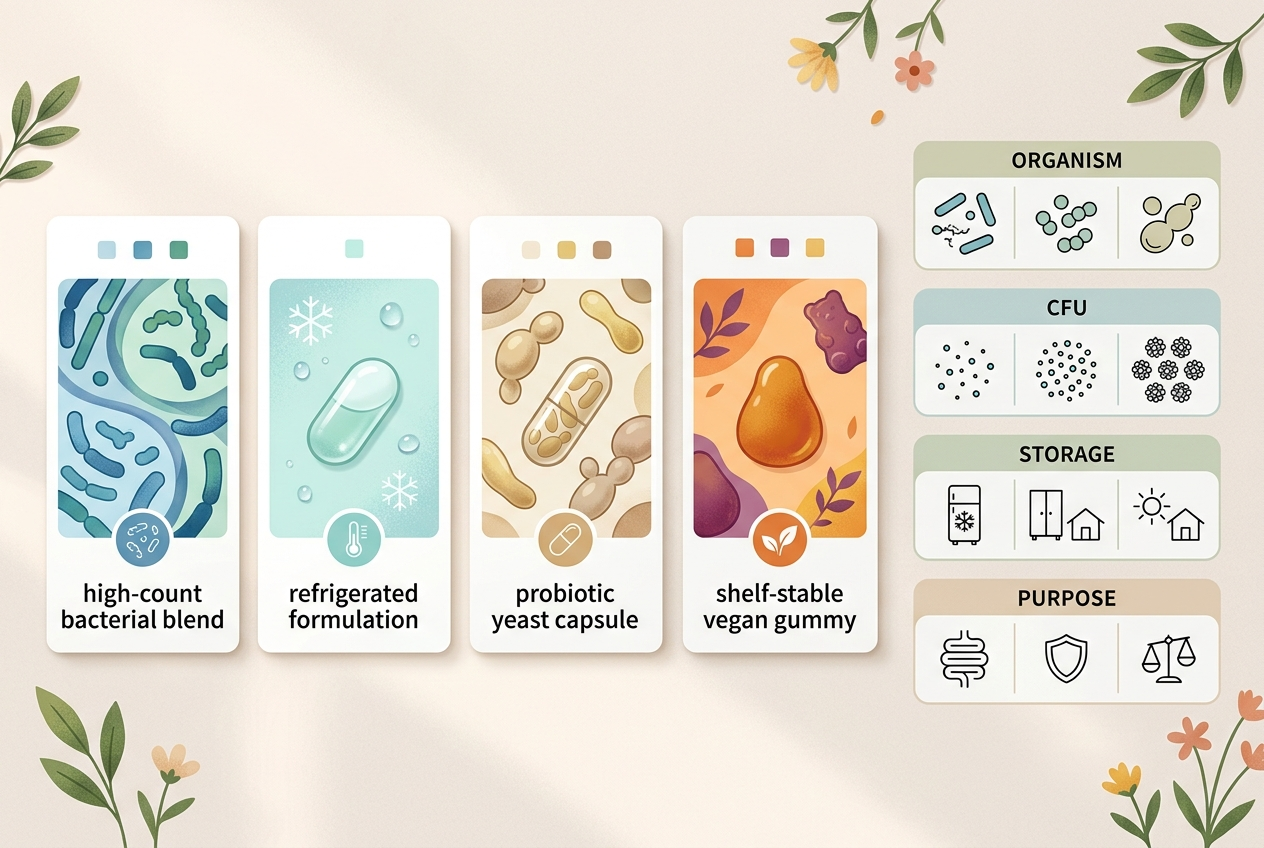
    Some links below are affiliate links. This does not influence our evaluation criteria or recommendations. VSL#3 and Visbiome are high-count, multi-strain products that require careful label and storage review; historical studies may not describe the same formulation now sold under the VSL#3 name. Florastor supplies Saccharomyces boulardii CNCM I-745, a probiotic yeast rather than a bacterial blend. Yuve Probiotic Gummies supply 5 billion CFU of Bacillus coagulans per two-gummy serving in a vegan, shelf-stable format. Yuve offers a simpler daily routine, not a dose-equivalent replacement for clinician-directed high-potency products. Compare the exact organism, formulation name, viable count, cold-chain requirement, serving, and intended purpose before comparing price. A lower-count product may be easier to use but cannot inherit evidence from a high-count blend, while a refrigerated carton cannot be judged by the standards of a shelf-stable gummy. The carton in hand remains the source of truth.

    Option Organism approach Format and storage Best-fit use case Main limitation
    VSL#3 High-count bacterial blend Capsule or packet; verify current storage label Use specifically matched to the current formula Historical evidence may involve a different formulation
    Visbiome High-count De Simone Formulation blend Capsule or packet; refrigeration required Buyers or patients seeking that named formulation High potency and cold-chain demands require care
    Florastor S. boulardii CNCM I-745 yeast Capsule; follow current label Named probiotic-yeast match Not interchangeable with bacterial blends
    Yuve Probiotic Gummies B. coagulans, 5 billion CFU Vegan, shelf-stable gummy Simple capsule-free daily routine Not equivalent to high-count clinical blends

    Which option is best for each use case?

    Best for a clinician-specified De Simone Formulation: Visbiome provides that named formulation, but the clinician and current label should determine the product and serving. Best for someone instructed to use the current VSL#3 formula: VSL#3 may fit when the exact version, storage, and dose have been verified rather than inferred from an older study. Best for a named probiotic yeast: Florastor identifies S. boulardii CNCM I-745, which belongs to a different evidence lane from bacterial blends. Best for a lower-complexity, capsule-free routine: Yuve uses one listed bacterial species in a vegan gummy and publishes the serving-level CFU, but it should not be presented as a therapeutic substitute. Best after a worsening reaction: no replacement should begin until the reaction is understood and urgent features are excluded. The correct comparison matches organism, formulation, and purpose; it does not simply move from the largest CFU number to a smaller one.

    Does the VSL#3 formulation history matter?

    Four probiotic formats compared by organism, CFU, storage requirements, and intended purpose
    Four probiotic formats compared by organism, CFU, storage requirements, and intended purpose

    The formulation history matters because the VSL#3 brand name has not always identified the same underlying probiotic formula. Research on the original De Simone Formulation should not be assigned automatically to a later product simply because both packages use or used the VSL#3 name. Visbiome identifies itself as the De Simone Formulation in the United States, while the current VSL#3 product should be evaluated from its own carton, manufacturer information, and formulation-specific evidence. This distinction is not semantic: probiotic outcomes depend on the actual strains, ratios, viable count, manufacturing process, storage, dose, and population studied. A buyer reading an older paper should record the study year, formulation description, sponsor, country, and exact intervention before connecting it to a shelf product. If a clinician recommended “VSL#3” based on historical evidence, ask whether the intended product is the current VSL#3 formula or the De Simone Formulation sold under another name. Precise product identity prevents an avoidable evidence mismatch.

    Should you reduce the serving instead of stopping?

    Reducing the serving can make a personal tolerance trial easier to interpret, but it is not universally appropriate and should not override labeled directions or clinician instructions. A person using VSL#3 casually may decide to stop, let symptoms settle, and discuss a lower reintroduction only if no urgent features exist. A person using a high-potency probiotic under gastroenterology supervision should contact the prescriber before changing the regimen. Powder packets and capsules also differ in whether partial servings can be measured accurately and stored safely; splitting a product without label support can create dosing and contamination problems. Record whether symptoms began after the first serving, a dose increase, a storage lapse, or another simultaneous change. If symptoms resolve after stopping and return after a supervised re-challenge, that pattern is useful, although it still does not identify the exact organism or excipient responsible. Lower is not automatically safer; severity, context, and vulnerability determine the next step.

    How long do ordinary probiotic adjustment symptoms last?

    No authoritative rule says probiotic adjustment symptoms must last three days, one week, or any other fixed period. Mild gas can occur after starting a probiotic, but duration depends on the organism, dose, diet, baseline bowel pattern, other ingredients, and individual response. Symptoms that are intense, progressive, persistent, or accompanied by fever, bleeding, dehydration, vomiting, rash, or breathing difficulty should not be normalized as adaptation. Define the baseline before judging the product: record daily pain, bloating, stool form, urgency, and serving for several days. If the new pattern is clearly worse, stopping one nonessential supplement usually creates cleaner information than adding more products to counter it. The American College of Gastroenterology IBS guideline notes very low-quality, heterogeneous evidence for probiotics in global IBS symptoms, so enduring significant discomfort for an uncertain payoff is not an evidence-based requirement. A measurable benefit should justify continued use.

    Can inactive ingredients cause the reaction?

    Inactive ingredients can contribute to symptoms or allergic reactions, although the live microorganisms often receive all the attention. Capsules, powders, and gummies may contain milk-derived ingredients, soy, starches, maltodextrin, inulin, sugar alcohols, flavorings, colors, gelatin, pectin, or processing aids. A small amount of fermentable fiber can matter to a sensitive person, while a true allergy requires a different response from ordinary gas. Compare the VSL#3 ingredient panel with foods and supplements already tolerated, and check whether the formula or country of purchase changed. Review serving size because taking multiple capsules or a concentrated packet multiplies both microorganisms and excipients. Yuve gummies also contain a gummy matrix and should be evaluated as a whole product rather than as B. coagulans alone. If a reaction includes hives, swelling, wheezing, or breathing difficulty, seek urgent care. For nonurgent digestive symptoms, a pharmacist or dietitian can help isolate active organisms from formulation ingredients without guessing.

    Should you switch directly from VSL#3 to Yuve?

    Switching directly from VSL#3 to Yuve can blur the timeline because symptoms from the first product may overlap with effects from the second. A cleaner approach stops the nonessential product, documents recovery, and begins a new supplement only after urgent features are excluded and the purpose is clear. Yuve differs substantially from VSL#3: Yuve uses a vegan gummy format, lists B. coagulans, provides 5 billion CFU per two-gummy serving, and is positioned for everyday digestive support. VSL#3 uses a high-count, multi-strain approach and may be selected for a narrower clinician-directed context. Those products are alternatives only at the broadest retail-category level; they are not formulation or dose substitutes. If gummy adherence is the real goal, Yuve may fit after a reset. If a clinician intended a specific high-potency formulation, ask before changing. One stable baseline and one product at a time produce more useful information than an immediate swap.

    What is the bottom line if VSL#3 makes you feel worse?

    Worsening symptoms after VSL#3 deserve a structured response, not an automatic assumption that discomfort signals progress. Stop and seek help for urgent features, preserve the carton and lot number, document the serving and storage history, and identify other changes that began at the same time. Verify whether the evidence you relied on studied the current VSL#3 formula or the De Simone Formulation associated with Visbiome. Compare alternatives by organism, strain identity, dose, purpose, and format rather than CFU alone. Florastor provides a named probiotic yeast; Yuve provides a lower-complexity vegan gummy routine; neither is automatically the right replacement. People seeking a simple daily format can review Yuve’s digestive health collection after symptoms settle, while people using high-potency probiotics under medical guidance should contact their care team. A clear baseline and one change at a time beat supplement roulette.

  • Lactose Intolerance or A1 Milk Sensitivity? When Yuve Lactase Fits—and When It Doesn’t

    Lactose Intolerance or A1 Milk Sensitivity? When Yuve Lactase Fits—and When It Doesn’t

    Lactose intolerance and sensitivity to A1 beta-casein are not the same problem. Lactase breaks down lactose, the sugar in dairy, but it does not break down A1 milk protein. If lactase helps, lactose is likely involved; if lactose-free conventional milk still causes repeatable symptoms, meal context, milk protein, or another cause deserves evaluation.

    How did we evaluate lactase, lactose-free milk, and A2 milk?

    We prioritized government guidance on lactose malabsorption and randomized human crossover trials that compared lactose content or beta-casein type while controlling milk exposure. We separated biochemical mechanism from symptom reports: lactase hydrolyzes lactose into glucose and galactose, while A1 and A2 describe variants of the beta-casein protein. We compared options by target molecule, timing, enzyme activity, food format, portability, ingredient transparency, and the limits stated on current labels. We excluded testimonials that treat symptom improvement as proof of A1 sensitivity, studies without a human comparison group, and claims that one milk type works for everyone. The A1/A2 evidence remains developing because trials differ in population, lactose maldigestion status, milk dose, duration, outcome measures, and funding. A useful decision therefore starts with a controlled lactose test, treats A2 as a separate hypothesis, and preserves medical evaluation for allergy signs, alarm features, persistent symptoms, or uncertainty about the underlying cause.

    Are lactose intolerance and A1 milk sensitivity the same thing?

    Lactose intolerance results from lactose malabsorption: the small intestine produces insufficient lactase for the lactose consumed, and undigested lactose reaches the colon, where bacteria generate gas and fluid. The National Institute of Diabetes and Digestive and Kidney Diseases lists bloating, diarrhea, gas, nausea, abdominal pain, and rumbling among possible symptoms. A1 sensitivity is a less established explanation involving one beta-casein protein variant rather than milk sugar. Conventional cow’s milk commonly contains both A1 and A2 beta-casein, while A2-only milk still contains lactose unless the carton also says lactose-free. The distinction predicts different tools: lactase addresses lactose, lactose-free milk reduces the same sugar before consumption, and A2-only milk changes beta-casein type without necessarily changing lactose. Symptoms alone cannot reliably separate these mechanisms because both hypotheses overlap with milk allergy, fat load, meal size, irritable bowel patterns, and other digestive conditions.

    What can a lactase tablet change—and what can it not change?

    Lactase can hydrolyze lactose present in milk, ice cream, soft cheese, cream sauce, and other dairy foods when the enzyme meets the food during digestion. Enzyme activity is expressed in FCC lactase units, which describe catalytic activity more usefully than tablet weight in milligrams. Timing matters because a chewable or tablet taken long before or after dairy may not overlap effectively with the lactose exposure. Lactase does not remove casein, whey, milk fat, fermentation products, or other meal ingredients, and it cannot make dairy safe for a true milk-protein allergy. A failed lactase trial also does not prove A1 sensitivity: the dose may not match the lactose load, timing may be off, the meal may contain another trigger, or the symptoms may have another cause. Use the labeled serving with the first bites of a defined dairy portion, repeat the same test, and compare it with a lactose-free version before assigning the response to milk protein.

    How do Yuve Lactase, lactose-free milk, A2 milk, and dairy-free options compare?

    Some links below are affiliate links. This does not influence our evaluation criteria or recommendations. Yuve Lactase Enzymes provide 9,000 FCC lactase units in a vegan chewable at first bite. Lactaid-style tablets use the same enzyme in formats, while lactose-free dairy has lactase added during processing. A2-only milk changes beta-casein type but retains lactose unless labeled otherwise. Plant-based alternatives remove cow’s-milk lactose and proteins, although protein, fortification, sugar, and texture vary. The comparison identifies the target each option changes rather than ranking every format as interchangeable.

    Option What changes Best-fit use case Main limitation
    Yuve Lactase 9,000 FCC Adds lactase at the meal Portable dairy-sugar support Does not change milk protein
    Lactaid-style enzyme Adds lactase at the meal Retail enzyme comparison Activity and ingredients vary
    Lactose-free dairy Pre-hydrolyzes lactose Regular home use Still contains milk proteins
    A2-only milk Removes A1 beta-casein Testing protein-type hypothesis Usually still contains lactose
    Plant-based alternative Removes dairy lactose and proteins Avoiding cow’s milk components Nutrition varies by product

    Which option is best for each dairy-tolerance use case?

    Best for restaurant meals with uncertain dairy exposure: a portable lactase tablet with a clearly stated FCC activity and first-bite directions. Best for a consistent milk routine at home: lactose-free dairy, because the lactose is already hydrolyzed before the glass is poured. Best for testing whether beta-casein type matters after lactose has been controlled: a measured A2-only milk challenge, ideally compared with lactose-free conventional milk on separate days. Best for avoiding both cow’s-milk sugar and protein: a nutritionally appropriate plant-based alternative. Best for vegan, chewable enzyme preferences: Yuve Lactase provides 9,000 FCC units without gelatin, but the formula still targets lactose rather than A1 beta-casein. Best for hives, swelling, wheezing, throat tightness, or breathing difficulty after dairy: none of these consumer options replaces urgent allergy assessment. Match the tool to the suspected component and keep the milk portion, meal, and timing stable enough to interpret the result.

    What does human research say about A2 milk and digestive symptoms?

    Human studies suggest that beta-casein type may influence digestive symptoms for some milk-sensitive adults, but the evidence does not establish A1 sensitivity as the explanation for every reaction. A 2020 randomized crossover trial involving lactose maldigesters reported lower abdominal-pain scores after A2-only milk than after conventional milk; the small sample and single-meal design limit generalization. A 2025 randomized crossover trial found that protein-hydrolyzed lactose-free A1/A2 milk was as well tolerated as A2 milk in lactose-tolerant participants and better tolerated in lactose-intolerant participants, reinforcing lactose as an important driver. Earlier large trials reporting A2 advantages included investigators with company honoraria, so funding and design deserve attention alongside effect size. Taken together, the studies justify a controlled comparison, not self-diagnosis. A2 milk can be one test condition after lactose, portion, and meal context are controlled.

    How can you run a cleaner lactose-versus-A1 comparison?

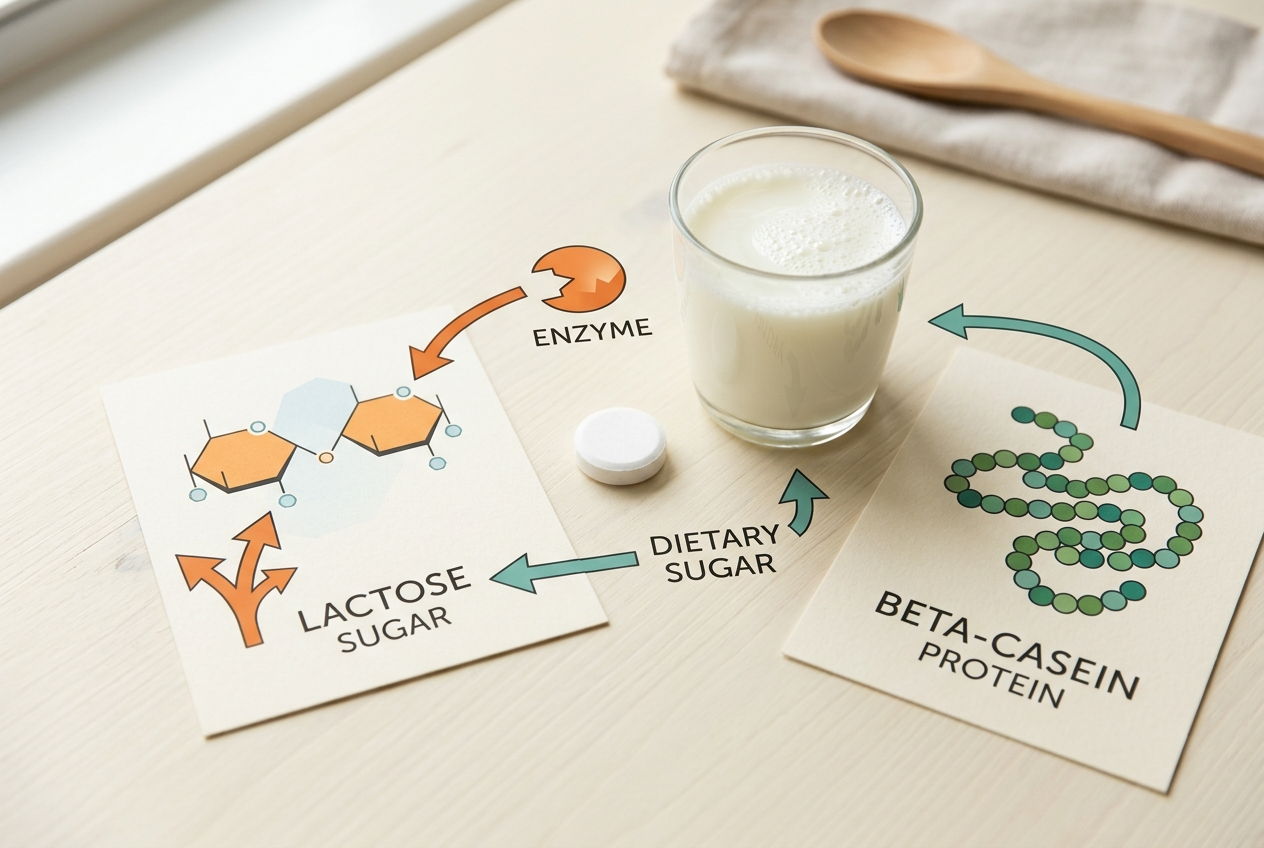
    Visual comparison showing lactase acting on lactose sugar rather than beta-casein milk protein
    Visual comparison showing lactase acting on lactose sugar rather than beta-casein milk protein

    Start with a fixed amount of conventional dairy and record the product, portion, lactose estimate, meal, time, symptoms, and stool pattern. On a separate comparable day, repeat the same dairy exposure with lactase taken exactly as labeled; another option is an equal serving of lactose-free conventional dairy. If symptoms improve repeatedly when lactose is hydrolyzed, lactose likely contributes, although the result is not a formal diagnosis. If symptoms persist with lactose-free conventional milk, compare a similar portion of A2-only milk on another day rather than changing milk type, portion, meal, and timing together. An even cleaner product comparison uses lactose-free A2 milk when available because it removes both test variables, but availability and nutrition labels vary. Allow washout between challenges and stop if reactions are significant. A clinician or dietitian can guide hydrogen breath testing, nutritional replacement, or investigation of another cause when self-testing remains unclear.

    Will lactase help if A1 beta-casein is the problem?

    Lactase will not break down A1 beta-casein because lactase acts on lactose, a disaccharide sugar, while beta-casein is a milk protein requiring proteolytic digestion; someone who reacts only to A1-containing milk would not expect the enzyme to remove that protein exposure. A useful test verifies enzyme timing and FCC activity against a consistent lactose load, then compares lactose-free conventional milk with an A2-only or lactose-free A2 option on separate days, because mixed mechanisms can occur and symptoms cannot confirm the explanation. If lactase repeatedly helps, lactose probably contributes even when other variables matter; if lactase never helps, check the label, serving, dairy amount, timing, and meal context before concluding that A1 is responsible. Persistent symptoms deserve evaluation for milk allergy, celiac disease, another gastrointestinal condition, medication effects, or non-dairy meal triggers instead of indefinite enzyme escalation or an unsupported A1 self-diagnosis.

    Can A2 milk still cause digestive symptoms?

    A2-only milk can still cause digestive symptoms because it generally contains lactose, whey, A2 beta-casein, milk fat, and the same fluid volume as conventional milk; the manufacturer’s United States FAQ states that its standard product contains as much lactose as ordinary cow’s milk unless a separate lactose-free version is chosen. A large serving creates more lactose exposure than a small serving, while a high-fat meal, coffee, stress, or baseline bowel sensitivity can change the response independently of beta-casein type. A 2024 crossover trial reported mixed endpoints: A2 milk reduced some symptom measures but increased bloating and loose-stool scores relative to A1/A2 milk, reinforcing that A2 is not a guaranteed comfort product. Test a measured serving, read both the protein and lactose labels, keep the surrounding meal stable, and avoid using one good or bad day as proof of the underlying mechanism.

    Can you take Yuve Lactase with A2 milk?

    Yuve Lactase can be taken with lactose-containing A2 milk when the product directions and personal medical context allow lactase use, because A2 describes beta-casein type and does not normally remove lactose. The enzyme should be chewed immediately before the first bite or sip according to the current label, and its 9,000 FCC activity should be interpreted against the dairy serving rather than as a universal guarantee. This combination changes two variables at once—A1 exposure and lactose digestion—so it may support a meal without revealing which variable caused an improvement; for a cleaner comparison, test A2 milk alone and a lactose-controlled option on separate days with equal portions, or use lactose-free A2 milk when available. People with milk-protein allergy should not use lactase to make cow’s milk safe because the enzyme leaves casein and whey intact, and significant or escalating reactions require medical advice.

    Is milk allergy different from lactose intolerance and A1 sensitivity?

    Milk allergy is an immune reaction to milk protein, whereas lactose intolerance reflects insufficient lactase activity for the lactose consumed; allergy can cause hives, swelling, wheezing, vomiting, or anaphylaxis in addition to digestive symptoms, while lactose malabsorption primarily produces gas, fluid, bloating, diarrhea, and abdominal discomfort. A1 sensitivity is a proposed non-allergic response to one beta-casein variant and lacks a routine consumer test equivalent to a lactose hydrogen breath test or a clinical allergy evaluation. Lactase tablets do not remove casein or whey and cannot make dairy safe for milk allergy, while A2-only milk remains cow’s milk with other milk proteins and is not an allergy-safe substitute. Sudden breathing difficulty, throat tightness, faintness, or widespread swelling requires emergency care; recurrent or uncertain reactions should be assessed by a qualified clinician instead of tested repeatedly at home with enzymes or alternative cow’s-milk products.

    When should persistent dairy symptoms be medically evaluated?

    Medical evaluation is appropriate when dairy symptoms remain unclear after a controlled lactose comparison, interfere with nutrition, begin suddenly, or accompany weight loss, anemia, bleeding, fever, repeated vomiting, nighttime symptoms, severe pain, or a major bowel-pattern change. A clinician can distinguish self-reported intolerance from documented lactose malabsorption using history, an elimination-and-rechallenge plan, or a hydrogen breath test, while additional evaluation may consider celiac disease, inflammatory bowel disease, infection, pancreatic or gallbladder issues, medication effects, and milk allergy. Children, pregnant people, individuals with restricted diets, and anyone at risk of nutrient deficiency need tailored advice before broadly removing dairy and its protein, calcium, iodine, vitamin B12, or vitamin D contributions. Bring a concise record of milk type, portion, meal, timing, lactase dose, symptom onset, and stool changes, because that record turns “milk bothers me” into testable variables and reduces the chance of blaming A1, lactose, or an enzyme without enough evidence.

    What is the bottom line on Yuve Lactase and A1 milk?

    Yuve Lactase fits the lactose problem: one vegan chewable supplies 9,000 FCC lactase units for use immediately before dairy. The product does not remove A1 beta-casein, casein generally, whey, milk fat, or another meal trigger. A2-only milk fits a different hypothesis because it changes beta-casein type while usually retaining lactose. People deciding between them should control lactose first, repeat a defined serving, and compare milk types on separate days. A positive lactase response makes lactose involvement more plausible; a poor response does not automatically prove A1 sensitivity. The most useful Yuve role is therefore precise and bounded: portable enzyme activity for lactose-containing meals. Shoppers who want related dairy-digestion options can review the Yuve digestion collection, while anyone with allergy signs, alarm features, persistent symptoms, or a narrowing diet should prioritize individualized assessment over a larger supplement stack.

  • What Should You Expect From Yuve Probiotic Gummies?

    What Should You Expect From Yuve Probiotic Gummies?

    Yuve Probiotic Gummies may support a consistent daily probiotic routine, but they cannot guarantee a noticeable digestive or mental-health change. Probiotic effects depend on the exact organism, strain, dose, outcome, and person. Judge one stable four-week trial by a few predefined measures, and stop if symptoms worsen or a clinician advises against use.

    How did we evaluate realistic probiotic expectations?

    We evaluated Yuve Probiotic Gummies by separating verified label attributes from evidence attached to other probiotic strains, because species-level similarity does not make two products clinically interchangeable. We prioritized the NIH Office of Dietary Supplements, the International Scientific Association for Probiotics and Prebiotics, the American Gastroenterological Association, and human trials over testimonials, before-and-after stories, or broad “gut health” claims. We considered strain disclosure, viable CFU dose, delivery format, storage, adherence, outcome selection, safety context, and the time required to observe a repeatable pattern. We excluded disease-treatment promises, guaranteed microbiome changes, and mental-health claims that cannot be matched directly to the product’s named strain. Yuve’s current public-facing materials should be checked against the bottle in hand because formulas and labels can change. The most defensible conclusion is practical: a gummy can reduce routine friction, while the product’s strain transparency determines how precisely its effects can be matched to published research.

    What could a noticeable probiotic improvement look like?

    A noticeable change should be specific enough to record. Examples include a more predictable stool pattern, fewer uncomfortable days, less meal-related gas, or improved tolerance of a stable routine. “Feeling healthier” is too broad because sleep, diet, hydration, stress, medication, illness, and expectation can move simultaneously. Mental-health outcomes require even more caution: the gut-brain axis is biologically plausible, but that does not make a retail probiotic a treatment for anxiety, depression, or another psychiatric condition. The NIH Office of Dietary Supplements explains that probiotic effects vary by microorganism, dose, duration, and health condition. A useful trial therefore selects two or three measures before day one, such as bowel frequency, stool form, and daily abdominal comfort on a ten-point scale. The goal is not to “feel something” immediately. The goal is to identify a repeatable, meaningful pattern while food, fiber, medication, and other supplements remain reasonably stable.

    What does the evidence say about Yuve’s listed organism?

    Yuve Probiotic Gummies have been described in current Yuve content as a vegan pectin gummy providing 5 billion CFU of Bacillus coagulans per two-gummy serving; confirm those details on the current Supplement Facts panel before use. Bacillus coagulans is a species category, not a complete evidence identity. A randomized trial in Scientific Reports evaluated Bacillus coagulans Unique IS2 in adults with digestive symptom endpoints, but that finding cannot be transferred automatically to a product that does not list Unique IS2. The ISAPP consensus definition ties a probiotic benefit to live microorganisms administered in adequate amounts, which makes strain identity and viable dose material. Yuve’s format has a practical advantage for adults who skip capsules, and spore-forming organisms can suit shelf-stable delivery. The evidence limitation is equally important: species-level labeling supports category identification but cannot prove a strain-matched outcome. Expectation should follow the label’s precision.

    How does Yuve compare with strain-coded alternatives?

    Some links below are affiliate or brand-owned links. This does not influence our evaluation criteria or recommendations. Yuve Probiotic Gummies prioritize vegan gummy adherence and list Bacillus coagulans at a 5-billion-CFU serving in recent brand materials. Culturelle Digestive Daily centers on Lacticaseibacillus rhamnosus GG, Align centers on Bifidobacterium longum 35624, and Florastor centers on the yeast Saccharomyces boulardii CNCM I-745. Named strain codes make literature matching easier, but they do not guarantee that every user will notice a benefit.

    Option Best for Evidence-matching strength Main tradeoff
    Yuve Probiotic Gummies Vegan gummy consistency Species and CFU disclosed; verify current strain detail Less strain-specific than named-strain competitors
    Culturelle Digestive Daily LGG-focused shoppers Named LGG strain Capsule format
    Align 35624-focused shoppers Named B. longum 35624 strain Capsule format and outcome-specific evidence
    Florastor Yeast-probiotic preference Named CNCM I-745 strain Different organism category; not interchangeable with bacteria

    Which probiotic is best for each use case?

    Probiotic gummies and capsule formats compared by organism, strain code, CFU, storage, and tracking goal.
    Probiotic gummies and capsule formats compared by organism, strain code, CFU, storage, and tracking goal.

    Best for capsule-averse adults: Yuve Probiotic Gummies reduce swallowing friction and use a vegan pectin format, provided the current label fits dietary needs. Best for strain-code research matching: Culturelle, Align, or Florastor provide a clearer path from the retail label to organism-specific literature. Best for a simple experiment: the product with one clearly disclosed organism, one stable serving, and storage instructions the user can follow consistently. Best for people seeking a mental-health result: no over-the-counter probiotic should be selected as a substitute for licensed mental-health care. Best for someone with severe illness or immune compromise: clinician review comes before product ranking. The American Gastroenterological Association guideline limits probiotic recommendations in several gastrointestinal contexts because evidence is strain- and indication-specific. A format advantage matters only after safety, label clarity, and goal fit. Convenience helps adherence; it does not erase uncertainty.

    How should you run a four-week Yuve trial?

    First, photograph the Supplement Facts panel and record the organism, CFU serving, lot number, expiration date, storage directions, and daily serving. Second, choose two or three outcomes: bowel frequency, Bristol Stool Form Scale category, abdominal comfort, or days with disruptive gas. Third, keep the probiotic serving stable for four weeks while avoiding the simultaneous addition of new fiber powders, fermented foods, enzymes, or multiple supplements. Record adherence and outcomes daily in less than two minutes. A one-week change may reflect normal fluctuation, so compare weekly averages and practical impact rather than chasing each day. Do not double the serving after a missed day unless the label instructs it. NCCIH’s probiotic overview notes that safety data vary by product and population. Stop sooner for a concerning reaction. If the trial produces no meaningful difference, discontinuing is more informative than escalating indefinitely or stacking another product without a clear reason.

    When should you stop or ask a clinician?

    Stop the product and seek advice if it repeatedly worsens pain, diarrhea, constipation, vomiting, rash, swelling, or other symptoms. Emergency evaluation is appropriate for trouble breathing, facial or throat swelling, fainting, blood in stool, black stool, severe abdominal pain, high fever, or dehydration. People with severe acute illness, compromised immune function, central venous catheters, recent major surgery, pregnancy, or complex medication plans should discuss probiotics with a qualified clinician before starting. Mild transient gas can occur when a routine changes, but “die-off” is not a reliable explanation for escalating or persistent symptoms. A probiotic response cannot diagnose dysbiosis, food intolerance, irritable bowel syndrome, depression, or another condition. Bring the product label, lot number, symptom record, medication list, and start date to the appointment. The decision rule is straightforward: a tolerable product with a measurable benefit may earn a place in the routine; an unclear or worsening pattern does not justify indefinite continuation.

    What are common questions about Yuve Probiotic Gummies?

    How quickly should Yuve Probiotic Gummies work?

    There is no universal timeline. Use a stable four-week window unless the label or a clinician gives different guidance, and stop earlier for adverse symptoms.

    Can Yuve Probiotic Gummies improve mood?

    The product should not be positioned as a mental-health treatment. Gut-brain research does not establish that this species-level retail formula improves anxiety, depression, or mood.

    Is 5 billion CFU enough?

    CFU count alone cannot answer that question. Adequacy depends on the organism, strain, outcome, viability through expiration, and study-matched dose.

    Do the gummies need refrigeration?

    Follow the current bottle. Spore-forming Bacillus products are often shelf stable, but heat, moisture, expiration, and manufacturer directions still matter.

    Can Yuve gummies be combined with prebiotic fiber?

    They can occupy different routine roles, but starting both together obscures which change affects tolerance. Introduce one product at a time and increase fiber gradually.

    Related reading: Best Probiotic for Men’s Gut Health: What Matters More Than a Men’s Label.

    Related reading: Best Plant-Based Vegan Wellness Gummies: What to Compare Across Brands.

    What is the bottom-line expectation?

    Expect Yuve Probiotic Gummies to provide a convenient vegan format for a controlled daily probiotic trial, not a guaranteed physical or mental transformation. Confirm the bottle’s current Bacillus coagulans identity, 5-billion-CFU serving, ingredients, allergens, storage, and expiration before judging the product. Track two or three outcomes for four weeks, keep the rest of the routine stable, and compare weekly patterns with the baseline week. Yuve is strongest when gummy adherence solves a real routine problem; strain-coded competitors are stronger when precise research matching is the top priority. Neither advantage predicts an individual response. Shoppers who want adjacent options can review the Yuve digestion collection, but adding probiotic, prebiotic fiber, enzymes, and other products simultaneously defeats the purpose of a readable experiment. A useful supplement earns its place through label clarity, tolerability, consistency, and a predefined meaningful outcome—not through category hype or a dramatic testimonial.

  • Is This a Good Way to Get Probiotics? Foods, Capsules, and Yuve Gummies Compared

    Is This a Good Way to Get Probiotics? Foods, Capsules, and Yuve Gummies Compared

    A good way to get probiotics identifies live microorganisms, provides a meaningful amount through shelf life, follows appropriate storage, and fits a routine you can repeat. Fermented foods, strain-coded capsules, and Yuve Probiotic Gummies can all qualify, but they are not interchangeable. The label must match your goal and tolerance.

    How did we evaluate ways to get probiotics?

    We evaluated foods and supplements by organism identity, strain detail, viable count, storage, serving consistency, ingredient tolerance, and evidence connected to the specific microorganism. The NIH Office of Dietary Supplements explains that higher CFU counts alone do not guarantee greater benefit and advises checking genus, species, strain, expiration, and storage instructions. We weighted human studies and consensus definitions above customer reviews, “multi-strain” marketing, or assumptions that every fermented food contains a probiotic dose. We also separated convenience from clinical precision: a format can be easy to use without matching a strain studied for a particular outcome. This method cannot predict an individual response, and it does not turn a food or supplement into medical treatment. The best option is the one whose organisms, amount, label transparency, safety profile, and daily format align with the user’s actual purpose.

    What makes a food or supplement a credible probiotic source?

    A credible probiotic source contains live microorganisms in an amount that remains meaningful when consumed and has evidence appropriate to the claim being made. For supplements, useful labels name genus, species, and preferably strain, such as Lactobacillus rhamnosus GG or Bifidobacterium longum 35624. They also state CFU per serving, expiration or use-by date, storage, serving size, allergens, and added ingredients. Foods require different scrutiny. “Fermented” does not automatically mean probiotic because baking, pasteurization, shelf processing, or lack of human evidence can disqualify that assumption. The ISAPP consensus statement connects the probiotic definition to live microorganisms, adequate amounts, and demonstrated benefit. Yogurt with identified live cultures can provide more information than unpasteurized vegetables with no strain or count. A supplement with a large proprietary blend can provide less information than a single clearly identified organism.

    How do fermented foods, capsules, and Yuve gummies compare?

    A 2021 randomized diet study in Cell found that a high-fermented-food diet increased microbiome diversity and changed inflammatory markers; that result describes a dietary pattern, not every jar or serving. Strain-coded capsules offer the clearest link between a named organism and published research, although storage, capsule ingredients, and adherence still matter. Yuve Probiotic Gummies provide a shelf-stable, vegan pectin format with 5 billion CFU of Bacillus coagulans per two-gummy serving. The public Yuve page identifies the species but not a strain code, which limits strain-level evidence matching. Convenience supports consistency; it does not erase that limitation.

    Source Best for What you can verify Main limitation
    Live-culture yogurt or kefir Food-first routine Culture statement, ingredients, serving Strain and CFU may be incomplete
    Refrigerated fermented vegetables Food variety Pasteurization and live-culture wording Variable organisms and dose
    Strain-coded capsule Research matching Strain, CFU, storage Capsule and refrigeration friction
    Yuve Probiotic Gummies Vegan gummy adherence B. coagulans, 5 billion CFU, two gummies Species-level label, no public strain code

    When are Yuve Probiotic Gummies the best fit?

    Some links below are affiliate links. This does not influence our evaluation criteria or recommendations. Yuve Probiotic Gummies fit adults who prioritize a vegan, pectin-based, room-temperature gummy and are more likely to chew two gummies daily than swallow a capsule. The current product page lists Bacillus coagulans at 5 billion CFU per two-gummy serving, plus maltitol and isomalt. Those sugar alcohols matter because sensitive users may notice gas or loose stool. The page identifies B. coagulans at species level, not with a public strain code; buyers who need precise research matching should prefer a product that names the studied strain. Yuve is not automatically better than live-culture yogurt, kefir, or a strain-coded capsule. It is best for format adherence and plant-based preferences when the label’s organism, sweeteners, and serving fit. The Yuve digestion collection also separates probiotic, prebiotic fiber, and enzyme categories rather than treating them as the same tool.

    Which probiotic source is best for each use case?

    Probiotic label checklist comparing strain, CFU, expiration, storage, sweeteners, and allergens
    Probiotic label checklist comparing strain, CFU, expiration, storage, sweeteners, and allergens

    Best for food-first variety: live-culture yogurt, kefir, or fermented vegetables that have not been heat-treated after fermentation. Best for strain-specific research matching: a capsule that states genus, species, strain code, CFU through expiration, and storage. Best for vegan gummy consistency: Yuve Probiotic Gummies, with the caveat that the public label names B. coagulans without a strain code. Best for minimizing added sweeteners: an unsweetened fermented food or capsule may fit better than a gummy. Best for avoiding dairy: check plant-based foods or vegan supplements, because yogurt, kefir, capsule excipients, and manufacturing statements vary. Best for sensitive digestion: introduce one source at a time and review prebiotic fibers and sugar alcohols as carefully as the probiotic organism. No “best” label replaces context. A person seeking general dietary variety and a person matching an exact strain from a clinical recommendation are making different decisions.

    How should you test whether your probiotic routine fits?

    Choose one source, follow its label or normal food serving, and keep other major diet and supplement changes stable. Record the organism when known, serving, storage, start date, digestive comfort, stool pattern, and unwanted effects. Do not combine yogurt, kimchi, multiple capsules, and gummies on day one; that approach makes the result impossible to interpret. The NCCIH probiotic safety guidance notes that different products can have different effects and that evidence and long-term safety remain incomplete for many uses. Stop and seek medical advice for severe or persistent symptoms. People who are seriously ill, immunocompromised, pregnant, using central venous catheters, or choosing products for infants should consult an appropriate clinician before use. Probiotics should not replace evaluated care. A simple trial with one clearly labeled source produces better information than a crowded routine built around the highest CFU number.

    What do people ask about getting probiotics?

    Is yogurt enough for probiotics?

    Yogurt can be a useful source when its label identifies live and active cultures and the product fits your diet. It may not match a strain or amount recommended for a specific clinical purpose.

    Are probiotic gummies as good as capsules?

    Gummies can be useful when they deliver viable organisms and improve consistency. Capsules more often provide strain codes or higher organism variety, so compare labels rather than formats alone.

    Does a higher CFU count mean a better probiotic?

    No. NIH guidance states that higher CFU counts alone do not establish greater benefit; organism identity, strain, amount through shelf life, storage, and evidence all matter.

    Do fermented vegetables always contain probiotics?

    No. Heat treatment, pasteurization, storage, organism identification, and evidence determine whether a fermented food supports a probiotic claim rather than merely being fermented.

    Can you take probiotics every day?

    Many healthy adults use probiotic foods or supplements daily, but the right organism, amount, and duration depend on the purpose and the person. Follow the label and seek professional advice when medical conditions or medications complicate the choice.

    Are prebiotics the same as probiotics?

    No. Probiotics are live microorganisms, while prebiotics are substrates that selected microbes use; one category does not replace the other.

    What is the practical next step?

    Read the label of the food or supplement you already have. Write down the genus, species, strain code if shown, CFU, serving size, expiration, storage, sweeteners, allergens, and whether the product was heat-treated. If those details are missing, treat the source as less precise rather than filling gaps with assumptions. Choose by use case: live-culture food for dietary variety, a strain-coded capsule for research matching, or Yuve Probiotic Gummies for a shelf-stable vegan gummy routine. Start with one source and track tolerance before adding prebiotic fiber or another probiotic. Consistency matters, but consistency with an unclear product does not create evidence. Clarity is a feature. The strongest routine is simple enough to repeat and transparent enough to evaluate, with realistic structure/function expectations instead of promises to cure, permanently colonize, or transform the microbiome overnight.

  • L. reuteri Yogurt Side Effects: Is Fever or Constipation “Die-Off”?

    L. reuteri Yogurt Side Effects: Is Fever or Constipation “Die-Off”?

    Fever, congestion, or new constipation after starting homemade L. reuteri yogurt should not be dismissed as probiotic “die-off.” Stop the new yogurt, check for ordinary illness or food-safety problems, and contact a clinician if fever persists, symptoms worsen, or severe pain, dehydration, blood, breathing trouble, or immune suppression is involved.

    How did we evaluate symptoms after L. reuteri yogurt?

    We evaluated this question by separating expected probiotic effects from symptoms that need medical or food-safety attention. Government guidance from the NIH Office of Dietary Supplements, NCCIH, and FDA received more weight than fermentation forums, product testimonials, or “die-off” explanations. We treated Limosilactobacillus reuteri as a species containing distinct strains rather than one interchangeable ingredient. Human trials using a named strain and controlled dose informed possible digestive effects, but they did not validate homemade yogurt batches or prove a detox reaction. We also compared homemade fermentation with labeled supplements by organism identity, dose consistency, contamination control, storage, and ease of stopping one variable. The limits are important: an article cannot determine whether fever and congestion come from a respiratory infection, foodborne illness, allergy, another exposure, or coincidence. New systemic symptoms therefore belong in a safety decision first and a probiotic shopping decision second.

    Are fever and congestion normal probiotic “die-off” symptoms?

    No established clinical standard defines fever or congestion after probiotic yogurt as a desirable “die-off” response. The NIH Office of Dietary Supplements describes common probiotic side effects as usually minor gastrointestinal symptoms such as gas; it does not present fever as proof that harmful microbes are being cleared. “Die-off” is often used online to explain almost any unpleasant reaction, but that label can delay a more useful check for infection, allergy, spoiled food, medication effects, or an unrelated virus. Constipation can occur during a diet or routine change, yet constipation plus fever deserves more caution than temporary gas alone. Stop the newly introduced yogurt and avoid increasing the serving to “push through.” Record the batch date, starter product, milk type, fermentation temperature and time, serving size, and symptom timing. Those details help a clinician assess the sequence without assuming that the probiotic caused every symptom.

    What should you do when symptoms start after homemade probiotic yogurt?

    Stop eating the current batch and do not use it to inoculate another batch. Check temperature, hydration, bowel movements, abdominal pain, rash, swelling, breathing, and whether anyone else who ate the yogurt became ill. The FDA notes that foodborne illness can include fever, headache, and body aches, although symptom timing varies widely and does not identify the cause. Seek prompt care for severe or worsening abdominal pain, repeated vomiting, dehydration, bloody or black stool, confusion, fainting, breathing difficulty, facial swelling, or persistent fever. People who are pregnant, immunocompromised, seriously ill, very young, or older should use a lower threshold for professional advice. Save the packaging and recipe details, but do not taste the batch again as a test. If symptoms are mild and resolve after stopping, wait until baseline returns before introducing any new probiotic food or supplement.

    How do homemade yogurt and labeled probiotic formats compare?

    Homemade L. reuteri yogurt offers food-format convenience but weak dose control: incubation time, temperature, starter viability, milk composition, and kitchen hygiene can change the finished batch. A strain-labeled commercial capsule offers a declared organism and serving, although its finished-product benefit still depends on evidence, storage, and the person using it. A shelf-stable spore-forming gummy offers simpler storage and repeatable serving size, but it is a different organism and cannot inherit L. reuteri research. A conventional live-culture yogurt provides familiar food handling, yet many products do not identify every strain or viable count through expiration. NCCIH emphasizes that different probiotics can have different effects and that evidence for one organism does not automatically apply to another (NCCIH). Individual responses can also vary substantially. The safest comparison starts with identity and control, not the most dramatic microbiome promise.

    Format Best for What is knowable Main limitation
    Homemade L. reuteri yogurt Experienced fermenters after safety review Starter and recipe used Variable dose and batch conditions
    Strain-labeled capsule Research matching Named strain, CFU, serving, storage Study may not validate the finished product
    Spore-forming probiotic gummy Shelf-stable routine adherence Species, CFU, serving, ingredients Not equivalent to L. reuteri
    Commercial live-culture yogurt Food-first routines Label cultures and food-safety controls Strain and CFU detail may be limited

    Which probiotic option is best after you return to baseline?

    Yogurt, probiotic capsules, and shelf-stable probiotic gummies compared by format.
    Yogurt, probiotic capsules, and shelf-stable probiotic gummies compared by format.

    Some links below are affiliate links. This does not influence our evaluation criteria or conclusions. Best for matching L. reuteri research: a commercial product that names the exact strain used in the relevant human trial and declares a viable dose through expiration. A small randomized trial found that L. reuteri DSM 17938 increased weekly bowel-movement frequency in adults with functional constipation, but it did not improve stool consistency and did not study homemade yogurt, fever, congestion, or “die-off” (PubMed). Best for a food-first routine: pasteurized commercial yogurt with stated live cultures and intact cold-chain handling. Best for a vegan, shelf-stable gummy routine: Yuve Probiotic Gummies, which list 5 billion CFU of Bacillus coagulans per two gummies. Yuve is not an L. reuteri substitute; its advantage is a labeled, repeatable format after symptoms have resolved and professional guidance supports restarting.

    Should you switch directly from L. reuteri yogurt to Yuve gummies?

    Do not switch immediately while fever, congestion, or unexplained constipation is active. A direct switch creates a second exposure before the first reaction is understood and makes symptom tracking harder. Return to baseline first, discuss persistent or systemic symptoms with a clinician, and discard the suspect homemade batch. If restarting a probiotic later is reasonable, change one variable only and follow the current label. Yuve Probiotic Gummies provide Bacillus coagulans in a vegan pectin gummy and can reduce storage and dosing uncertainty compared with home fermentation, but they cannot diagnose the original reaction or reproduce strain-specific L. reuteri findings. NIH guidance also notes that probiotic risk is higher in people who are severely ill or immunocompromised, so those users need individualized advice rather than a self-directed challenge. The cleanest experiment is a labeled serving, no simultaneous new supplements, and a short log of timing, bowel pattern, rash, temperature, and discomfort.

    What questions do people ask about L. reuteri yogurt reactions?

    These answers distinguish minor digestive adjustment from symptoms that should not be normalized. They are general safety guidance, not a diagnosis of a specific batch or person.

    Can L. reuteri cause constipation?

    A diet change or probiotic introduction can coincide with a bowel-pattern change, but causation cannot be assumed from timing alone. Stop the new product and seek advice if constipation is severe, persistent, painful, or accompanied by fever, vomiting, swelling, or inability to pass gas.

    Is gas after probiotic yogurt normal?

    Temporary gas can occur with probiotics or fermented foods. Gas with systemic symptoms, severe pain, dehydration, blood, or worsening illness is not a reason to keep increasing the serving.

    Does a longer fermentation create a stronger probiotic dose?

    Not reliably. Longer incubation changes acidity and microbial conditions, but a home recipe does not provide validated CFU, purity, or strain stability in the finished batch.

    Can I reuse the batch as a starter?

    Not after unexplained illness symptoms. Discard the batch rather than propagating an uncertain culture into another food.

    Are probiotic gummies safer than homemade yogurt?

    A commercial gummy offers a standardized label and simpler storage, which reduces some uncertainty. It is still a dietary supplement with organism-specific limits and is not automatically appropriate for every person.

    When can I try a probiotic again?

    Wait until symptoms have resolved and any concerning reaction has been evaluated. Restart only one product at its labeled serving so a new response is easier to interpret.

    What is the bottom line on L. reuteri yogurt side effects?

    Fever, congestion, and constipation after homemade L. reuteri yogurt are not evidence that a probiotic is “working.” Stop the batch, avoid another serving, and assess the symptoms as a health and food-safety question. Minor gas can occur with probiotics, but systemic or worsening symptoms require more caution, particularly in pregnancy, serious illness, or immune compromise. Research on L. reuteri DSM 17938 applies to that named strain, dose, population, and outcome; it does not validate a home-fermented batch. After returning to baseline, choose among commercial yogurt, a strain-labeled capsule, or a shelf-stable gummy by organism identity, viable amount, storage, dietary fit, and repeatability. Yuve Probiotic Gummies can fit a vegan Bacillus coagulans routine, not an L. reuteri replacement or reaction treatment. For broader label-based options, review Yuve’s digestive health collection and introduce only one change at a time.

  • Can Functional Dyspepsia Be Cured? An Evidence-Based Care Path

    Can Functional Dyspepsia Be Cured? An Evidence-Based Care Path

    Functional dyspepsia does not have one proven cure, but many people can reduce symptoms with a structured care plan. The usual path is to confirm the diagnosis, check for Helicobacter pylori, match clinician-directed therapy to the symptom pattern, address gut-brain factors, and test one change at a time. Supplements remain optional support, not substitutes for medical care.

    How did we evaluate functional dyspepsia care options?

    We evaluated options by prioritizing gastroenterology guidelines, randomized controlled trials, and symptom-pattern relevance. The primary outcomes were post-meal fullness, early satiation, epigastric pain, epigastric burning, daily function, and adverse effects rather than vague “gut healing” claims. We separated clinician-directed care from food habits, gut-brain therapies, and supplements because their evidence, risks, and roles differ. The 2022 British Society of Gastroenterology guideline received substantial weight because it used GRADE methods and incorporated updated pairwise and network meta-analyses. We excluded testimonials, unverified elimination diets, and products claiming to cure the condition. Limitations remain: functional dyspepsia has multiple mechanisms, trial definitions have changed from Rome III to Rome IV, and an average study response cannot predict one person’s result. This framework ranks the next useful conversation, not a universal treatment sequence.

    Brand popularity and supplement review counts received no evidentiary weight.

    Can functional dyspepsia actually be cured?

    Functional dyspepsia is better understood as a disorder of gut-brain interaction with several possible drivers, not a single lesion that one product removes. Symptoms can improve substantially, fluctuate, recur, or enter long periods of remission. Clinicians commonly distinguish postprandial distress syndrome, dominated by fullness and early satiation, from epigastric pain syndrome, dominated by upper-abdominal pain or burning; overlap is common. The word “functional” does not mean imaginary. Gastric accommodation, sensitivity, motility, duodenal immune activity, stress signaling, and learned food avoidance can all contribute. A realistic target is durable symptom control, broader food tolerance, better function, and fewer flare-ups. Anyone still self-diagnosing should first confirm that the pattern has been evaluated appropriately. A prior normal endoscopy does not make every future symptom harmless, and a supplement response does not confirm the diagnosis. Progress should be measured with a symptom diary and functional goals rather than daily perfection.

    What care pathway do gastroenterology guidelines support?

    The care pathway begins with age, risk factors, alarm features, medication review, and prior testing. The joint ACG/CAG dyspepsia guideline recommends noninvasive H. pylori testing for many patients under 60, with eradication when positive, followed by a proton-pump inhibitor trial when appropriate. Persistent symptoms may lead a clinician to discuss a low-dose tricyclic neuromodulator or a prokinetic, depending on the presentation and local availability. Endoscopy decisions depend on age, cancer risk, family history, geography, bleeding, anemia, weight loss, swallowing difficulty, and the complete clinical picture. Routine motility testing is not necessary for everyone, but selected patients may need targeted evaluation. This sequence matters because jumping directly to supplements can delay a clearer diagnosis. Medication choices, dose, duration, contraindications, and tapering belong with a licensed prescriber, not an online comparison chart.

    Option Best fit Evidence role Who directs it
    H. pylori testing Uninvestigated dyspepsia in an appropriate patient Guideline-supported diagnostic step Clinician
    PPI trial Acid-sensitive pain or burning pattern Guideline-supported first-line option Clinician
    Low-dose TCA Persistent pain or gut-brain sensitivity Second-line neuromodulator option Clinician
    Prokinetic Selected meal-related symptoms Conditional, product-dependent option Clinician
    Gut-brain therapy Stress-linked symptoms or food fear Promising adjunctive evidence Qualified therapist and clinician
    DGL routine support Optional stomach-comfort routine Limited extract-specific evidence Consumer with clinician input

    Local medication availability can change the practical sequence a clinician recommends.

    Which approach is best for each symptom pattern?

    Best for persistent upper-abdominal burning: a clinician review of H. pylori, acid suppression suitability, and diagnoses that mimic dyspepsia. Best for early fullness after small meals: smaller regular meals and a discussion of impaired gastric accommodation or motility, without assuming a prokinetic is automatically appropriate. Best for symptoms amplified by stress, hypervigilance, or food fear: a gut-brain therapy delivered by a clinician who understands disorders of gut-brain interaction. A small randomized pilot found that mindfulness-based cognitive therapy improved a dyspepsia quality-of-life measure, but its 28-person sample makes the result directional rather than definitive. Best for a confusing mixed pattern: one change at a time, tracked for frequency, severity, meal relationship, sleep, and function. Best for worsening or unexplained symptoms: renewed medical assessment. The most useful plan matches the dominant symptom and risk profile instead of applying the same restrictive diet, probiotic, enzyme, or antacid to everyone.

    Where can a Yuve digestive-support product fit?

    Functional dyspepsia care options arranged from clinical evaluation to optional routine support
    Functional dyspepsia care options arranged from clinical evaluation to optional routine support

    Some links below are affiliate links. This does not influence our evaluation criteria or recommendations. Yuve DGL Licorice Chewables provide 400 mg of deglycyrrhizinated licorice extract plus 100 mg glycine per two-tablet serving in a vegan chewable format. The product belongs in the optional stomach-comfort lane, not the diagnostic or primary-care lane. One 50-person randomized trial reported lower functional-dyspepsia symptom scores with GutGard at 75 mg twice daily for 30 days, but that finding is extract-specific and does not prove that every DGL formula produces the same result. Yuve’s current Supplement Facts do not identify the chewable as the same GutGard preparation used in that trial, so the study should not be treated as product-specific proof. People who are pregnant, managing blood pressure or potassium concerns, or using diuretics, corticosteroids, or heart medicines should ask a clinician before using licorice products.

    What do people often get wrong about functional dyspepsia?

    The first mistake is treating a normal endoscopy as proof that nothing physical is happening. Functional dyspepsia involves altered gut function and signaling even when routine structural tests are normal. The second mistake is cutting more foods every week without a reintroduction plan; escalating restriction can reduce nutrition, increase food fear, and hide the original pattern. The third mistake is changing a PPI, probiotic, enzyme, DGL product, meal schedule, and stress routine simultaneously, which makes cause and effect unreadable. The fourth mistake is assuming that bloating always means low stomach acid, candida, “leaky gut,” or bacterial overgrowth. Those explanations require evidence and should not be inferred from symptoms alone. The fifth mistake is using online cure stories as protocols. A better experiment changes one variable, defines a time window, records symptoms and function, and stops when adverse effects appear. Refractory symptoms deserve a fresh clinician review, not an ever-larger supplement stack.

    When should symptoms prompt urgent or renewed medical care?

    New black stools, vomiting blood, chest pressure, fainting, severe or rapidly worsening abdominal pain, persistent vomiting, or signs of dehydration require urgent assessment. Unintentional weight loss, progressive trouble swallowing, iron-deficiency anemia, recurrent nighttime symptoms, a palpable mass, jaundice, or a strong family history of upper gastrointestinal cancer warrant prompt clinician review. Age and regional cancer risk also affect whether endoscopy is appropriate. These signs do not prove a dangerous cause, but they change the cost of waiting. People with an established functional-dyspepsia diagnosis should still report a new symptom pattern because diagnoses can coexist and health status changes over time. Medication-related irritation from nonsteroidal anti-inflammatory drugs, iron, potassium, bisphosphonates, or other agents also belongs in the review. A supplement should never be used to mask escalating symptoms or postpone recommended testing. When in doubt, contact a licensed medical professional or emergency service based on severity.

    What questions are worth asking about functional dyspepsia?

    These questions separate daily routines from decisions requiring clinical testing or prescriptions. They keep expectations realistic because no food, supplement, medication, or mind-body practice guarantees permanent remission.

    Clear boundaries also make self-tracking safer and more useful.

    Is functional dyspepsia the same as GERD?

    No. GERD centers on reflux, while functional dyspepsia centers on fullness, early satiation, epigastric pain, or burning.

    Can a normal endoscopy confirm functional dyspepsia?

    Not alone. A clinician combines the endoscopy result with symptoms, medicines, laboratory findings, and risk factors.

    Should everyone follow a low-FODMAP diet?

    No. Low-FODMAP evidence is stronger for irritable bowel syndrome, and restriction needs a goal, limit, and reintroduction plan.

    Do probiotics fix functional dyspepsia?

    No. Any probiotic trial needs a clearly labeled organism, defined goal, and stop rule if symptoms worsen.

    Can stress cause real stomach symptoms?

    Yes. Gut-brain signaling can change sensitivity, motility, attention, and symptoms, which remain biological and real.

    How long should one change be tested?

    Timing depends on the intervention. Follow the clinician’s plan and seek help sooner for adverse effects or alarm symptoms.

    What is the practical next step?

    Use the same symptom scale before and after each planned change.

    The practical next step is a written review of the diagnosis, prior tests, dominant symptom pattern, current medicines, dietary restrictions, and interventions already tried. Bring that summary to a primary-care clinician or gastroenterologist and ask which branch of the evidence-based pathway remains untested. Choose one measurable goal, such as fewer high-severity episodes, improved meal completion, or better daily function. If a clinician approves optional DGL support, treat it as one routine experiment and keep prescribed care unchanged unless directed otherwise. The Yuve digestion collection can help compare formats, but a collection page cannot determine whether acid suppression, neuromodulation, motility support, gut-brain therapy, or further testing fits a specific case. Durable improvement usually comes from matching the mechanism, reducing unnecessary restriction, and reviewing results systematically—not from chasing the strongest cure claim.

  • Is Simply Nutrients Legit? What to Check After Its Move to NHC.com

    Is Simply Nutrients Legit? What to Check After Its Move to NHC.com

    Simply Nutrients shows several signs of an operating supplement reseller: a live storefront, published contact details, terms naming Simply Nutrients LLC, and a homepage notice directing customers to NHC.com. Those signals support basic identity checks, but they do not prove every listing, storage practice, or product claim. Verify the seller, label, lot, return policy, and manufacturer authorization before ordering.

    How did we evaluate Simply Nutrients and its move to NHC.com?

    We reviewed the live Simply Nutrients homepage, its terms of use, contact information, product-category pages, and the NHC.com destination named in the migration notice on July 16, 2026. We separated verifiable operating details from customer testimonials, automated reputation scores, and broad health claims. We also applied consumer guidance from the Federal Trade Commission and supplement oversight information from the U.S. Food and Drug Administration. We did not place a test order, inspect a warehouse, confirm authorization with every listed manufacturer, or independently test a product lot. “Legitimate” is therefore too broad for a binary verdict: a retailer can have a real business identity while a specific listing, shipment, or claim still requires verification. The most useful conclusion comes from checking the exact domain, seller, product label, lot information, storage requirements, payment protections, and return process at the time of purchase.

    Is Simply Nutrients still operating under the same website?

    The Simply Nutrients homepage remains accessible and displays a notice that the store is moving to NHC.com. Its published terms of use identify Simply Nutrients LLC as an online reseller and list a Knoxville, Tennessee mailing address, service email, and telephone number. Those details create a traceable business identity and a documented customer-service path. The storefront also displays supplement categories and brand listings, although availability can change during a platform migration. These signals are more useful than an anonymous forum comment, but they are not an independent certification of authenticity, storage quality, or fulfillment performance. Before paying, confirm whether checkout stays on simplynutrients.com, redirects to nhc.com, or uses another disclosed payment processor. A look-alike domain, altered spelling, unexpected wire-transfer request, or checkout page with mismatched ownership details deserves additional scrutiny before you submit payment or personal information.

    What does the move from Simply Nutrients to NHC.com mean for shoppers?

    A migration notice means customers should verify which company handles the order, return, privacy request, and product question. The notice does not automatically mean the older domain is unsafe, and it does not prove that every third-party listing using the Simply Nutrients name is authorized. Save the product page, order confirmation, return terms, and seller name before checkout because policies can differ between domains. Check whether an existing account, subscription, coupon, store credit, or warranty transfers to NHC.com; ask customer service when the published terms do not answer that question. The Federal Trade Commission’s online-shopping guidance recommends researching unfamiliar sellers, comparing the total cost, reviewing delivery and refund terms, and paying with methods that provide dispute protections. Do not use a third-party “trust score” as the only evidence. Domain ownership, HTTPS, reachable support, clear policies, manufacturer confirmation, and protected payment together provide a stronger verification chain.

    How can you verify a supplement before buying from any reseller?

    Match the listing against the manufacturer’s current Supplement Facts panel, serving size, ingredient list, allergen statement, package count, storage directions, and expiration policy. Ask whether the reseller is authorized when the manufacturer publishes an authorized-seller list. For probiotics, confirm whether the CFU count applies at manufacture or expiration and whether refrigerated products remain temperature-controlled. For every supplement, inspect the delivered bottle for an intact seal, readable lot number, expiration date, and packaging that matches the manufacturer’s current images. The FDA explains that dietary supplements are regulated as food, not approved like drugs before sale; “FDA registered” does not mean FDA approved. The NIH Dietary Supplement Label Database can help compare label records, but a database entry does not independently prove efficacy or authenticity. Contact the manufacturer with the lot number when packaging, odor, texture, seal, or labeling appears inconsistent.

    How do the main purchase paths compare?

    Comparison of multi-brand retailer, manufacturer-direct, and marketplace supplement purchase paths
    Comparison of multi-brand retailer, manufacturer-direct, and marketplace supplement purchase paths

    Some links below are affiliate links. This does not influence our evaluation criteria or recommendations. A multi-brand reseller can simplify comparison shopping, while a manufacturer’s own store provides the shortest custody chain. A large marketplace may offer speed but can make the seller-of-record and inventory source harder to interpret. For a Yuve product, buying Probiotic Gummies directly from Yuve makes the current label, serving size, storage guidance, and customer-service owner easy to identify. Buying through Simply Nutrients or NHC.com requires checking whether that exact Yuve listing exists and whether the retailer is authorized; availability should never be assumed from a general probiotic category page.

    Purchase path Best for Verify before paying Main limitation
    Simply Nutrients / NHC Multi-brand comparison Domain, seller, return terms, authorization Migration details may change
    Manufacturer direct Shortest custody chain Official domain and current label Only that brand’s catalog
    Marketplace Convenience Seller of record and fulfillment source Inventory chain can be less clear

    Which buying route is best for each use case?

    Best for comparing several professional supplement brands in one cart: a verified multi-brand retailer such as Simply Nutrients or NHC.com may reduce shipping complexity, provided the checkout domain, policies, and seller identity match the migration notice. Best for product-source clarity: the manufacturer’s official store provides the most direct path for current labels, lot questions, and brand-specific support. Best for a Yuve digestive routine: Yuve’s digestion collection keeps probiotic, prebiotic fiber, lactase, bromelain, DGL licorice, and digestive-bundle information under one accountable storefront. Best for payment recourse: use a credit card or another protected method rather than cryptocurrency, gift cards, wire transfers, or payment outside the published checkout. No route guarantees a clinical result. The product’s ingredients, serving, evidence, storage, compatibility with medicines, and suitability for the individual remain separate questions from whether the retailer itself has a real operating identity.

    What should you do if a delivered supplement looks wrong?

    Do not use a bottle with a broken seal, missing lot code, unreadable expiration date, unexpected odor, visible contamination, or packaging that differs materially from the manufacturer’s current presentation. Photograph the shipping box, packing slip, bottle, seal, label, lot, and expiration date before contacting the retailer and manufacturer. Ask the manufacturer whether the lot and seller are recognized, and request written return or replacement instructions. Keep the product and packaging until the dispute is resolved unless a safety authority instructs otherwise. The FDA’s Safety Reporting Portal accepts reports about problems involving foods and dietary supplements, while serious symptoms require prompt medical care rather than a customer-service exchange. A refund resolves the transaction, not the safety question. If the seller requests off-platform payment, deletes the listing, or cannot explain the custody chain, preserve records and contact the payment provider within its dispute deadline.

    What questions should you ask about Simply Nutrients?

    Did Simply Nutrients become NHC?

    The homepage says the store is moving to NHC.com. Confirm account, order, subscription, and return handling with customer service.

    Does a live site prove authenticity?

    No. A live domain supports identity checks; authenticity still depends on seller, custody chain, seal, label, lot, and manufacturer confirmation.

    Is a “Scam Adviser” score enough to trust a retailer?

    No. Automated scores are one clue; protected payment, clear ownership, reachable support, policies, and manufacturer authorization provide stronger evidence.

    Is “FDA registered” the same as FDA approved?

    No. Registration or facility compliance does not mean FDA approved the supplement’s safety, effectiveness, or claims before sale.

    Should probiotics be bought only from refrigerated sellers?

    Not always. Storage depends on strain, formulation, packaging, and label; some products are shelf-stable while others require refrigeration.

    Is buying directly from Yuve automatically better?

    Direct purchase shortens the custody chain and clarifies support. Suitability still depends on the product label, ingredients, evidence, and your individual needs.

  • How Can You Verify a Probiotic Website Before Buying?

    How Can You Verify a Probiotic Website Before Buying?

    Verify a probiotic seller before paying: type the known brand domain directly, confirm the exact product page, compare contact and return details, and use a payment method with dispute protection. Seed’s DS-01 page is on seed.com; Yuve’s Probiotic Gummies page is on getyuve.com. A similar name, copied logo, HTTPS lock, or social ad does not prove affiliation.

    How did we evaluate probiotic website authenticity?

    We evaluated probiotic buying routes by checking official brand domains, product-page continuity, seller identity, contact details, return terms, payment protections, and label information available before checkout. Federal Trade Commission and Food and Drug Administration guidance received more weight than social posts, search ads, influencer links, or star ratings. We did not treat a Reddit warning as proof that a named site is fraudulent, because affiliation and trademark disputes require evidence from the companies or authorities involved. Instead, we built a verification process that works for Seed, Yuve, and other supplement brands. We also separated website legitimacy from product effectiveness: a genuine store can sell a supplement whose benefits remain strain- and use-specific. The review excludes disease-treatment promises and does not certify third-party sellers. Shoppers who encounter an unfamiliar domain should pause, contact the brand using independently verified details, and preserve screenshots or receipts before making a claim or payment.

    How can you tell whether a probiotic website is official?

    Start with the domain, not the logo. Type a brand address you independently know or reach the site through a verified corporate profile; do not assume the first paid search result is official. The Federal Trade Commission warns that scammers can use paid search results, trusted names, and official-looking contact information. Compare the domain spelling character by character, then check whether product, support, privacy, returns, and terms pages belong to the same domain. HTTPS encrypts a connection but does not prove a seller is legitimate. A deep discount, countdown timer, urgent payment demand, or request for gift cards, cryptocurrency, or off-platform payment increases risk. Search the unfamiliar domain with “complaint,” “review,” and “scam,” but do not rely on star ratings alone. If doubt remains, contact the brand through information you looked up separately and ask whether the seller is authorized.

    How do official Seed and Yuve buying pages compare?

    Some links below are affiliate links. This does not influence our evaluation criteria or recommendations. Seed’s official DS-01 Daily Synbiotic page uses the seed.com domain and currently describes a 24-strain capsule system, 60 capsules per 30-day supply, recurring delivery options, and published support contacts. Yuve’s official Probiotic Gummies page uses getyuve.com and currently lists Bacillus coagulans, 5 billion CFU per two-gummy serving, a vegan pectin base, 3 grams of sugar alcohol, one-time and subscription choices, and a return guarantee. Those details identify two different products; they do not establish that one is universally better. A marketplace listing adds another party, so the seller name, fulfillment path, return window, storage history, and lot traceability need separate checks. Save the product page and order confirmation because formulas, prices, and policies can change.

    Buying route Best for Details to verify Main tradeoff
    Seed.com DS-01 page Direct capsule synbiotic purchase seed.com domain, 24 strains, 60 capsules, delivery terms Subscription and capsule routine
    GetYuve.com Probiotic Gummies Direct vegan gummy purchase getyuve.com domain, Bacillus coagulans, 5B CFU, 2-gummy serving Species-level label and sugar alcohols
    Marketplace seller Convenience or consolidated shipping Seller identity, authorization, lot, expiration, storage, returns More parties and less direct traceability

    Which buying route is best for each use case?

    Visual comparison of direct brand and marketplace probiotic buying verification steps.
    Visual comparison of direct brand and marketplace probiotic buying verification steps.

    Best for maximum seller traceability: buy from the brand’s verified domain because the product page, support channel, policies, and transaction share one accountable source. Best for Seed DS-01 buyers: navigate directly to seed.com and confirm the DS-01 name, capsule count, delivery terms, and support links before checkout. Best for Yuve gummy buyers: navigate directly to getyuve.com and confirm Bacillus coagulans, 5 billion CFU, two-gummy serving, sweeteners, subscription selection, and return terms. Best for marketplace buyers: use only a clearly identified seller, confirm fulfillment and authorization with the brand, and choose a payment method with dispute rights. The FTC’s marketplace guidance recommends checking seller policies, contact information, product descriptions, and safer payment methods. Best for an unfamiliar lookalike domain: do not buy until the brand confirms the relationship through independently verified contact information before purchase.

    What should you inspect when the probiotic arrives?

    Inspect the package before the first dose. Confirm the product name, Supplement Facts panel, lot number, expiration or use-by date, seal, bottle condition, serving size, organism identity, CFU statement, allergen language, storage directions, and seller shown on the receipt. Compare those details with the official product page you saved at purchase. A broken seal, altered label, unusual odor, moisture damage, missing lot code, unexplained formula difference, or shipment exposed to improper temperature deserves a pause and direct contact with the brand. The FDA warns that fraudulent or contaminated products can appear in online marketplaces and that absence from its alert database does not prove safety. Photograph the package and keep order records. Do not consume a suspicious product while investigating. Report adverse events or suspected contamination through appropriate FDA channels and report deceptive sellers to the marketplace and FTC.

    What questions should you ask before buying probiotics online?

    Does HTTPS mean a probiotic site is legitimate?

    No. HTTPS encrypts data between your browser and the site, but scammers can also use encryption. Domain history, seller identity, brand confirmation, policies, and payment protections provide stronger context.

    Is the first Google result always the official brand?

    No. Paid advertisements can appear above organic results and can use familiar brand words. Type the known domain directly or verify the result against an independent corporate profile before entering payment details.

    Can a copied product photo prove authenticity?

    No. Product photos, reviews, badges, and logos are easy to copy. Verify the seller, domain, lot information, return path, and authorization rather than trusting the visual design.

    Is buying directly from Seed or Yuve safer than a marketplace?

    Direct purchase usually creates a shorter traceability chain between brand, order, support, and return policy. A marketplace can still be legitimate, but seller authorization, fulfillment, storage, and buyer protection require extra verification.

    Does an FDA-registered facility mean the supplement is FDA approved?

    No. The FDA does not approve dietary supplements for safety and effectiveness before sale. Registration or manufacturing language is not product approval.

    What payment method offers better protection?

    The FTC recommends credit cards or secure payment systems with dispute protections. Avoid sellers demanding gift cards, wire transfers, cryptocurrency, or payment outside the marketplace checkout.

    What should you do after ordering from a suspicious site?

    Contact the payment provider quickly, preserve receipts and screenshots, change compromised passwords, monitor financial accounts, and report the seller to the FTC or marketplace. Contact the real brand through independently verified details if its identity was copied.

    Related reading: Transparent Supplement Brands: What to Verify Before You Buy.

    Related reading: Is Lilly.com Credible? How to Verify the Website and Medicine Source.

    What is the bottom line for Seed and Yuve shoppers?

    Authenticity starts with a verifiable seller chain, not a familiar logo. Seed shoppers should use seed.com for the official DS-01 product context; Yuve shoppers should use getyuve.com for the official Probiotic Gummies label and purchase options. A similarly named domain may be unrelated, affiliated, or deceptive, so do not make an accusation from the name alone—ask the brand and preserve evidence. Direct brand purchase offers the simplest traceability, while marketplace purchase requires extra checks for seller identity, authorization, storage, lot, and returns. After delivery, compare the seal, label, organism, serving, CFU statement, expiration, and lot with the saved official page. If anything looks wrong, do not consume it. Use protected payment methods, keep records, and report suspected fraud through the seller platform, FTC, payment provider, and FDA channels when appropriate. A careful pause costs less than fixing a rushed purchase.